
The Judgment of Solomon
When Life Magazine Brought Palestine to America's Breakfast Tables
On July 5, 1937, American families tore open their mailboxes to find something unprecedented: a magazine that asked them to witness an empire's reckoning.
The cover showed Dorothea Lange's photograph of July corn—stalks golden and ordinary, quintessentially Midwestern. But inside, readers encountered something far less familiar: "Britons Try to Deliver a Judgment of Solomon on Jews vs. Arabs." It was one of the first times most Americans had seen the crisis in British Palestine not as biblical abstraction, but as photographic fact—raw, immediate, and impossible to ignore.
This wasn't just reporting. It was Life Magazine inventing a new grammar of conflict journalism, one where images didn't illustrate the story. They were the story.
The Impossible Commission
By mid-1936, Palestine had become Britain's bleeding wound. The mandate territory—roughly 410,000 Jews, 850,000 Arabs, and one exhausted colonial administration—was convulsing. The Arab Revolt had erupted that spring, paralyzing cities and countryside alike. Strikes, ambushes, and bombings targeted both British forces and Jewish settlements. After decades of managing incompatible promises, London finally admitted it had no answers.
Enter the Palestine Royal Commission, led by Earl Peel. Their mandate was clinical: investigate the causes of unrest, propose solutions. Their actual task was theological: split the land without shattering it.
Life's photographers captured the Commission at work in Jerusalem—British officials seated beneath portraits of King George V and Queen Mary, presiding over hearings where Sir Arthur Wauchope, the High Commissioner, delivered careful testimony. These were men accustomed to solving colonial puzzles. Palestine would prove different.
The Commission would eventually recommend partition—carving Palestine into separate Jewish and Arab states. It was the first formal proposal of its kind, and it would haunt the region for generations.
Issue Profile
Life Magazine
July 5, 1937
Palestine Royal Commission (Peel Commission)
Published weeks before the Peel Report's formal release on July 7, 1937
Dorothea Lange – July Corn
What Life Saw
The magazine's Jerusalem bureau didn't just document policy debates. They captured transformation in real time.
The Settlement Drive: Photographs showed Jewish settlers staking empty land at dawn, erecting prefabricated barracks by noon, celebrating the arrival of trains to new villages like Beth Joseph by sunset. This was colonization at industrial speed—methodical, energetic, and irreversible.
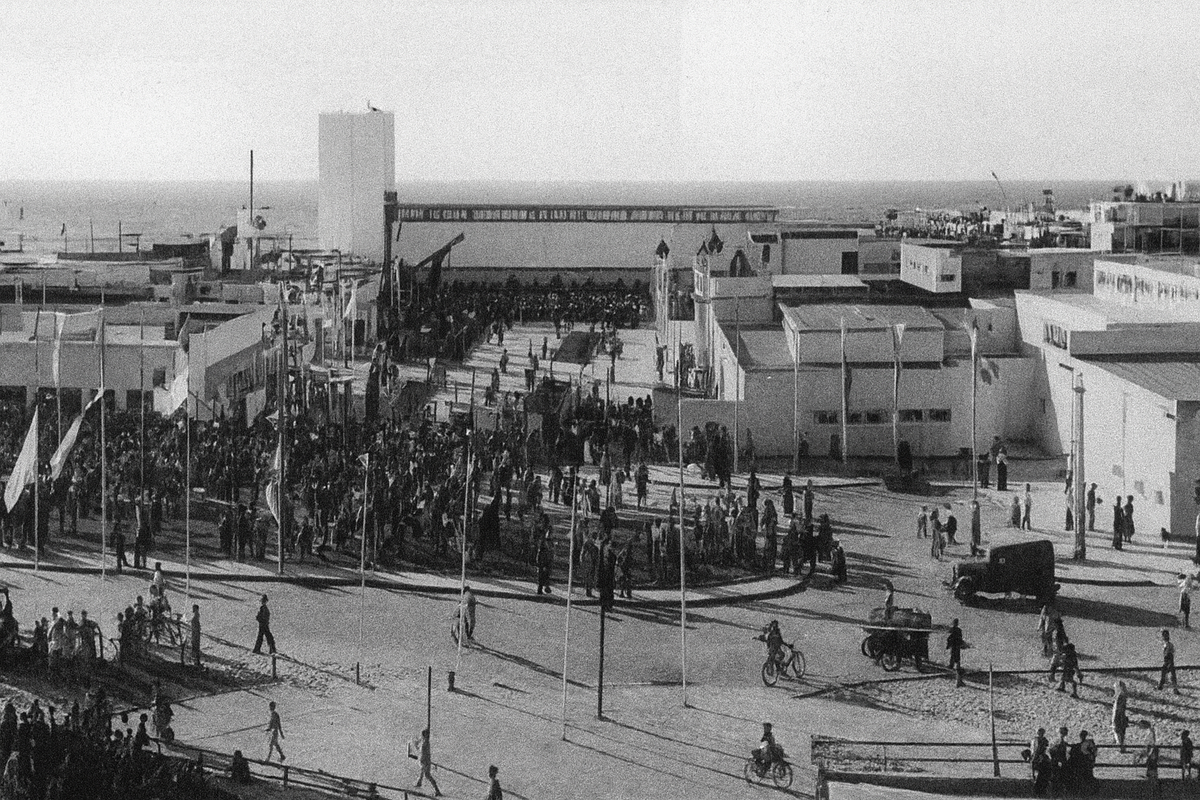
Tel Aviv's Metamorphosis: In 1920, the city had numbered 3,000 souls. By 1937, it housed 160,000. Life's cameras found modernist apartment blocks, the Opera House, museums, beaches thick with sunbathers. The caption called it "the world's only all-Jewish city," and the photographs proved the boast. White concrete, Bauhaus lines, Hebrew signage—this was European modernism transplanted to the Mediterranean.
Arab Unrest: Street scenes captured protests led by the Hussein family and young nationalists. The photographs are blunt: crowds, British troops, the friction of occupation. Life's editorial voice described "riots" without interrogating causes. The framing was symptomatic of its era—Arabs appeared reactive, not self-determining.
Agricultural Theater: Images of Jewish men and women plowing sun-baked fields, sowing grain, draining malarial swamps. The captions emphasized labor, technology, land reclamation. Arab peasants appeared in contrast, described with the period's casual bigotry as "lazy tropic-wise Arabs"—language that now reads as damning evidence of how the conflict was packaged for American consumption.
The Medium Was the Message
Life Magazine, relaunched in November 1936, had invented something revolutionary: photojournalism as immersive experience. Before Life, foreign news meant dense columns of wire service prose. After Life, it meant sitting in your living room, turning oversized pages, and confronting other people's realities through images you couldn't unsee.
The Palestine feature exemplified this new power. Where newspapers buried Middle East dispatches on inside pages, Life gave the conflict a visual architecture. The layout alternated between wide shots of British authority and intimate portraits of daily life—Arab shepherds, Jewish farmers, Tel Aviv's nightlife, the Jordan River's biblical geography made modern and contested.
This was deliberate editorial strategy. Life aimed to make Americans feel globally literate without leaving home. The juxtaposition of Dorothea Lange's corn and the Palestine crisis inside the same issue sent a message: your world and their world are connected, whether you realize it or not.
What the Article Revealed
Beneath the photographs, Life offered a narrative thesis—implicit but unmistakable:
Palestine was irreconcilable. Two populations, equally rooted, equally determined. Arabs feared dispossession; Jews feared annihilation. Britain sought the impossible: satisfying both while maintaining imperial credibility.
The article didn't resolve this tension. It displayed it. Readers saw Jewish settlers celebrating new farms while Arab protesters filled streets. They saw British commissioners in formal poses and Arab peasants in traditional dress. They saw Tel Aviv's modernity and Jerusalem's ancient stones.
What Life didn't provide was symmetry of perspective. The photographic essay leaned toward Jewish nation-building as progress, Arab resistance as obstacle. This wasn't unique to Life—it reflected broader American assumptions in 1937. European Jews fleeing Hitler commanded sympathy. Arab nationalism registered as foreign and faintly threatening. The visual grammar reinforced these hierarchies.
The Historical Shadow
The timing makes this issue extraordinary. Life published on July 5, 1937—weeks before the Peel Commission formally released its partition recommendation on July 7. This magazine reached American homes as British officials were finalizing a document that would reshape Middle Eastern history.
The Peel partition never happened. Arabs rejected it outright; Jewish leaders debated and ultimately accepted the principle while disputing the borders. Britain, exhausted by the revolt, would shelve the proposal within a year. But the idea—partition as solution—had been planted. It would resurface a decade later when the United Nations voted to divide Palestine in 1947.
Life's photographs, then, captured not just a moment but a turning point. The images of 1937 settlements, Arab protests, British deliberations, and Tel Aviv's skyline documented the landscape before partition became inevitable.
Key Themes in the July 5, 1937 Issue
Why It Matters Now
Historical Timing
Published weeks before the Peel Commission formally issued its partition report on July 7, 1937. This makes it a near-contemporary document of a pivotal turning point in Middle Eastern history.
Photographic Rarity
The photographs of Arab Revolt protests, British commissioners, Jewish settlements, and early Tel Aviv architecture are irreplaceable records of 1930s Palestine unavailable elsewhere.
Primary Source Material
For collectors and historians, this isn't a reproduction—it's the actual magazine American families held and debated, revealing how the conflict was introduced to Western consciousness.
Cultural Resonance
One of the earliest major American visual narratives of a conflict that remains unresolved today. The issue documents how media shaped public understanding at the origin point.
The Collector's Perspective
Vintage Life magazines occupy a unique position in the memorabilia market. They're not as expensive as first-edition books or as fragile as newspapers, but they're far more visually rich than either. A single issue like July 5, 1937 contains dozens of photographs unavailable anywhere else, wrapped in period advertising and cultural context.
For those interested in Middle Eastern history, Jewish diaspora studies, British imperial decline, or photojournalism's evolution, this issue is foundational. It's the magazine that made Palestine visible to America—not as prophecy or politics, but as place.
Serious collectors value these magazines not just as objects but as windows. They let us see what our grandparents saw, read what shaped their understanding, encounter bias and insight in their original packaging.
The Magazine as Time Capsule
In 1937, Americans consumed news slowly. You waited for the magazine to arrive, sat with it, studied photographs, read captions aloud. The July 5 issue offered something television never would: the ability to linger. To compare photographs. To form your own judgments.
That slowness produced depth. Life's Palestine coverage wasn't breaking news—it was context, analysis, and witness combined. The format forced engagement. You couldn't scroll past these images. They demanded attention.
Today, that same issue invites a different kind of attention: historical reckoning. We can examine not just what Life showed but what it chose to frame, what it cropped out, whose voices it amplified. The magazine becomes evidence of how conflicts are constructed in the telling.
Accessing History
The July 5, 1937 issue is part of a larger archive—thousands of Life magazines documenting the 20th century as it unfolded. For collectors, students, and historians, original issues offer something digital reproductions cannot: the tactile experience of history.
Browse Life Magazine CollectionHolding the Moment
The July 5, 1937 Life Magazine captured Palestine at a hinge point—when British authority was crumbling, partition was being conceived, and two national movements were hardening into permanent opposition. Its photographs gave Americans their first sustained visual encounter with a conflict that would outlive the magazine itself.
Eighty-seven years later, these pages remain powerful not despite their limitations but because of them. They show us how the story was told when it was still unfolding, when outcomes weren't yet inevitable, when the land could still be photographed without the weight of all that would follow.
Life Magazine promised to be a mirror of the 20th century. Issues like this one prove it kept that promise—reflecting not just events, but how those events were seen, packaged, and delivered to a nation still learning to think globally.
History isn't distant. It's preserved, printed, and waiting to be revisited.