
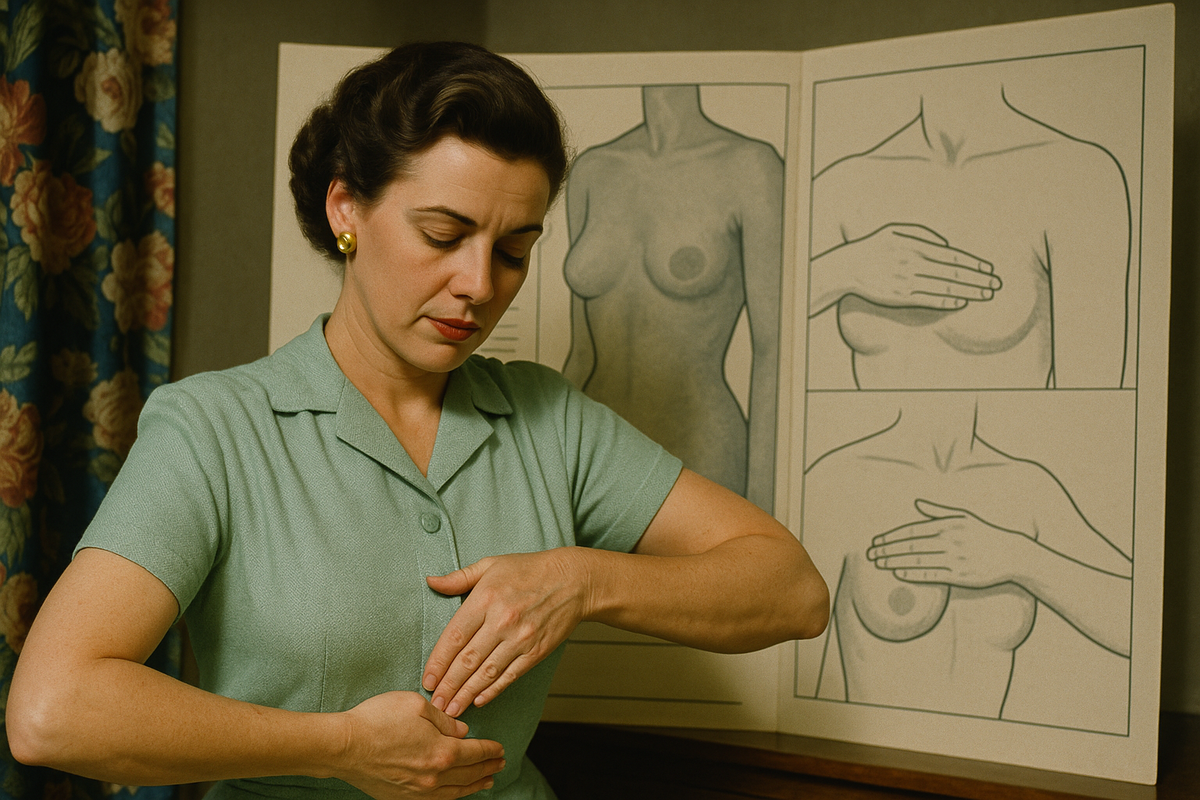
A Quiet Revolution in Women's Health
How a 1952 Ladies' Home Journal feature broke the silence on breast cancer and taught women to save their own lives
In August 1952, a woman opened her copy of Ladies' Home Journal expecting recipes and decorating tips. Instead, she found something that would save lives: detailed instructions on how to examine her own breasts for cancer.
The article was called "Self-Examination for Cancer of the Breast." For a generation of American women who had been taught that the female body was too delicate—and too private—for frank discussion, this was nothing short of radical. Cancer was "the dreaded disease," whispered about but never named. Doctors often withheld diagnoses from their own patients, believing women couldn't handle the truth. And now here was America's most popular women's magazine, circulation in the millions, telling readers to strip to the waist and check themselves for lumps.
It was a pivot point in both medicine and culture. Before public health campaigns, before mammography became routine, before breast cancer had a ribbon or a month, there was this: a middle-class housewife's magazine, sandwiched between advertisements for bedsheets and fiction serials, quietly handing women the tools to save their own lives.
Archive Details
Publication: Ladies' Home Journal
Issue Date: August 1952
Feature Article: "Self-Examination for Cancer of the Breast"
Historical Significance: One of the first mainstream American publications to instruct women in breast self-examination
Cultural Context: Postwar America, traditional gender roles, medical paternalism
The Context: Postwar Silence
The early 1950s were an era of forced optimism. Women who had riveted bombers and managed farms during World War II were now expected to return to full-time domesticity. Ladies' Home Journal both reflected and reinforced this ideal, its pages filled with recipes, child-rearing advice, and the moral instruction of the suburban middle class.
But the magazine was also more complicated than its reputation suggests. Alongside the homemaking features ran Eleanor Roosevelt's columns and Dorothy Thompson's political essays. The Journal understood that its readers were not simply housewives—they were citizens, thinkers, and, increasingly, their own first line of medical defense.
Cancer occupied a strange place in the American imagination. It was everywhere and nowhere—common enough that most families knew someone who had died of it, yet so stigmatized that the word itself was often avoided. Breast cancer carried additional shame, bound up in anxieties about femininity, sexuality, and bodily exposure. Many doctors believed their female patients were too modest or too uninformed to discuss such matters openly.
The Journal's decision to publish a detailed, illustrated guide to breast self-examination broke that silence. It was an assertion that women could be trusted with medical knowledge about their own bodies—and that such knowledge belonged in the domestic sphere, right alongside tips for organizing linen closets.
The Article: Empowerment Through Information
"Self-Examination for Cancer of the Breast" opened with two uncompromising truths: breast cancer was more common than most women realized, and early detection dramatically improved survival.
The instructions were systematic. Women were told to perform monthly self-exams—not as a replacement for medical care, but as a first defense. The article provided statistical guidance that reflected the medical knowledge of the time: less than 20% of breast cancers occurred in the inner half of the breast, while more than two-thirds appeared in the outer half. Most critically, about 50% of cancers were found in the upper outer quadrant, near the armpit.
Illustrated diagrams showed how to divide the breast into zones and use flat fingers to check methodically for changes. The tone was calm but urgent. Not every lump was cancer, readers were told, but every lump required medical evaluation. Women over 40 and over 70—when risk increased—were especially urged to maintain vigilance.
What made the article powerful was its refusal to infantilize its audience. It didn't offer vague reassurances or defer entirely to medical authority. Instead, it told women that their own hands were their most powerful diagnostic tool.
The Juxtaposition: Commerce and Mortality
Turn to the spread containing the breast cancer feature, and you'll find something startling: on the facing page, a full-color advertisement for Lady Pepperell sheets and blankets. A glamorous model reclines across a vividly patterned bed, her smile promising comfort and luxury.
Next to her: diagrams of hands pressing against shaded outlines of the breast, accompanied by sober instructions about palpation technique.
This wasn't an editorial mistake. It was the essence of Ladies' Home Journal's approach. The magazine understood that women's lives contained multitudes—domesticity and mortality, consumer desire and medical necessity. Health advice appeared alongside fashion spreads and fiction because that's where women actually lived, in the overlap between beauty and survival.
The visual style of the medical diagrams mattered, too. They were simple, clean, unthreatening—more like sewing patterns than hospital charts. This was deliberate. Women who might recoil from clinical textbooks could absorb these instructions as naturally as they absorbed recipes.
By weaving serious content into the fabric of everyday reading, the Journal ensured that even taboo subjects entered the American home through the front door.
The Significance: What Changed
In 1952, this article accomplished several things simultaneously:
Named the Unnameable
Using the word "cancer" in a women's magazine was an act of editorial courage that broke decades of silence.
Redistributed Medical Authority
Women were told they could—and should—monitor their own bodies, shifting power from doctors to patients.
Normalized Female Anatomy
Placing diagrams of breasts beside household advertisements helped destigmatize the female body as a subject of rational, medical discussion.
Expanded Domestic Responsibility
If a woman's role included managing the household, the Journal argued, it also included protecting her own survival.
This fit within a broader shift. By the early 1950s, women's magazines were beginning to cover mental health, child psychology, and social policy. The Journal was part of a growing recognition that women's lives extended beyond the kitchen—into science, politics, and public health.
Adding breast cancer awareness to the mix was a declaration: women's bodies were not too delicate for discussion. Women themselves were not too fragile for the truth.
Why This Issue Matters to Collectors
Health Milestone
This issue captures one of the first mainstream American publications to instruct women in breast self-examination—a watershed moment in public health education.
Cultural Artifact
The juxtaposition of consumer glamour and lifesaving medical guidance on the same spread reveals the contradictions of postwar America in material form.
Visual History
The mid-century advertising—like the Lady Pepperell bedding spread—makes this a window into postwar design, domesticity, and consumer culture.
Personal Connection
For families, owning this issue honors the generation of women who first learned about breast cancer from magazines, not doctors—a reminder of how change happens quietly, one reader at a time.
Issues like this are prized not for nostalgia alone, but for what they reveal about gender, medicine, and the circulation of knowledge. They show us how change happens—not all at once, but in quiet revolutions, one reader at a time.
Explore the Archive
Browse original issues of Ladies' Home Journal and discover the moments when women's magazines became platforms for social change.
Browse Ladies' Home Journal Magazine CollectionThe August 1952 Ladies' Home Journal feature on breast cancer self-examination stands as a milestone in both medical and cultural history. It broke the silence around cancer, gave women tools to protect themselves, and left behind a collectible artifact that still speaks across the decades.
For the women who read it in 1952, this article may have been the first time they heard that their own hands could save their lives. For us, it's a reminder of how far we've come—and how the most important turning points in history sometimes arrive not with fanfare, but in the pages of a magazine, tucked between the recipes and the ads for bedsheets.