
The Magazine That Made Pearl Harbor Real
Life's December 15, 1941 issue delivered war to America's doorstep—seven days after the bombs fell
Seven days after the bombs fell, Americans opened their mailboxes to find something they'd never seen before: war, rendered visible.
The December 15, 1941 issue of Life Magazine didn't arrive with gentle headlines or cautious commentary. Its cover screamed a single word in massive black type—WAR—and inside, across dozens of pages, the attack on Pearl Harbor materialized in photographs that most Americans couldn't yet fathom were real. Bombers over Waikiki Beach. Battleships burning in the harbor. The Pacific Fleet, America's maritime pride, reduced to twisted metal and oil slicks.
This wasn't just journalism. It was the visual reckoning of December 7, 1941—the day that President Franklin D. Roosevelt would immortalize as "a date which will live in infamy." For a nation still processing the shock, Life delivered what radio broadcasts and newspaper columns could not: proof.
The Attack That Shattered Isolation
At 7:55 a.m. on December 7, waves of Japanese aircraft swept across Oahu in a calculated strike against the U.S. Pacific Fleet. Within two hours, they had sunk or crippled eight battleships, obliterated nearly 200 American planes, and killed more than 2,400 servicemen and civilians. The attack wasn't merely tactical—it was a geopolitical earthquake. Japan, already entrenched in brutal campaigns across China and Southeast Asia, had gambled that a single devastating blow would cripple American naval power and secure its dominance in the Pacific.
It miscalculated.
On December 8, Roosevelt stood before Congress and delivered his six-minute address, calling Pearl Harbor "a date which will live in infamy." The declaration of war passed with only one dissenting vote. Days later, when Germany and Italy honored their Axis pact by declaring war on the United States, America found itself thrust into a global conflict it had spent years trying to avoid.
By December 15, when Life hit newsstands, the nation was no longer debating intervention. It was mobilizing for total war.
Historical Context
Publication Date: December 15, 1941
Days After Attack: 8 days
Publisher: Time Inc. / Henry Luce
Archive Significance: First photographic record of Pearl Harbor available to the American public
Cover Design: Single word "WAR" in black type—no photograph
Why Life Magazine Mattered in 1941
Life wasn't simply a magazine—it was the visual record of American life. Launched in 1936 by Time Inc. founder Henry Luce, Life pioneered a new form of storytelling: photojournalism as narrative art. Where newspapers offered grainy wire service photos and text-heavy columns, Life delivered sweeping photo essays that transformed news into experience.
By 1941, Life commanded a circulation that rivaled any publication in the country. Its photographers were cultural icons. Its editors understood that a single image—properly framed, captioned, and sequenced—could communicate what a thousand words could not.
Pearl Harbor was the ultimate test of that philosophy.
Anatomy of an Iconic Issue
The Cover
Life had published hundreds of covers by December 1941—starlets, landscapes, cultural profiles. None looked like this.
The December 15 cover abandoned imagery entirely. Instead, the word WAR dominated the page in stark black letters, brutal and unadorned. There was no photograph, no illustration, no softening. Just the word itself, towering and inescapable.
It remains one of the most recognized magazine covers in history—not for what it showed, but for what it refused to soften.
Inside: "Japan Launches Reckless Attack on U.S."
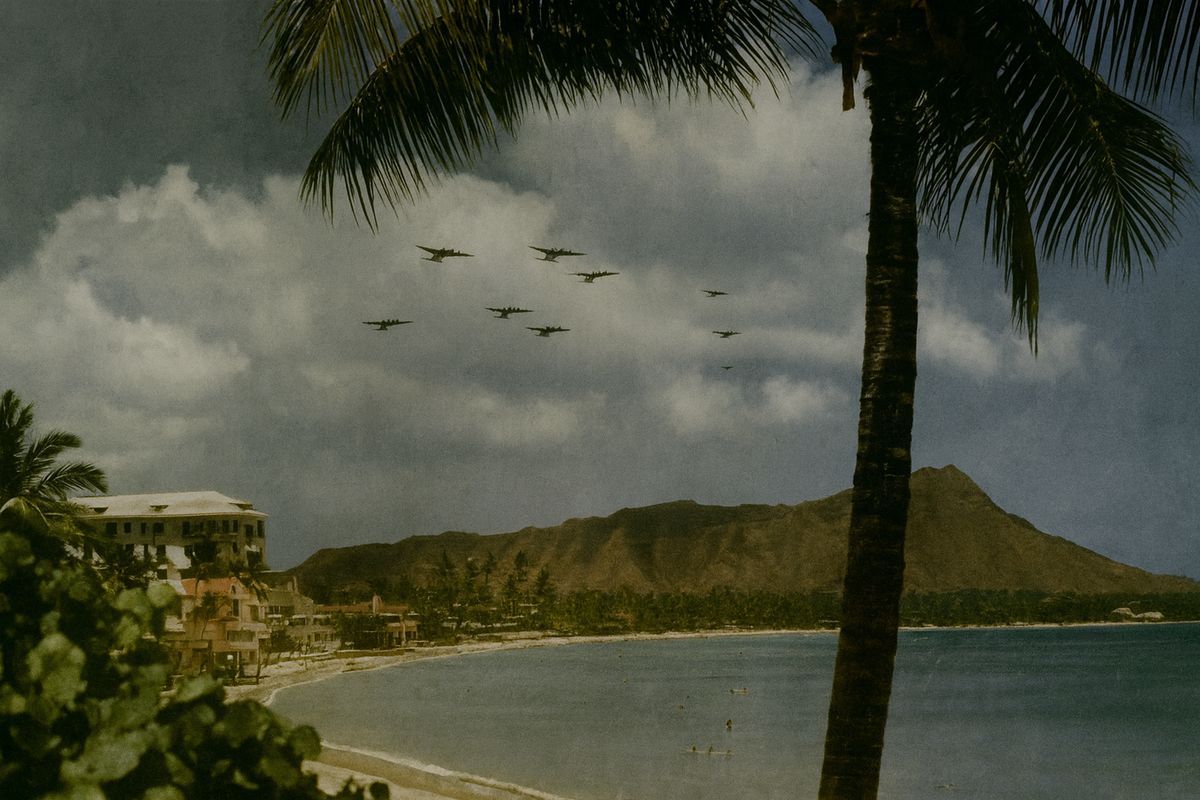
Life's photo essay opened with an image that would have seemed impossible a week earlier: Japanese bombers in formation above Waikiki Beach and Diamond Head. Paradise as a war zone.
The pages that followed documented the devastation with unflinching precision:
The Burning Fleet
The USS Oklahoma and USS West Virginia, two of the Navy's mightiest battleships, capsized and ablaze in the harbor. Captions detailed the hits, the casualties, the speed of the sinking.
Hickam Field Destroyed
The Army's principal air base on Oahu, reduced to rubble and flame. More than 100 soldiers dead. Aircraft shredded on the tarmac.
Defenders Scrambling
U.S. planes silhouetted against smoke-choked skies, launching desperate counterattacks. Reports claimed at least one Japanese carrier had been sunk in retaliation.
Command in Crisis
Admiral Husband Kimmel and his staff, photographed mid-conference as disaster reports poured in. Their faces captured the disbelief that defined the first hours of the attack.
The Enemy Revealed
Earlier publicity photographs of the Japanese fleet, now republished to chilling effect. Readers could see the carriers—Akagi, Kaga, and others—that had launched the strike.
Harbor Defenses
Images of Fort Kamehameha and coastal installations showed the frantic effort to regroup and fortify Hawaii against a feared invasion.
For Americans who had never seen Pearl Harbor, who barely knew where Oahu was on a map, these photographs transformed abstraction into reality. The attack wasn't a distant headline. It was visceral, immediate, and impossible to ignore.
The Power of Seeing
What made Life's coverage transcendent wasn't just the photographs—it was the synthesis of image, caption, and narrative design.
Visual Primacy – The photos didn't illustrate the story. They were the story. Readers didn't need lengthy explanations when they could see bombers over paradise, warships split open, soldiers running toward danger.
Narrative Precision – Every caption anchored the image in specificity: locations, ship names, casualty counts, tactical details. The result was a seamless fusion of documentation and storytelling.
Design as Journalism – The "WAR" cover wasn't decoration—it was editorial argument. It declared that everything had changed, and there was no point in pretending otherwise.
Human Scale – Amid the wreckage of steel and fire, Life never lost sight of the human cost. Exhausted defenders. Wounded sailors. Civilians watching the sky in horror.
This was photojournalism operating at the peak of its cultural power.
Why Collectors Prize This Issue
More than eight decades later, the December 15, 1941 Life Magazine remains one of the most sought-after wartime publications.
Historical Immediacy
Published just one week after the attack, it captures the raw shock before memory could soften the edges.
Iconic Design
The "WAR" cover stands as a landmark in magazine history, studied in design schools and journalism programs worldwide.
First Visual Record
These were the first photographs of Pearl Harbor most Americans ever saw. That primacy is irreplaceable.
Cultural Artifact
This issue doesn't just describe the moment America entered World War II—it is that moment, preserved in ink and paper.
Collector Demand
Among WWII ephemera, few items carry the same combination of aesthetic power and historical weight.
Tangible History
To own this magazine is to hold a fragment of December 1941—when the world split into before and after.
The Enduring Witness
Wartime journalism fades. Photographs yellow. Memories blur and vanish.
But original copies of Life Magazine endure as something more than collectibles. They are time capsules, sealed at the moment of creation. When you hold the December 15, 1941 issue, you aren't reading about Pearl Harbor—you're experiencing it as Americans did when the shock was still fresh, when the war was just beginning, when the future remained terrifyingly uncertain.
That directness, that unmediated connection to history, explains why vintage Life Magazines command lasting fascination. They don't interpret the past. They preserve it.
Explore the Archive
The December 15, 1941 issue represents just one chapter in Life Magazine's decades-long chronicle of American history. From the 1930s through the 1970s, Life documented every major war, cultural revolution, political upheaval, and social transformation in real time.
Browse Life Magazines CollectionThe December 15, 1941 Life Magazine stands as a masterpiece of wartime journalism—a publication that captured the precise moment when America stopped debating and started fighting. Its "WAR" cover and Pearl Harbor photo essays gave a stunned nation its first visual understanding of the attack that changed everything.
More than 80 years later, this issue retains its power not merely as a collectible, but as a portal. It transports us back to December 1941, when Americans opened their mailboxes and confronted, for the first time, the faces of a war that would define a generation.
For those who value history, these aren't just magazines. They're witnesses.