
The Day Dr. Spock Walked Into America's Kitchen
How a single magazine column in July 1954 gave millions of mothers permission to trust themselves
In July 1954, something shifted in the suburbs. Not with fanfare. Not with legislation or protest. But with a single magazine column that would reach more American mothers than any pediatrician's office ever could.
When Ladies' Home Journal—the most trusted voice in millions of homes—announced Dr. Benjamin Spock as its new monthly columnist, it wasn't just adding content. It was crowning a revolution.
"Spock Talks with Mothers" debuted that summer, and with it came permission: You can trust yourself. Your instincts matter. Love is not spoiling.
For a generation of women drowning in rigid schedules, expert condescension, and the impossible standards of postwar domesticity, these words weren't just advice. They were oxygen.
Historical Context
Featured Figure: Dr. Benjamin Spock, pediatrician and author
Issue Date: July 1954
Archive Source: Ladies' Home Journal
Column Debut: "Spock Talks with Mothers"
Historical Significance: First monthly column in the most widely-read women's magazine of the era
The Pressure Cooker of 1954
The baby boom was at full throttle. Birth rates soared. Suburbs sprawled. Women who had riveted bombers and managed wartime logistics were now expected to perfect the art of the spotless home and the obedient child—often with three, four, five kids underfoot.
The prevailing wisdom? Don't pick up a crying baby too often. Feed on schedule, not on demand. Discipline over affection. Detachment over bonding. Experts warned that too much maternal warmth would produce weak, dependent children.
Then came Spock.
His 1946 book, The Common Sense Book of Baby and Child Care, had already sold millions by challenging this orthodoxy. But books required seeking out. Ladies' Home Journal came to you—every month, into your mailbox, onto your kitchen table. When the Journal made Spock a columnist in July 1954, it transformed his ideas from bestseller theory into household gospel.
Why Ladies' Home Journal Mattered
By the 1950s, Ladies' Home Journal wasn't just a magazine. It was infrastructure.
With circulation in the millions, it blended fiction, fashion, recipes, and advice into a formula that shaped how American women saw themselves. It was aspirational without being alienating, authoritative without being cold. Adding Spock elevated it from lifestyle companion to parenting bible.
The July 1954 feature didn't bury readers in medical terminology. Instead, Spock spoke directly, warmly, as if sitting across the kitchen table:
"Every time you pick your baby up—every time you change him, bathe him, feed him, smile at him—he's getting a feeling that he belongs to you—and that you belong to him."
"Don't be afraid to trust your own common sense."
"Enjoy him as he is—that's how he'll grow up best."
Simple. Radical. Liberating.
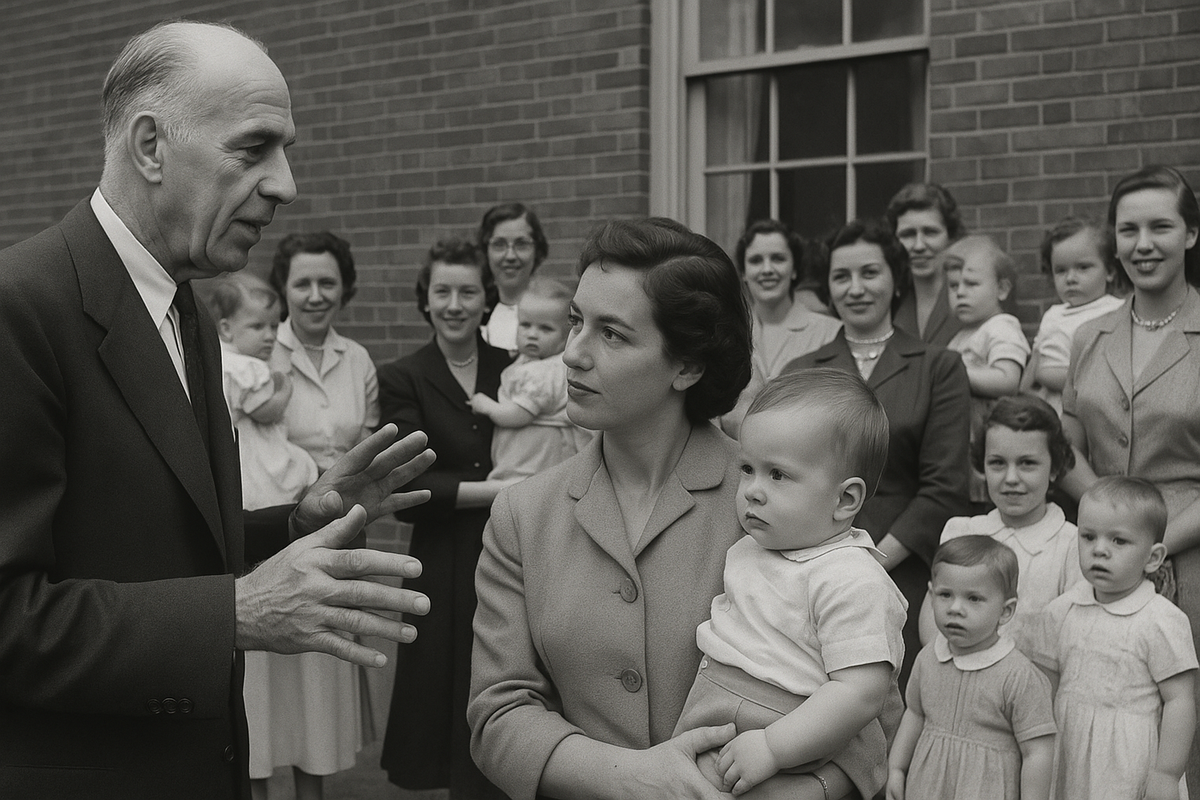
The photographs sealed it. One showed Spock himself—professional but approachable, a doctor who listened. Another captured a crowd of women and children outside the Ladies' Home Journal office, described as "Spock babies," celebrating the column's launch. The message was clear: this wasn't abstract theory. This was a movement, and it was already underway.
The Magazine as Mirror
The cover of the July 1954 issue remained true to form—fashionable women, domestic ideals, aspirational womanhood. But inside, the Spock feature represented something deeper: the Journal's understanding that women needed both inspiration and validation.
Other publications might address parenting clinically. Medical journals stayed detached. Advice manuals preached from on high. Ladies' Home Journal did something different—it wove expert authority into the texture of daily life, making it immediate, relatable, personal.
This was the Journal's genius: it didn't just inform. It conversed. And in doing so, it helped shape how millions of women saw themselves—not just as mothers, but as decision-makers navigating impossible expectations with intelligence and heart.
What Spock Actually Changed
Trust in Instinct
Spock's central message—that mothers possessed innate wisdom—was a direct rebuke to the experts who had infantilized them for decades.
Emotional Architecture
Feeding, bathing, smiling—these weren't chores. They were the building blocks of a child's emotional foundation.
Liberation from Perfection
Spock's tone offered compassion, not judgment. Mistakes were survivable. Love mattered more than precision.
Visual Authority
The images of Spock and the families who followed him lent credibility—not through credentials alone, but through lived experience.
Accessibility at Scale
By publishing in the Journal, Spock bypassed medical gatekeepers and spoke directly to the audience that needed him most.
Cultural Permission
This wasn't just parenting advice. It was cultural permission to redefine motherhood itself.
Why It Still Resonates
Spock's presence in Ladies' Home Journal endures because he wasn't dispensing rules. He was opening a dialogue. His questions remain universal: How do we raise children with both love and boundaries? How do we balance external expectations with internal knowing? How do we trust ourselves when the stakes feel impossibly high?
Just as LIFE magazine's wartime photo-essays became time capsules of global conflict, Spock's early Journal columns are time capsules of family life—of motherhood reimagined, of cultural expectations challenged, of a generation finding its voice.
Why Collectors Covet This Issue
The July 1954 Ladies' Home Journal is more than a vintage magazine. It's a historical inflection point.
Peak Baby Boom Documentation
This issue captures the exact moment when American parenting philosophy pivoted for an entire generation.
Cultural Monument
Dr. Spock became one of the most influential figures of the 20th century. His first Journal column marks the beginning of his mass-media presence.
Visual Archive
The photographs—mothers, children, Spock himself—document 1950s family culture with rare intimacy.
Collector Demand
Milestone issues like this command attention from historians, educators, archivists, and anyone tracing the evolution of American family life.
To own this issue is to hold a piece of women's history—a record of the anxieties, aspirations, and quiet revolutions that shaped millions of lives during one of America's most transformative decades.
For Collectors and Historians
If you're drawn to this era—to the intersection of medicine, culture, and women's lives—the July 1954 Ladies' Home Journal belongs in your collection. Not as nostalgia. As evidence.
Browse Ladies' Home Journal CollectionWhether you're a collector tracking cultural shifts, a researcher studying postwar domesticity, or someone honoring family memory, these magazines offer something rare: direct access to the conversations that shaped a generation.
The July 1954 Ladies' Home Journal marks the moment Dr. Benjamin Spock's philosophy moved from bookshelf to breakfast table. His warm, intuitive approach gave millions of mothers permission to trust themselves during the most demanding years of the baby boom.
Like LIFE's landmark issues, this edition of the Journal is more than print and paper. It's a living artifact—proof that culture shifts not through declarations, but through conversations. One column. One reader. One family at a time.