
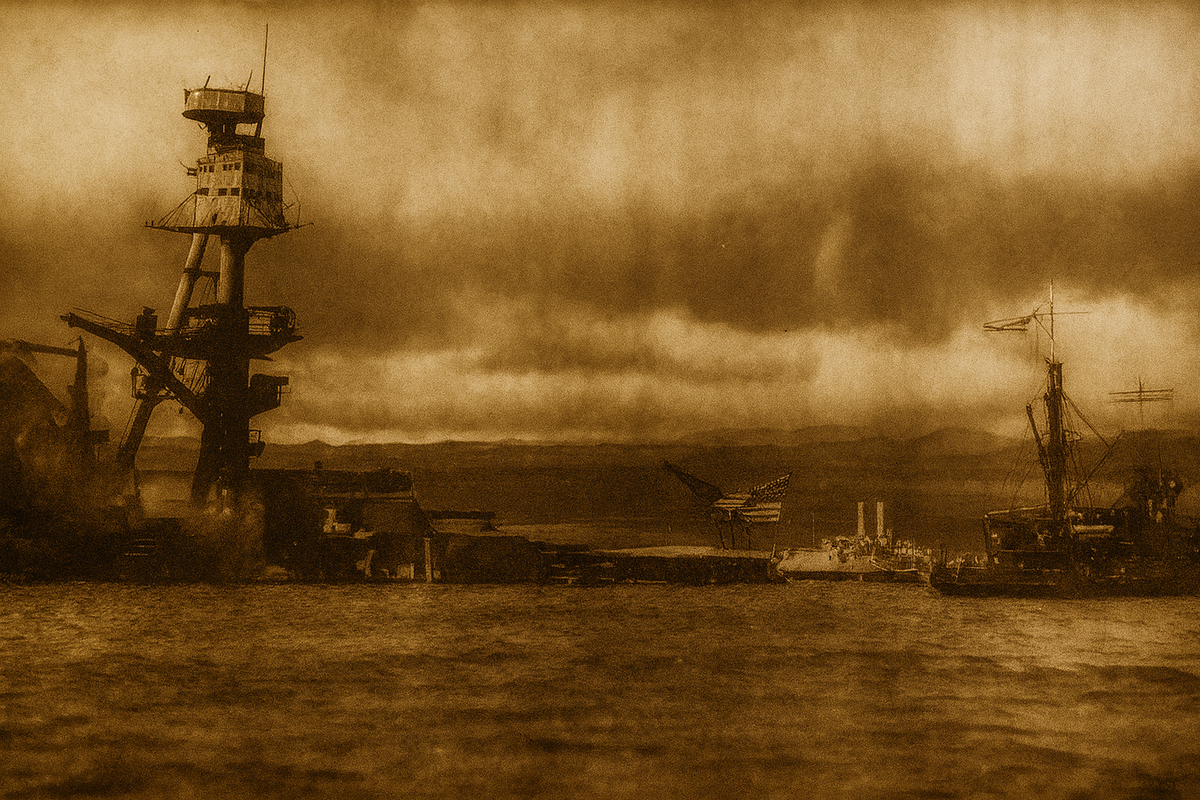
When America First Saw Pearl Harbor
The Life Magazine Issue That Turned Grief Into Defiance
The magazine arrived in American mailboxes on January 5, 1942—twenty-nine days after the attack. Inside, there were no screaming headlines, no propaganda posters, no calls for vengeance. Instead, Life Magazine offered something far more powerful: the first photographs most Americans would ever see of what actually happened at Pearl Harbor.
And beneath the twisted steel and oil-slicked water, the images revealed something the Japanese high command had not anticipated: American sailors were already rebuilding.
This wasn't journalism meant to comfort a grieving nation. It was journalism meant to galvanize one.
Archive Details
Publication: Life Magazine
Issue Date: January 5, 1942
Feature: "Clean-up Crews at Pearl Harbor Speed the Work of Refitting and Repair"
Historical Context: Published 29 days after the December 7, 1941 attack on Pearl Harbor
Significance: First widespread photographic documentation of Pearl Harbor's aftermath available to the American public
The Issue That Arrived Too Soon—and Right On Time
When the January 5, 1942 edition hit newsstands, the United States had been at war for less than a month. Families were still processing the shock. More than 2,400 Americans had been killed in a single morning. President Roosevelt's "date which will live in infamy" speech still echoed in living rooms across the country. The very idea of safety—of oceans as protective barriers—had been shattered.
Newspapers had covered the attack with urgent dispatches and official statements, but they could only describe the devastation. Life Magazine did something different. It showed the aftermath, unfiltered and undeniable, through a photo essay titled "Clean-up Crews at Pearl Harbor Speed the Work of Refitting and Repair."
The article's genius was in its framing. Life didn't dwell on the violence itself—it focused on what came next. Readers saw the USS Arizona, her superstructure gutted by fire and explosions, but still flying the Stars and Stripes. They saw sailors lined up for coffee from a battered urn, continuing the small rituals that anchor human beings in crisis. They saw officers giving speeches to crews who cheered in response, their voices rising above the wreckage.
And they saw chalkboard messages scrawled across the Navy Yard: "CARRY ON."
Why Life Magazine Owned This Moment
By 1942, Life had already established itself as the premier photojournalism publication in America. Founded in 1936, it understood a fundamental truth: photographs bypass the intellect and strike directly at emotion. A dispatch could report that ships had been damaged; a photograph could show you the blistered paint, the smoke-stained decks, the exhaustion carved into a sailor's face.
Life's editorial approach was surgical. Large-format photographs dominated each spread, supported by brief, pointed captions. The magazine didn't editorialize or inflate—it simply presented evidence and let readers draw their own conclusions. In the Pearl Harbor feature, this restraint became its own form of power.
The photograph of the sunken Arizona was accompanied by a matter-of-fact caption noting her guns still elevated, her flag still aloft. A shot of sailors drinking coffee carried no melodrama—just the observation of an ordinary act performed in extraordinary circumstances. Images of chalkboard notes captured both humor and vigilance: motivational slogans sat alongside practical warnings about poisoned sugarcane near the harbor.
What Life understood—and what separated it from illustrated magazines like The Saturday Evening Post—was that wartime demanded unvarnished truth. Americans didn't need reassurance wrapped in sentiment. They needed to see that their Navy, though bloodied, was already rising.
The Photographs That Refused to Look Away
Life's visual narrative moved through the Navy Yard with deliberate purpose, constructing a story of resilience without ever using the word. The magazine captured:
The Arizona's flag, still flying above a shattered hull, became an inadvertent icon—not of loss, but of continuity. The ship was destroyed, but the nation it represented was not.
Sailors queued for coffee, a mundane ritual that carried psychological weight. Maintaining normalcy in the face of chaos is its own form of resistance.
Repair crews hauled tools from shipboard workshops. Torches sparked against twisted metal. The work had begun immediately—not next week, not when the shock wore off, but now.
Tents pitched beside battleships served as makeshift barracks. Sailors slept within sight of their damaged vessels, refusing to abandon their posts even when their ships couldn't sail.
Chalkboards throughout the base carried scrawled commands and encouragements—"CARRY ON" chief among them. These weren't official orders; they were expressions of collective will.
Life didn't sanitize the destruction. Fire-scorched decks, gutted compartments, and twisted steel appeared throughout the essay. The magazine trusted its readers to absorb both the damage and the response.
This wasn't propaganda in the traditional sense. It was something more sophisticated: proof of concept. The Navy Yard was functional. Sailors were working. Officers were leading. The machinery of war, though damaged, remained operational.
What Made This Issue Different
Other publications covered Pearl Harbor with patriotic fervor or righteous anger. Life Magazine chose documentation over emotion, and the result was more affecting than any editorial could have been. The photo essay operated on multiple registers simultaneously:
For families with sons or husbands in the Navy, it offered reassurance—visual confirmation that the Pacific Fleet, though crippled, was not annihilated.
For a public hungry for information, it provided details newspapers couldn't convey: the scale of the damage, the condition of the ships, the mood of the men.
For an administration managing public morale, it served as evidence that America's military response was already underway.
And for future historians, it created an irreplaceable visual record of the immediate aftermath—images captured before official narratives hardened, before the attack became mythology.
The magazine's timing amplified its impact. Published less than a month after December 7th, it arrived while the wound was still fresh, while uncertainty still dominated the national conversation. Life didn't wait for hindsight or historical distance. It reported the story as it was unfolding, with all the urgency and rawness that immediacy brings.
The Collector's Perspective: Why This Issue Endures
More than eight decades later, the January 5, 1942 edition remains one of the most sought-after issues in Life Magazine's 36-year run. Its value to collectors stems from multiple factors that compound over time.
This issue captured America's transition from shocked bystander to active combatant. It documented not just an event, but a national transformation—and it did so in real time, before anyone knew how the war would end.
These images represented some of the earliest visual documentation of Pearl Harbor's aftermath available to the general public. Military censorship was still light in early 1942; later wartime photography would face far greater restrictions.
This isn't a book about Pearl Harbor or a documentary made decades later. It's an original document from January 1942—the actual pages that Americans held while trying to comprehend what had happened to their country.
Wartime issues of Life carry a charge that later retrospectives can't replicate. The fear, determination, and uncertainty of the moment are embedded in the printing, the advertisements, the articles surrounding the Pearl Harbor feature.
WWII historians want it for the documentation. Magazine collectors want it for the photography. Military enthusiasts want it for the Naval coverage. Family historians want it to honor relatives who served. The issue sits at the intersection of multiple collecting communities.
Condition matters, as with all vintage magazines, but even well-read copies command attention. These were publications meant to be handled, studied, passed around dinner tables. The wear they carry is part of their story.
The Larger Archive: Life as Historical Witness
The January 5, 1942 issue exists within a larger continuum of wartime journalism that defined Life's legacy. The magazine would go on to document D-Day, the liberation of concentration camps, V-E Day, Hiroshima, and the Pacific theater's brutal island campaigns. Its photographers—Margaret Bourke-White, Robert Capa, W. Eugene Smith—became legends.
But this early Pearl Harbor coverage established the template: photograph first, editorialize never. Let the images carry the weight. Trust readers to understand what they're seeing.
In an era when news cycles measured in seconds and digital images vanish as quickly as they appear, these magazines offer something increasingly rare: permanence. They are physical objects that anchor history in time and space. To hold one is to hold a moment—not a reproduction, not a summary, but the actual artifact that bore witness.
Add This Piece of History to Your Collection
The January 5, 1942 edition of Life Magazine represents a turning point in both American history and photojournalism. It captured the earliest days of the nation's entry into World War II and provided unmatched visual documentation of Pearl Harbor's aftermath—images of resilience that countered despair, evidence of recovery that answered devastation.
For collectors seeking authentic wartime publications, this issue offers something beyond historical significance: it offers proximity to the moment when everything changed.
Browse Life Magazine CollectionOur archive includes thousands of authentic issues spanning the Great Depression, World War II, the postwar boom, the space race, and the cultural upheavals of the 1960s and 70s. Each magazine is an original publication—not a reprint, not a digital scan, but the actual artifact from its era.
The January 5, 1942 issue of Life Magazine stands as one of wartime journalism's defining achievements. Its photographs of sailors repairing ships, maintaining routines, and carrying on despite catastrophic loss gave Americans not just information, but resolve. The Navy was damaged, not defeated. The fleet would sail again.
More than eighty years later, this issue remains both historically vital and deeply collectible—a window into the moment when shock transformed into determination, when a nation looked at the wreckage and decided to rebuild.