
The Face That Launched a Thousand Imitations
When Audrey Hepburn and Alberto de Rossi Redefined Beauty in Vogue, 1972
On November 1, 1972, Vogue didn't just publish a beauty feature. It printed a manifesto.
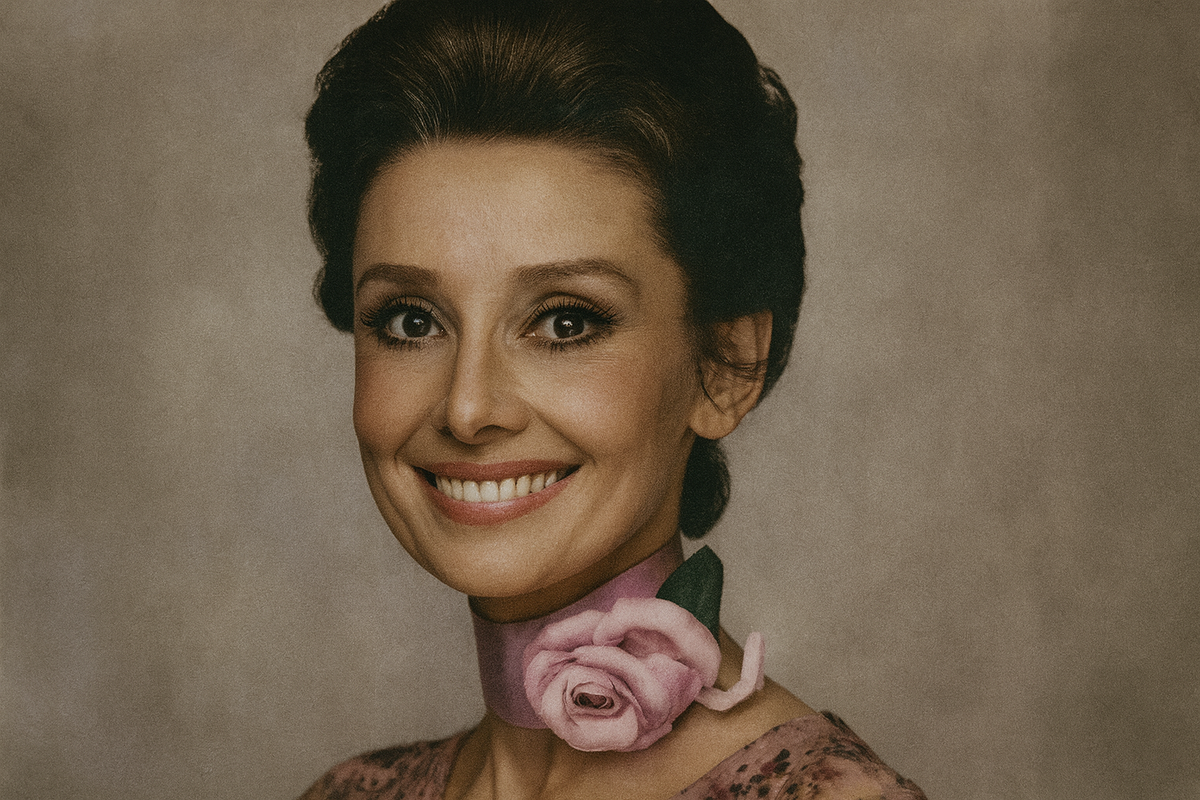
Tucked between the advertisements for Halston and the seasonal runway reports was something rarer than any couture gown: a master class in the philosophy of beauty, delivered by Alberto de Rossi—the Italian makeup artist who had sculpted the faces of Hollywood's most legendary women—and illustrated by the one woman who needed no introduction. Audrey Hepburn, at 43, gazed out from page 153 in full color, wearing Valentino chiffon scattered with mauve blossoms and a rose-on-ribbon she'd pinned herself. Her face glowed with that particular luminosity that only de Rossi could conjure: not mask, not artifice, but amplification.
This wasn't makeup advice. It was alchemy.
And in 1972—a year suspended between the naturalism of the counterculture and the emerging glamour of Studio 54—it arrived at precisely the right cultural moment.
Archive Details
Historical Figure: Audrey Hepburn & Alberto de Rossi
Issue Date: Vogue, November 1, 1972
Feature Title: "What You Can Learn from a Great Makeup Artist"
Archive Source: Original Vogue Magazine Collection
The Tension of an Era
The early 1970s churned with contradiction. The women's liberation movement was dismantling beauty standards imposed by decades of patriarchal expectation. The '60s had rejected rigid glamour in favor of bare faces and long hair. Yet Hollywood icons—Hepburn, Taylor, Bardot—still defined aspiration. Women wanted authenticity, but they also craved the artistry of transformation.
Vogue understood this tension. By pairing Hepburn with de Rossi, the magazine wasn't taking sides. It was offering synthesis: beauty as both natural and constructed, timeless and contemporary, democratic and exclusive. Hepburn herself embodied this paradox. No longer the gamine of Roman Holiday, she had evolved into something more complex—a woman whose elegance didn't fight age but absorbed it, whose style adapted without capitulating.
De Rossi's feature, titled "What You Can Learn from a Great Makeup Artist," bridged the gap between individuality and craft. It said: You can be yourself and a work of art.
The Tutorial as Philosophy
The feature unfolded across two images and several pages of text, each element meticulously chosen.
First, a candid black-and-white photograph from the set of Two for the Road (page 152): Hepburn with de Rossi mid-collaboration, a reminder that every iconic image begins with partnership, not magic. Then the full-color portrait (page 153): Hepburn in that Valentino dress, hair styled by Alexandre of Paris, her face a canvas demonstrating de Rossi's method.
His eight-step technique read like a painter's instruction manual. Begin with cleansing. Apply foundation as a "thin veil"—never a mask. Mist the face with Evian spray after powdering to dissolve harshness and restore glow. Then came the sculpture: shadows at the temples, light on the cheekbones, contouring along the jawline and nose. He worked in chiaroscuro, treating bone structure as architecture.
But technique alone doesn't explain why this feature endures. What elevated it was de Rossi's philosophy. "Venus de Milo is ages away from Bardot," he wrote, "but both are beautiful." He rejected the tyranny of a single ideal. Every face—Hepburn's doe-eyed delicacy, Elizabeth Taylor's violet-eyed drama, Ava Gardner's sultry geometry—possessed its own potential. Beauty wasn't replication. It was revelation.
His warnings carried equal weight. No heavy creams suffocating the skin. No liner that overpowered bone structure. No formulaic approach to lips—proportion and softness mattered more than fullness. And always, restraint. "I am a real man," he declared. "I love women. I want them all to be beautiful." Not through disguise, but through clarity.
Where other magazines offered quick fixes, Vogue delivered art criticism.
Why De Rossi Mattered
Alberto de Rossi wasn't just any makeup artist. He was the artist behind the faces that defined mid-century cinema. While his Hollywood contemporaries worked within studio systems, de Rossi brought European sophistication to American film—a sensibility rooted in Renaissance portraiture, where light and shadow carved dimension from flatness.
His client list read like a golden age registry: Hepburn, Taylor, Gardner, Virna Lisi. Each face required different treatment, and de Rossi understood that makeup wasn't costume—it was interpretation. He didn't make actresses look like anyone else. He made them look like the most luminous version of themselves.
That he chose to share his methods in Vogue—step by step, with the kind of technical specificity usually guarded—made this feature extraordinary. Readers weren't just told how to emulate Hepburn. They were taught to see their own faces as landscapes of possibility.
The Elements That Endure
What made this feature revolutionary?
What Vogue Understood
The brilliance of this feature lay in what Vogue had always done best: elevate style beyond frivolity. Beauty wasn't trivialized—it was honored as art and philosophy. Hepburn wasn't simply photographed—she was positioned within a larger narrative about identity, femininity, and the relationship between inner character and outward presentation.
De Rossi wasn't dispensing tips. He was teaching women to see themselves differently, to understand their faces as singular works requiring individual approaches. The feature suggested that beauty could be studied, practiced, refined—not as vanity but as craft.
This is why vintage Vogue magazines transcend their original purpose. They're time capsules of aspiration, reflecting not just what women wore but what they imagined themselves becoming. They document the conversation between culture and self-image, between art and daily life.
Why Collectors Covet This Issue
A Collector's Imperative
For those seeking the November 1972 Vogue, this remains one of the most fascinating issues of its decade. With Hepburn's luminous portrait, de Rossi's meticulous methodology, and Valentino fashion woven throughout, it represents a convergence of cinema, couture, and beauty philosophy rarely achieved before or since.
Browse Vogue Magazine CollectionWhether you're a seasoned collector of fashion ephemera, a beauty historian researching the evolution of cosmetic technique, or simply someone who recognizes Audrey Hepburn's enduring influence, this issue offers something increasingly rare: direct access to a moment when beauty, fashion, and philosophy merged into a single, unforgettable vision.
Coda
The November 1, 1972 Vogue endures not because it predicted trends but because it articulated principles. Audrey Hepburn's portrait and Alberto de Rossi's step-by-step artistry created a feature that transcended cosmetics. It proposed that beauty was universal yet individual, constructed yet authentic, temporal yet eternal.
To hold this issue is to hold a master class in elegance. For contemporary readers and collectors, it functions as both inspiration and artifact—proof that when beauty is captured with intelligence and reverence, the magazine page becomes something more permanent than paper.
It becomes history.