
Picasso's Guernica and the Shock of Modern War
How the Spanish Civil War Reached the World Through Life Magazine, July 26, 1937
On a summer morning in 1937, an American housewife in Des Moines opened her mailbox and pulled out the latest issue of Life Magazine. She expected polo ponies and Hollywood portraits—the usual fare. What she got instead was a black-and-white scream.
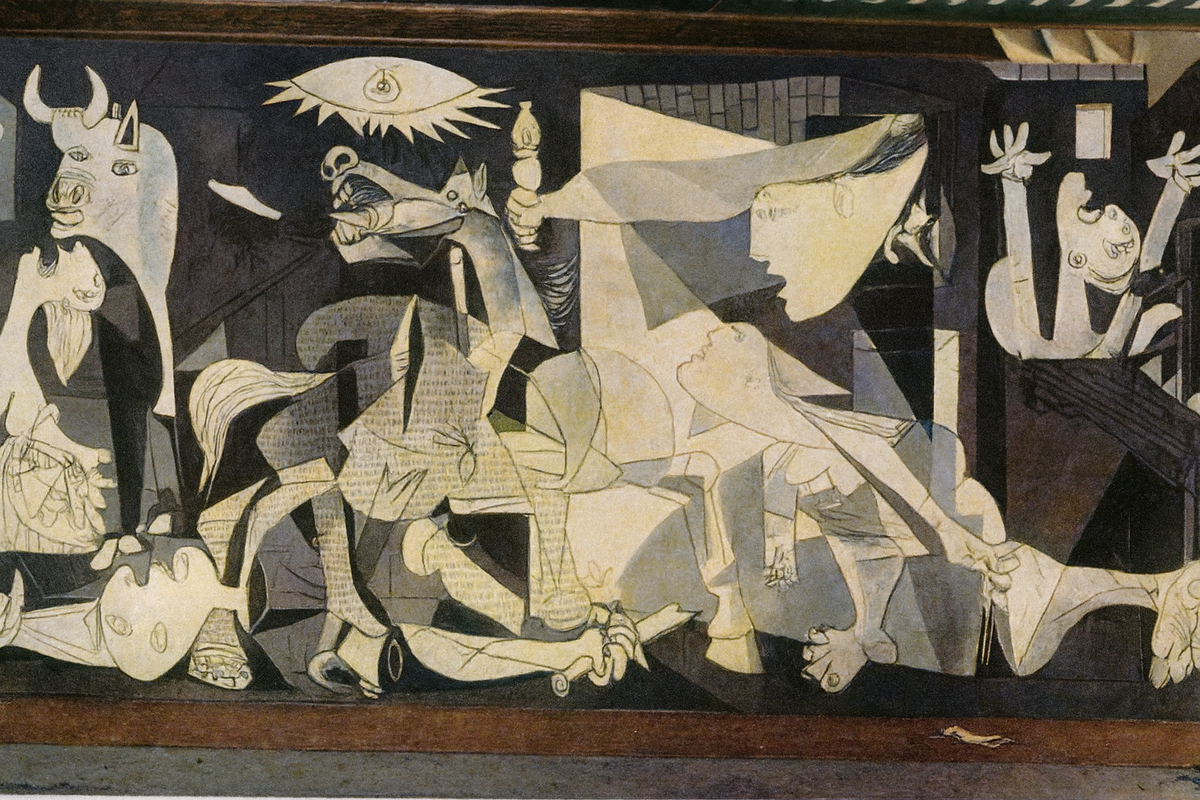
Across a full page, Pablo Picasso's Guernica stared back: a disemboweled horse, a mother clutching her dead child, a bull looming over the wreckage. The mural was massive, nearly 26 feet wide, and even in reproduction it dominated the page. For most Americans, this was their first encounter with what would become the most famous anti-war painting in history. And they encountered it not in a museum, not in an art journal, but in their living rooms—delivered alongside advertisements for cigarettes and refrigerators.
This was no accident. Life had made a calculated editorial decision: modern art was now front-page news.
Archive Details
Historical Figure
Pablo Picasso, Spain's most famous living artist
Issue Date
Life Magazine, July 26, 1937
Archive Source
Original Life Magazine Collection
Article Title
"Spain's Picasso Paints Bombing of Guernica for Paris Exposition"
When Art Became War Reporting
By July 1937, the Spanish Civil War had already carved Europe into factions. Republicans—backed by workers, intellectuals, and international brigades—faced off against Nationalists led by General Francisco Franco, whose forces enjoyed the full military support of Nazi Germany and Fascist Italy. The conflict was a dress rehearsal for the larger war to come, and everyone knew it.
On April 27, 1937, German planes of the Condor Legion bombed the Basque town of Guernica in one of the first large-scale aerial attacks on civilians in modern warfare. Hundreds died. The town burned for days. The world recoiled in horror—or pretended not to notice.
Picasso noticed. Commissioned to create a work for the Spanish Pavilion at the Paris Exposition Internationale, he abandoned his original plans and painted Guernica in a fury of productivity, completing the massive mural in just over a month. Its imagery—fractured bodies, animal agony, a broken sword—captured the chaos without depicting a single airplane or bomb. It was cubism weaponized, modernism turned into moral witness.
When Life Magazine published "Spain's Picasso Paints Bombing of Guernica for Paris Exposition" in its July 26 issue, the editors did something radical: they treated the painting as reportage. Not as a curiosity for the culture pages, not as avant-garde decoration, but as evidence. Evidence of what fascism meant when it fell from the sky.
The Magazine That Made Art Matter
Life had launched less than a year earlier, in November 1936, with a bold premise: photography could communicate truth more powerfully than words alone. By the summer of 1937, it had already established itself as America's most ambitious photojournalism project, blending high society, sports, international politics, and cultural commentary with an editorial confidence no other publication could match.
The July 26 cover featured Alfred Eisenstaedt's photograph of a polo pony at Bostwick Field in Long Island—pure American leisure. But inside, readers confronted something far darker. The reproduction of Guernica consumed an entire page, giving Americans a chance to study Picasso's distortions, his symbolic grammar, his refusal to make war beautiful.
The accompanying article didn't condescend. It pointed out the bull—possibly representing Franco's Rebels. The broken sword clutched by a fallen soldier: "obvious symbolism." The ghostly figure bearing a lamp into the darkness. It even compared one of the fleeing figures to James Thurber's cartoons in The New Yorker, a cultural bridge meant to help American readers navigate Picasso's strange visual language.
What mattered most was the immediacy. Readers weren't told about the bombing of Guernica—they were shown its echo. Life understood that the horrors of the modern world could not be separated from the ways artists responded to them. By placing Guernica in the context of war reporting rather than art criticism, the magazine collapsed the distance between aesthetics and atrocity.
Key Elements of Life's Coverage
The Bombing Context
Life contextualized Picasso's mural with the April 27, 1937 bombing—one of the first mass aerial attacks on civilians in history.
The Paris Exposition
The article noted that Guernica was created for the Spanish Pavilion at the 1937 Paris World's Fair, situating it within international politics.
The Bull Motif
The magazine speculated that the dislocated bull on the left side of the mural symbolized Franco's Rebels.
The Broken Sword
A fallen soldier clutching a shattered sword was described as "obvious symbolism" of defeat and resistance.
Cultural Bridge
One figure was compared to drawings by James Thurber in The New Yorker, helping American audiences interpret the unfamiliar style.
Art as Protest
The article made clear that Guernica was more than art—it was a direct political statement against fascist violence.
Why This Issue Matters to Collectors
For those who collect vintage Life magazines, the July 26, 1937 issue occupies a special place. It's not simply rare, though issues from the magazine's first years are significantly scarcer than later wartime editions. It's culturally pivotal.
This issue captured international outrage in real time—published just three months after the bombing. Few American publications reproduced Guernica so prominently in 1937, making this one of the earliest American records of a work that would define 20th-century art. More importantly, it demonstrates Life's unique editorial courage: the willingness to blend high art, politics, and journalism in ways that other magazines considered too risky or too confusing for mass audiences.
Today, Guernica hangs in Madrid's Museo Reina Sofía, recognized worldwide as a symbol of war's brutality. But in 1937, its meaning was still unfolding. For American readers, Life provided the gateway—not through gallery visits or academic lectures, but through the mailbox.
Holding this issue now means holding the same pages through which ordinary Americans first confronted one of history's greatest masterpieces. It's a tangible artifact of the moment when modern art stopped being an elite preoccupation and became a moral necessity.
For Collectors & Historians
The July 26, 1937 issue of Life Magazine stands as a landmark in media history—a moment when a magazine trusted its readers to look at something difficult, something strange, and something true.
Historical Timing
Published just three months after the bombing, this issue captured international outrage in real time.
Cultural Pivot
Few American publications reproduced Guernica so prominently, making this an early record of a 20th-century masterpiece.
Editorial Courage
Demonstrates Life's willingness to blend art, politics, and journalism in unprecedented ways.
Scarcity
Issues from the magazine's first years (1936-1937) are significantly rarer than later wartime editions.
The Living Archive
Vintage Life magazines are not museum pieces. They are time capsules that breathe. Each page reveals how people in real time first learned about the events that shaped the world.
Browse Life Magazine Collection