
The Moment the Ocean Became a Frontier
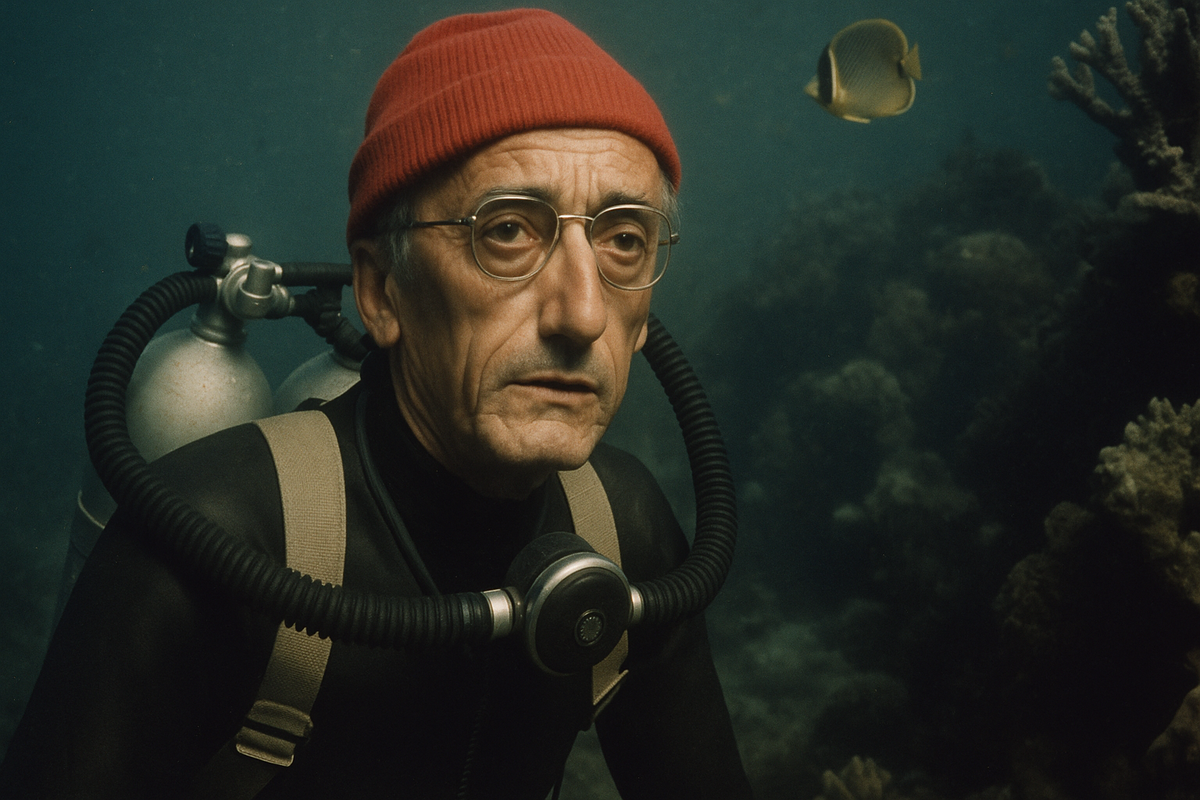
On March 28, 1960, Americans opened their mailboxes to find something unusual staring back at them from the cover of Time Magazine: not a politician, not a general, not a captain of industry—but a man in a wetsuit, surrounded by fish, beckoning them into a world that might as well have been another planet.
Jacques-Yves Cousteau had arrived.
While the nation's gaze remained fixed on the heavens—on Sputnik, on Mercury astronauts, on Kennedy's promise to reach the Moon—Time made a calculated editorial gamble. It turned the camera downward, into the blue abyss, and declared that Earth's last great wilderness wasn't in the stars. It was right here, seventy percent of the planet's surface, unexplored and unnamed.
This wasn't just a profile of a diver. It was the birth certificate of modern ocean consciousness.
When Inner Space Rivaled Outer Space
The late 1950s belonged to rockets. The Cold War had metastasized into a technological duel fought in the vacuum of space, where every satellite launch was a propaganda victory and every failed test a national humiliation. The Space Race consumed headlines, budgets, and the American imagination.
But Jacques Cousteau represented a different kind of pioneer. He had co-invented the Aqua-Lung, liberating divers from surface-tethered hoses and turning the ocean floor into accessible territory. His 1956 documentary The Silent World had won the Palme d'Or at Cannes and an Academy Award, bringing crystalline underwater footage into darkened theaters where audiences gasped at coral cathedrals and shark encounters filmed with a poet's eye.
By 1960, Cousteau's research vessel Calypso was the most famous ship in the world not built for war. And Time recognized what was happening: exploration wasn't a single frontier. It was dual. While NASA engineers calculated trajectories, Cousteau's divers were cataloging shipwrecks, charting reefs, and documenting marine ecosystems that had never been photographed.
The ocean had military significance too—submarines prowled the depths as invisible nuclear arsenals, and understanding underwater acoustics and navigation had become matters of national security. Cousteau's work served science, yes, but it also carried Cold War weight.
Time's editors understood all of this. The March 28 issue didn't just celebrate Cousteau. It repositioned the ocean as a theater of American ambition.
Historical Archive Details
Featured Subject: Jacques-Yves Cousteau, French naval officer, oceanographer, filmmaker
Issue Date: March 28, 1960
Article Title: "Poet of the Depths"
Publication: Time Magazine
Cultural Context: Cold War era, Space Race at peak intensity, emerging environmental consciousness
Significance: First major American mass-market coverage positioning oceanography as equal to space exploration
"Poet of the Depths": How Time Framed the Ocean
Time Magazine specialized in transforming technical subjects into cultural moments, and its treatment of Cousteau in the article titled "Poet of the Depths" demonstrated that editorial alchemy at full power.
The piece avoided the dry language of oceanography journals. Instead, it rendered Cousteau's expeditions as epic narratives—divers descending into ancient shipwrecks where Greek amphorae rested undisturbed for millennia, coral gardens exploding with color in waters so clear they seemed lit from within, schools of fish moving in synchronized clouds that defied rational explanation.
The photography was revolutionary. Full-color underwater images were rare in 1960, expensive to produce and difficult to reproduce in print. Time committed the resources. Readers saw lionfish hovering like ornate sculptures, reefs teeming with alien life forms, and the blue gradient of deep water disappearing into darkness. For most Americans, these were first encounters—proof that wonder didn't require a rocket, just the courage to descend.
But the article's genius lay in its framing of Cousteau himself. He wasn't merely a scientist or adventurer. He was a philosopher of the deep, someone who could articulate why humanity needed to know what lived beneath the waves. Time captured his conviction that the ocean was fragile, finite, and already threatened by human activity—environmental thinking that wouldn't reach mainstream consciousness for another decade.
The Cover That Changed Marine Science
That March 28 cover image—Cousteau in diving gear, marine life swirling around him—was a visual manifesto. Time's covers had power in 1960. They conferred legitimacy, signaled importance, and shaped national conversation. Putting Cousteau there, during the Space Race's fever pitch, was a declaration: this matters as much as Cape Canaveral.
The interior layout reinforced the message. Time employed its signature style—authoritative prose paired with striking imagery, cultural analysis woven through factual reporting. This wasn't National Geographic's approach, which leaned scientific and educational. Time added context: politics, ambition, the psychology of exploration. It asked why Americans were drawn to frontiers, what drove men like Cousteau to risk nitrogen narcosis and decompression sickness for knowledge, and what it meant that we were finally seeing the planet we'd always lived on.
The magazine understood that Cousteau's work was inherently dramatic. His divers faced poisonous creatures, equipment failures in crushing depths, and the constant threat of nitrogen narcosis—the "rapture of the deep" that made divers feel invincible moments before drowning. Time didn't sanitize these dangers. It used them to elevate the stakes.
What the Issue Captured: A Cultural Inventory
Inside the March 28, 1960 issue, Time documented discoveries that seem commonplace now but were revelations then:
Ancient Wrecks as Time Capsules
Cousteau's expeditions had located Roman-era vessels, their cargo holds still packed with wine amphorae preserved by the sea. These weren't archaeological digs—they were underwater museums, proof that oceans held human history in suspension.
Reefs as Living Cities
The magazine's photographs revealed coral formations that functioned as ecosystems unto themselves—complex, interdependent, vulnerable. This was decades before "biodiversity" entered common vocabulary.
The Human Element
Time profiled Cousteau's divers not as nameless technicians but as characters in a drama—specialists who risked their lives to bring back footage and specimens, men who understood that every dive could be fatal.
Exploration as Advocacy
The article captured Cousteau's emerging environmental philosophy—his warnings about overfishing, pollution, and humanity's casual destruction of marine ecosystems. In 1960, this was prescient. By the 1970s, it would be prophetic.
The Tangible Archive: Why Print Endures
Digital news is instant and disposable. But a 1960 Time Magazine is an artifact—ink on paper, a physical object that existed in the world when Cousteau was still diving, when the Cold War was young, when the environmental movement was barely a whisper.
These magazines sat on coffee tables in ranch houses, in doctors' waiting rooms, in university libraries. They were read, discussed, sometimes saved. The surviving copies carry that history in their pages—subscription labels, marginal notes, the faint smell of decades.
For collectors and historians, these issues provide something the internet cannot: context in original form. The advertisements reveal consumer culture. The typeface and layout document graphic design evolution. The articles themselves show how Americans processed the world in real time, without retrospective knowledge of how events would unfold.
The March 28, 1960 Cousteau issue isn't just documentation of ocean exploration. It's evidence of how a magazine could shift cultural attention, how mass media created heroes, and how print journalism once served as the primary lens through which millions understood their world.
Why Collectors Pursue This Issue
Cousteau's American Apotheosis
This cover solidified his transformation from French naval officer to global icon. Post-1960, Cousteau became synonymous with ocean exploration, a reputation that would carry through his television specials and conservation work for decades.
1960 America in Transition
The issue reflects a moment when the nation was simultaneously looking up (space) and down (ocean), when scientific achievement was front-page news, and when exploration still carried genuine danger and mystery.
Historic Photography
These images represent some of the first mass-market color documentation of underwater life. For readers in 1960, this was as exotic as Mars rover photos would be forty years later.
Condition and Scarcity
Vintage Time issues from this era often suffered rough handling. Clean copies with intact covers and unfaded color have become increasingly difficult to source, particularly for culturally significant issues like this one.
Cross-Category Appeal
Cousteau enthusiasts, diving historians, environmental movement scholars, and Cold War researchers all have reasons to acquire this issue, creating sustained demand across multiple collector markets.
Museum-Quality Material
This is primary source documentation of the moment when modern oceanography and environmental awareness began to capture global imagination—historical evidence, not nostalgia.
Explore the Complete Archive
The March 28, 1960 issue is one entry in a vast catalog of 20th-century cultural history. From Cousteau's ocean to Armstrong's moon, from Cold War tensions to cultural revolutions—these magazines documented the moments that defined a century.
Browse Time Magazine Collection