
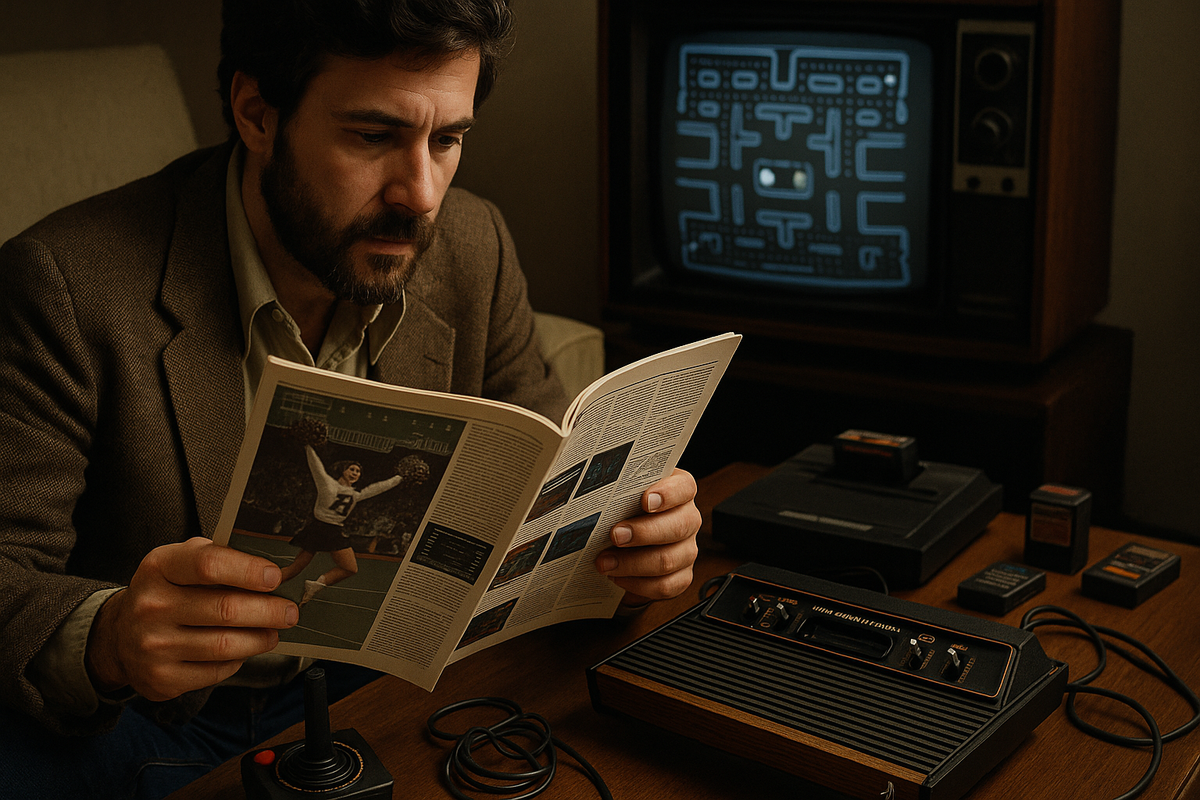
When the Arcade Lights Blazed Brightest
Electronic Games Magazine's Final Hurrah Before the Crash
October 1982. Walk into any American mall and you'd hear it—the electric symphony of Pac-Man death sequences, the staccato fire of Defender, the hypnotic pulse of Galaxian. The arcades were printing money. Home consoles were flying off shelves. And Electronic Games Magazine, America's first publication devoted entirely to video games, had just published what would become one of its most historically significant issues: the 1983 Videogame Preview.
Readers couldn't have known they were holding an obituary disguised as a celebration. Within months, the industry would implode.
Archive Essentials
Publication: Electronic Games Magazine
Issue: October 1982
Cover Feature: 1983 Videogame Preview
Historical Context: Published months before the 1983 video game market crash
Significance: First American magazine dedicated solely to video games
The Magazine That Took Games Seriously
Electronic Games launched in 1981 with a radical premise: video games deserved the same critical attention as film, literature, or music. While toy catalogs hawked products and hobby magazines relegated gaming to back-page columns, EG offered technical analysis, publisher profiles, and cultural commentary. It spoke to players as engineers, strategists, and enthusiasts—not children.
The October 1982 issue embodied this philosophy perfectly. Its 1983 preview wasn't mere hype; it was cartography, mapping an industry expanding at terrifying velocity.
What Readers Found Inside
The issue delivered substance where competitors offered spectacle:
Wiring diagrams for ColecoVision's Pac-Man and Galaxian conversions let hobbyists reverse-engineer their own hardware—a level of technical transparency unthinkable in today's locked-down ecosystem.
Deep previews of boundary-pushing titles: Beauty & the Beast, Atlantis, Swords and Serpents, Demon Attack. These weren't just games; they represented genuine attempts to expand what interactive entertainment could be.
Publisher spotlights tracked the industry's Cambrian explosion. Activision and Imagic were challenging Atari's monopoly with superior design. Spectravision, CBS Video Games, Games by Apollo, Tigervision—names that would vanish within eighteen months—commanded serious coverage alongside the giants.
The Videogame Hall of Fame section established a then-radical idea: some games mattered enough to be preserved, studied, remembered. EG treated Space Invaders and Asteroids the way critics treated Citizen Kane.
The writing balanced technical precision with genuine passion. Where other publications condescended, EG assumed intelligence. Where others chased trends, EG documented history in real time.
The Cover That Captured an Era
A cheerleader mid-leap, pom-poms raised, framed against a pixelated football scoreboard. The image perfectly synthesized analog American culture with the digital revolution—Friday night lights meeting cathode ray tubes. It was playful, optimistic, utterly confident in gaming's mainstream future.
That confidence would prove tragically premature.
The Invisible Cracks
Flip through the preview sections today and the warning signs scream from every page:
Console Overload
Atari VCS, Intellivision, ColecoVision, Vectrex, Emerson Arcadia 2001, Bally Astrocade. Retailers couldn't stock them all. Parents couldn't distinguish between them. The format war wasn't competition—it was chaos.
Publisher Proliferation
The preview covered dozens of companies, many producing shovelware to capitalize on the boom. Quality control had collapsed. E.T. The Extra-Terrestrial was months away from becoming the industry's most infamous disaster.
The Arcade-to-Home Pipeline
Conversions of Galaxian and Pac-Man remained major selling points, but home hardware couldn't match arcade quality. Every port disappointed. Every disappointment eroded consumer trust.
The Technical Enthusiasm
Those wiring diagrams? They revealed an audience sophisticated enough to understand that home systems were compromised. Players knew they were buying inferior versions of games they'd already mastered in arcades.
EG's editors couldn't have predicted the 1983 crash—nobody could. But they documented its causes with journalistic precision, one preview at a time.
The Legacy That Endures
Electronic Games validated a generation's hobby before that hobby became a global industry. In 1982, gaming was still fighting for legitimacy. EG argued—through rigorous coverage, technical depth, and cultural analysis—that games mattered. That they were art, technology, and community simultaneously.
The magazine couldn't prevent the crash. But it preserved the moment before impact with extraordinary fidelity. Reading these pages now, you don't just learn about Demon Attack or the Emerson Arcadia. You witness an entire creative economy in its final season of innocence.
That's why these issues transcend nostalgia. They're historical records of a revolution that almost died in infancy.
Why Collectors Covet This Issue
Historical Position
Published at the absolute zenith, months before the collapse. It captures an industry at maximum ambition and minimum self-awareness.
Content Density
The technical diagrams, publisher analyses, and game previews provide primary source material unavailable elsewhere. This is the industry explaining itself to its own audience.
Cultural Artifact Value
The cover alone—that cheerleader, that scoreboard—encapsulates early '80s techno-optimism with almost painful clarity.
Journalistic Integrity
EG took games seriously when nobody else did. That seriousness makes its archives indispensable for understanding how gaming culture formed.
Explore the Archive
The October 1982 issue represents one chapter in gaming's most volatile period. The complete Electronic Games Magazine collection traces the full arc—from arcade dominance through the crash and into the Nintendo-led renaissance.
Browse Electronic Games Magazine CollectionWhether you're researching gaming history, building a collection, or reconnecting with the medium's formative years, these magazines offer something irreplaceable: unfiltered documentation of the moment video games became culture.
The October 1982 Electronic Games Magazine remains essential reading for anyone serious about understanding interactive entertainment's origins. Its technical insights, cultural reporting, and inadvertent documentation of impending catastrophe make it both collector's treasure and historian's cornerstone. More than forty years later, it still glows with the light of those arcade screens—bright, flickering, impossible to ignore.