
When Black Signatures Appeared on American Money—And White America Lost Its Mind
How Jet Magazine's 1953 exposé resurrected the forgotten story of four African Americans who signed U.S. currency—and the system that tried to erase them
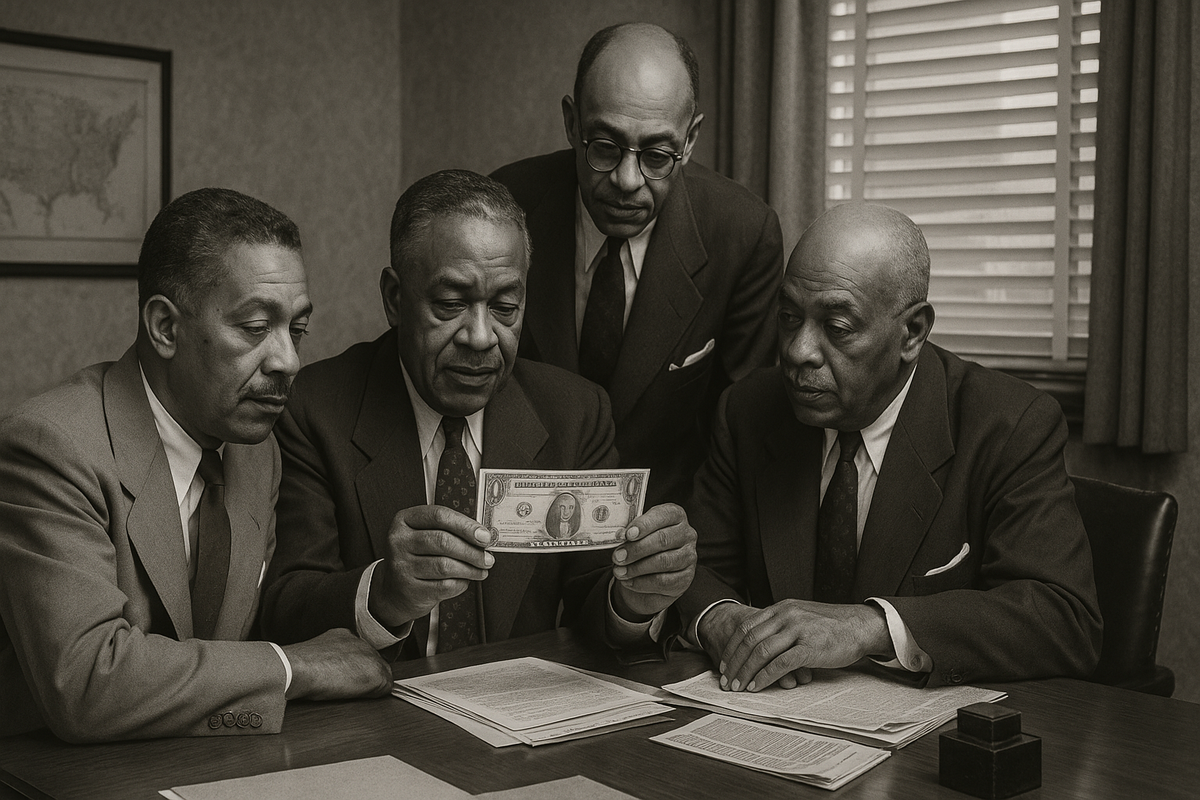
September 10, 1953. A blues singer graces the cover of Jet Magazine in trademark bold red. Inside, correspondent Simeon Booker has buried a piece of dynamite: the story of four African American men whose signatures appeared on billions of U.S. banknotes—men whose names had been systematically erased from the national memory.
This wasn't nostalgia. One year before Brown v. Board of Education would dismantle legal segregation, Booker's article, "Negroes Who Signed Money," became a manifesto disguised as history. It told Black readers in 1953 what the textbooks would not: You have always been here. Your authority has always mattered. And they have always tried to make you forget.
For African Americans living through Jim Crow, the revelation was electric. These weren't symbolic appointments or ceremonial gestures. These were men whose handwritten authority circulated through every wallet, every cash register, every bank vault in America—a daily, inescapable proof of Black competence that no segregationist could legislate away.
Four Men, Four Signatures, One Impossible Victory
The position was Registrar of the Treasury—a role that required signing every piece of U.S. paper currency issued during one's tenure. Between 1881 and 1913, four African Americans held this office. Each appointment was a political earthquake. Each tenure ended in betrayal.
Blanche K. Bruce (1841–1898) was born enslaved. By 1875, he was a U.S. Senator from Mississippi—the first Black senator to serve a full term. When President James Garfield appointed him Registrar in 1881, southern newspapers erupted. His signature on currency was derisively called "n***** money" by white politicians who refused to handle bills bearing his name. Bruce's reappointment became a political weapon, contested and undermined at every turn.
Judson W. Lyons (1860–1924) arrived at the 1880 Republican National Convention as its youngest delegate. Trained at Howard Law School, appointed Registrar by President William McKinley in 1898, Lyons faced unrelenting assault from southern Democrats who treated his very existence in federal office as an affront. His competence didn't matter. His credentials didn't matter. His Blackness was the only fact they needed.
William T. Vernon (1871–1944) was president of Western University in Kansas when he became Registrar in 1906. His tenure collapsed under the weight of political scandal—not because of incompetence, but because Black political appointments in a white supremacist system were inherently vulnerable. One misstep, one controversy, and the position could be weaponized against him.
James C. Napier (1845–1940), banker, lawyer, and Tennessee political power broker, was appointed by President Woodrow Wilson in 1911. Two years later, he resigned in protest after Wilson—who had courted Black voters—introduced formal segregation into federal agencies. Napier refused to be complicit. His resignation was a public repudiation of a president who betrayed him.
None of these men left office on their own terms. Each was pushed, manipulated, or forced out by a nation that could tolerate Black signatures on its money but not Black power in its government.
Historical Record
Publication: Jet Magazine
Issue Date: September 10, 1953
Feature Article: "Negroes Who Signed Money"
Correspondent: Simeon Booker
Cover Subject: Savannah Churchill
Historical Figures Profiled: Blanche K. Bruce, Judson W. Lyons, William T. Vernon, James C. Napier
Why Jet Told This Story—And Why It Mattered
Jet wasn't Life. It wasn't Time. It didn't have the luxury of pretending race was irrelevant or that history was neutral.
By 1953, Simeon Booker had already established himself as one of Jet's most unflinching voices. He understood that for Black readers, history wasn't academic—it was survival. Every story Jet told was a counter-narrative to the erasure happening in mainstream media, in textbooks, in the national consciousness.
"Negroes Who Signed Money" accomplished three things simultaneously:
It restored memory. Bruce, Lyons, Vernon, and Napier had been deliberately omitted from standard accounts of American political history. Jet gave them their names back.
It exposed structure. Booker didn't just celebrate these men—he documented the systemic machinery designed to undermine them. Readers saw the pattern: Black achievement was always conditional, always fragile, always under siege.
It provided fuel. In 1953, the civil rights movement was accelerating. This wasn't a story about the past. It was proof that resistance had always existed—and that representation, no matter how hard-won, mattered.
The paradox was visceral: millions of white Americans who would never sit next to a Black person on a bus were handling currency signed by Black officials every single day. The signatures couldn't be removed. The authority couldn't be erased. The money had already been printed.
The September 10, 1953 Issue: Celebrity and Consequence
The cover featured Savannah Churchill, the blues singer pivoting into spiritual music. Jet's pocket-sized format and red-branded design made it a magazine meant to be carried, shared, passed hand-to-hand in barbershops and living rooms.
But inside, the magazine's dual mission came into focus. Entertainment and empowerment. Celebrity and citizenship. Churchill's face sold copies. Booker's article changed minds.
This was Jet's genius: it never asked readers to choose between enjoying Black culture and understanding Black history. It insisted both were essential. Both were urgent.
What This Issue Reveals About Power and Visibility
Symbolic Permanence
A signature on currency is one of the most durable forms of public recognition a government can bestow. These men didn't just hold office—they left a mark on the literal fabric of American economic life.
Political Fragility
Every registrar's career ended under duress. Bruce's reappointment was contested. Lyons faced relentless opposition. Vernon was caught in scandal. Napier resigned in protest. Black political power in the early 20th century was always contingent, always revocable.
Community Pride and Realism
African Americans celebrated these appointments, but they also understood the terms. Pride coexisted with vigilance. Recognition came with risk.
Booker's Craft
By 1953, Simeon Booker had mastered the art of accessible history. He made scholarship readable without making it shallow. His reporting was both rigorous and urgent.
The Larger Legacy: Jet as Living Archive
Jet didn't wait for historians to validate Black achievement. It documented lives, careers, struggles, and triumphs as they happened—from the Montgomery Bus Boycott to everyday stories of professional success, beauty culture, and political organizing.
The magazine understood that visibility was power. That documentation was resistance. That telling the full story—celebrity and senator, entertainer and economist—was an act of defiance against a culture that wanted Black life to remain partial, footnoted, conditional.
"Negroes Who Signed Money" is a perfect distillation of that mission. It's not just about four men. It's about the insistence that Black authority, Black competence, and Black presence could not be legislated out of existence—even when the nation tried.
Why Collectors Prize This Issue
A Forgotten Chapter
This issue documents Reconstruction and Jim Crow politics, told when those eras were still within living memory—a primary source capturing history in real time.
Visual Documentation
Images of Bruce, Lyons, Vernon, and Napier—men whose photographs rarely appeared in mainstream publications—preserved for posterity.
Jet at Its Peak
A snapshot of the magazine balancing entertainment coverage with fearless historical journalism, showcasing its editorial mission in full force.
Artifact of Identity
A tangible connection to a moment when Black media actively constructed collective memory—doing work that universities and archives refused to do.
The September 10, 1953 edition is rare for a reason. Mid-century Jet issues that survive in good condition are increasingly scarce, and those that combine celebrity appeal with substantive historical reporting are especially valued.
For historians, this is primary source material. For collectors, it's a tangible connection to a moment when Black media was doing the work that universities and archives refused to do.
Explore the Full Collection
If this issue speaks to you, it's part of a larger archive waiting to be rediscovered. Decades of Jet magazines documented African American life in real time, preserving voices, faces, and stories that would otherwise have been lost.
For collectors, historians, and anyone preserving family heritage, these issues are more than memorabilia—they're primary documents of resistance, pride, and survival.
Browse Jet Magazine CollectionFinal Word
The signatures of Blanche Bruce, Judson Lyons, William Vernon, and James Napier appeared on billions of U.S. dollars. They were handled by people who would never have allowed those men into their homes, their schools, their lunch counters. But the signatures remained.
That's the quiet violence of the archive. That's the stubborn permanence of the historical record. And that's why Jet refused to let these men be forgotten.
For readers in 1953, this story was a reminder that Black achievement had always existed—and always been resisted. For collectors today, this issue is proof that vintage Jet magazines are not just reading material. They are living artifacts of a fight that never ended.