
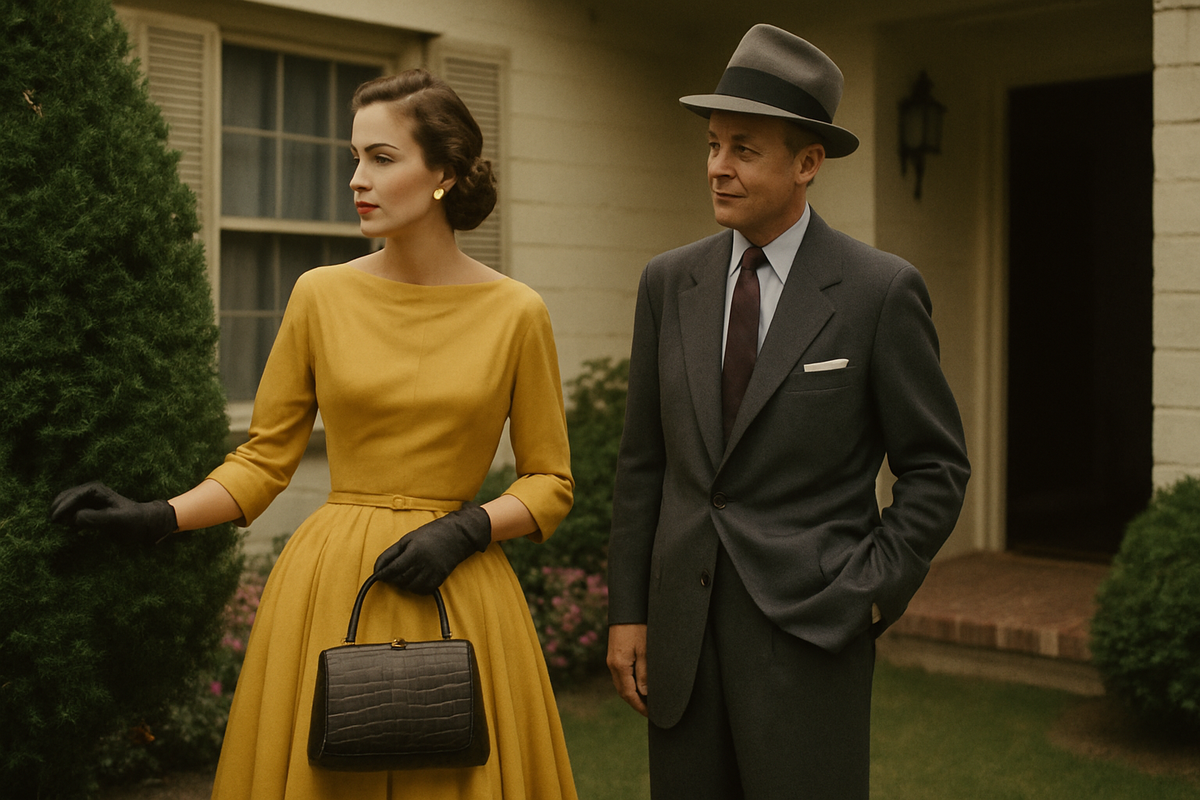
The Woman Who Had Nothing to Wear
How the October 1954 Ladies' Home Journal Captured American Fashion at Its Crossroads
"I haven't got many clothes." When Mrs. William W. Mein, Jr. said those words to Ladies' Home Journal fashion editor Wilhela Cushman in the fall of 1954, she wasn't apologizing. She was making a declaration. A fifth-generation Californian standing in her Woodside home, surrounded by pink walls and red accents, Mrs. Mein had distilled her wardrobe to what mattered: a charcoal-gray wool sheath with a red coat. Blue jeans and a wide calfskin belt for the garden. A yellow evening gown for when the occasion demanded it. Nothing superfluous. Nothing wasted.
She was, in other words, the perfect subject for a magazine trying to teach millions of American women how to be modern.
The October 1954 issue of Ladies' Home Journal didn't just photograph fashion—it photographed a philosophy. At a moment when Paris was drowning women in black wool reefer coats with ribbon bows (Christian Dior) and rhinestone-buckled Persian-lamb collars (Jacques Fath), American designers like Vera Maxwell were sending women to football games in practical elegance. The tension wasn't subtle. It was the entire point.
This single issue became a document of that negotiation: between European luxury and American pragmatism, between postwar domesticity and personal expression, between what women were told to want and what they actually needed.
Archive Details
Featured Profile: Mrs. William W. Mein, Jr., Woodside, California
Fashion Editor: Wilhela Cushman
Issue Date: October 1954
Archive Source: Ladies' Home Journal, Curtis Publishing Company
Designers Featured: Christian Dior, Givenchy, Balenciaga, Jacques Fath, Vera Maxwell
The Cultural Machinery of 1954
By mid-decade, Ladies' Home Journal had become something more powerful than a magazine—it was a manual for navigating modern life. Reaching millions of households monthly, it blended cooking advice with serialized fiction, medical columns with haute couture photography. It told women how to raise children, decorate homes, and dress for every occasion from gardening to galas.
But 1954 was a pressure point. Postwar prosperity had moved families to the suburbs, where women—many of whom had worked during the war—were expected to embrace full-time homemaking. Consumer spending was rising. Disposable income meant discretionary wardrobes. The question wasn't whether women could afford to think about fashion. It was what kind of fashion they should desire.
Paris had an answer: Balenciaga's black coats with pillbox hats and ermine trim. Givenchy's dramatic taffeta gowns with soft bloused tops. Dior's bell silhouettes that turned women into moving sculptures.
America had a different answer: clothes you could actually live in.
Postwar Prosperity
Suburban migration and rising consumer spending created new expectations for women's wardrobes and lifestyles.
Global Influence
Paris dictated haute couture with dramatic silhouettes, while American designers prioritized wearability.
Cultural Negotiation
Women balanced traditional domestic roles with emerging desires for individual expression and style.
Magazine as Authority
Ladies' Home Journal shaped how millions of women understood fashion, family, and modern femininity.
Mrs. Mein and the Art of Restraint
Wilhela Cushman's profile of Mrs. Mein reads like a quiet manifesto. She wore dramatic red wool skirts with silk blouses for afternoon gatherings, but she also wore blue jeans. Her pink satin and blue wool robe suggested leisure, not idleness. Her wardrobe was small by design—quality over quantity, longevity over trend-chasing.
The photographs tell the real story. Couples dressed in visual harmony, reinforcing ideals of marital partnership. Domestic scenes—gardening, home moments—balanced against evening glamour. Fashion wasn't abstracted into editorial fantasy. It was embedded in daily life.
Across the same pages, Cushman juxtaposed Mrs. Mein's California sensibility with the opulence of Paris. Dior's ribbon bows. Givenchy's short jackets. Jacques Fath's rhinestone buckles and wide cuff details. The message was clear: American women could admire Paris, but they didn't need to become Parisian. They could be glamorous without excess, stylish without extravagance.
It was a radical idea disguised as common sense.
What Paris Sold vs. What America Wore
The October 1954 issue made its ideological stance visible through layout. On one page: Balenciaga's black coat with pink satin lining and ermine trim, the kind of garment that required a driver and a destination. On another: Vera Maxwell's designs for football games, practical enough for bleacher seats and autumn wind.
This wasn't just editorial contrast—it was cultural positioning. Paris represented aspiration, artistry, the Old World. America represented adaptability, functionality, the New World. The Journal gave its readers both, but it didn't pretend they were equivalent. One was for dreaming. The other was for living.
That duality—aspiration balanced with reality—became the magazine's defining strength. It acknowledged that women wanted beauty and elegance, but it also acknowledged that most women had children to raise, homes to manage, and lives that didn't include chauffeurs.
Before the Revolution
It's easy to read this issue through the lens of what came later—the feminist movement of the 1960s, the rejection of traditional domesticity, the demand for professional equality. But that flattens what women in 1954 were actually doing.
They weren't passive. They were negotiating. The October issue captures that negotiation in every photograph: women who valued family and home but also sought individuality and self-expression. Women who understood that a well-chosen wardrobe wasn't frivolous—it was a form of agency.
Mrs. Mein's declaration—"I haven't got many clothes"—wasn't about deprivation. It was about control. In a consumer culture urging women to buy more, own more, want more, she had drawn her own boundaries. She had decided what mattered.
That's what makes this issue more than fashion journalism. It's a historical document of how women claimed power in the spaces available to them.
Why Collectors Hunt This Issue
Fashion Documentation
Vivid color photography documenting both American sportswear and Paris couture at a pivotal moment in fashion history.
Social History
Preserves how women lived, what they wore, and how they navigated postwar expectations and personal identity.
Design Excellence
Layouts and photography reflect the golden age of mid-century print—carefully composed, richly illustrated, technically sophisticated.
Cultural Artifact
Original copies are rare physical objects—time capsules that once shaped and reflected the lives of millions of American women.
The Artifact in Your Hands
The October 1954 Ladies' Home Journal isn't just about what women wore. It's about how they saw themselves, their families, and their place in a rapidly changing world. It's about the choices they made when the culture was pulling them in competing directions.
Mrs. Mein made her choice: quality over quantity, practicality over opulence, restraint over excess. She was photographed in her California home, surrounded by the colors she loved, wearing the clothes that suited her life.
That clarity—that refusal to apologize for knowing what she wanted—is why this issue still matters.
Explore the Archive
Discover the full collection of original Ladies' Home Journal magazines spanning the early 20th century through the 1970s. These aren't reproductions—they're the living artifacts, the actual pages that documented fashion, culture, and the voices of American women across decades.
Browse Ladies' Home Journal Magazine Collection