
The Night Folk Music Died in Print
How Rolling Stone's May 17, 1969 Issue Became the Official Obituary for an Entire Musical Era
On May 17, 1969, Rolling Stone published what amounted to a death certificate.
The magazine's readers—draft-dodgers and college radicals, record collectors and coffeehouse regulars—opened that week's issue to find Happy Traum's essay "The Swan Song of Folk Music" staring back at them. It wasn't a review. It wasn't a profile. It was an obituary for the movement that had soundtracked the first half of the decade, written while the body was still warm.
Four years after Dylan had betrayed Newport with an electric Stratocaster. Three months before Woodstock would consecrate rock as the new religion. Rolling Stone was documenting the exact moment when one generation's anthem became another's nostalgia.
Archive Details
Publication: Rolling Stone Magazine
Issue Date: May 17, 1969
Featured Article: "The Swan Song of Folk Music" by Happy Traum
Historical Context: Published between Dylan's electric Newport (1965) and Woodstock (August 1969)
The Funeral March Begins
The American folk revival had ruled the late 1950s and early 1960s with a fierce, acoustic purity. Pete Seeger taught a nation to sing "We Shall Overcome." Joan Baez made protest beautiful. Bob Dylan made it dangerous. Folk wasn't entertainment—it was solidarity, sung in union halls and at civil rights marches, passed around Greenwich Village basements like contraband.
By 1969, that world was collapsing. Festivals were hemorrhaging attendance. Coffeehouses couldn't pay rent. The kids who once knew every verse of "This Land Is Your Land" were buying Cream albums instead. Traum's essay didn't break the news so much as confirm what everyone already suspected: folk had lost the war for the counterculture's soul.
Dylan's 1965 apostasy at Newport had been the warning shot—a symbolic detonation that sent shockwaves through the purist community. But the real killer was subtler: folk had become respectable. Once the sound of resistance, it was now the sound of PBS fundraisers and college syllabi. It had traded urgency for acceptance, and in doing so, had signed its own commercial death warrant.
Rolling Stone Writes the Eulogy
Unlike trade rags or academic journals, Rolling Stone spoke the language of the movement it covered. Traum's piece wasn't detached criticism—it was a eulogy written by a mourner. He acknowledged the giants—Seeger, Dylan, Baez—but argued they could no longer sustain a movement that had already fragmented. The coffeehouse circuit that birthed the revival was shutting down, unable to compete with rock clubs where volume mattered more than intimacy.
Traum identified the generational rupture with surgical precision. Younger listeners didn't want Woody Guthrie ballads; they wanted Jimi Hendrix setting his guitar on fire. They didn't want protest songs sung in unison; they wanted The Doors breaking down doors. Folk had been born in collective action—voices joined, fists raised—but rock promised something more seductive: individual transcendence.
The essay traced folk's arc from radical movement to middle-class commodity. Once sung at labor strikes, it was now sold at record shops, shrink-wrapped and sanitized. Traum mourned this transformation even as he acknowledged its inevitability. Folk hadn't died; it had been absorbed, its DNA spliced into singer-songwriter confessionals and politically charged rock anthems. But as a mass movement with cultural dominance? That was over.
The Visual Elegy
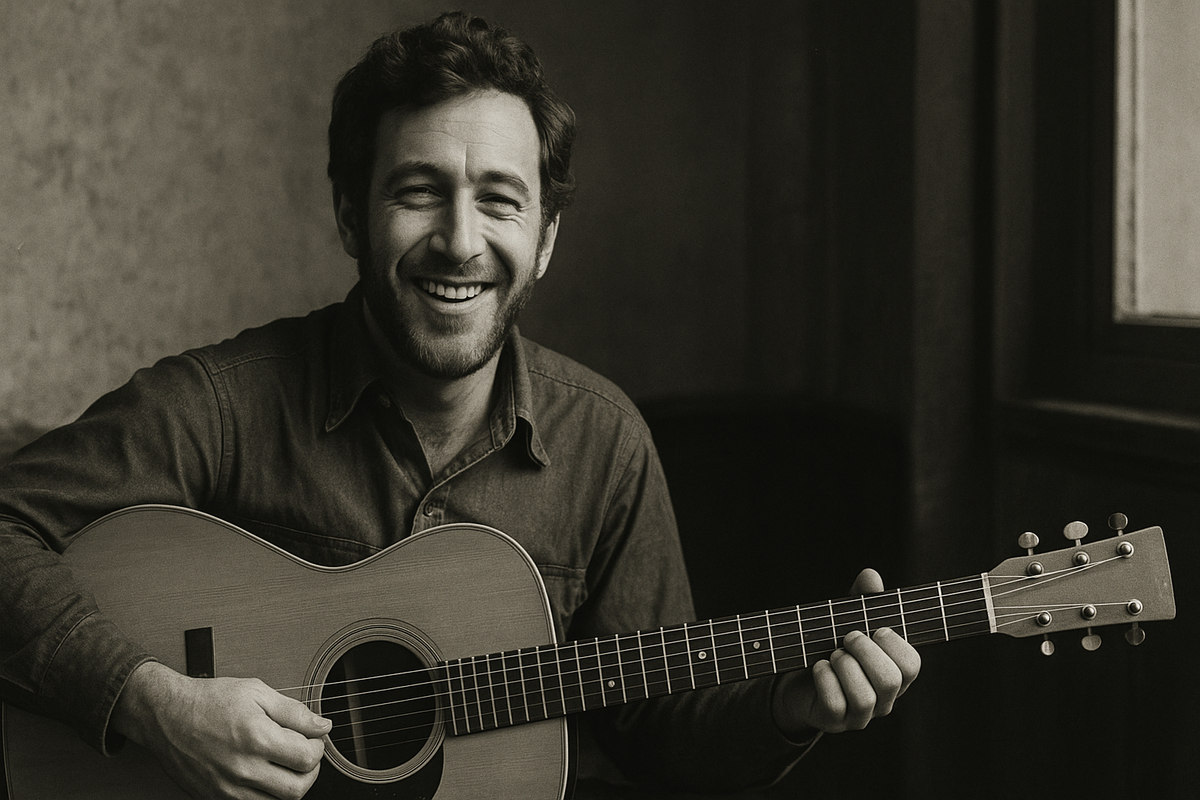
Rolling Stone paired Traum's words with an image that spoke volumes: a black-and-white portrait of a folk musician, guitar cradled, smiling gently. The photograph's simplicity was deliberate—no psychedelic swirls, no concert pyrotechnics, just the austere honesty that had always defined folk. The image didn't celebrate; it remembered.
In a year when Rolling Stone's covers exploded with acid-drenched color, this spread felt like a tombstone. It invited readers to reflect on what folk had meant before it slipped into history. The magazine's genius lay in this pairing of long-form journalism and visual restraint. This wasn't just music criticism—it was cultural archaeology, conducted in real time.
Key Themes in Traum's Analysis
Traum observed how the intimate venues that birthed the folk revival were closing, unable to compete with the rise of rock clubs where volume and spectacle trumped acoustic intimacy.
Once a radical movement, folk had become "safe" and middle-class, losing the rebellious energy that fueled its rise from union halls to mainstream acceptance.
The article acknowledged folk's critical role in civil rights and labor struggles, but questioned whether it still had relevance in 1969's rapidly evolving political landscape.
Bob Dylan's move to electric music in 1965 was framed as both a betrayal to purists and a necessary evolution—a symbolic moment that prefigured folk's transformation.
Young listeners were drawn to Hendrix, The Doors, and Jefferson Airplane, leaving folk behind as "music of the past" while rock represented the revolutionary future.
Traum honored their profound contributions but noted they could not sustain the movement alone as the cultural ground shifted beneath them.
Once born in protest halls and passed person-to-person, folk was now sold in record shops, stripped of its urgency and commodified for mass consumption.
Though diminished as a mass movement, Traum argued that folk's spirit lived on in new forms of songwriting, transformed but not extinguished.
The Archive Speaks
What gives this issue enduring power is Rolling Stone's refusal to treat music as mere entertainment. Traum's essay engaged with folk as identity, politics, and memory—a lens through which an entire generation had understood itself. That depth is what separates archival Rolling Stone from disposable pop journalism.
For contemporary collectors and historians, this issue offers more than nostalgia. It demonstrates how cultural movements don't simply end—they transform. Folk didn't vanish in 1969; it mutated into Joni Mitchell's confessionals, Neil Young's prairie laments, and eventually the Americana revival. But this issue captured the moment when it felt like an ending—and that emotional truth makes it historically indispensable.
Why Collectors Covet This Issue
Historical Positioning
Published three months before Woodstock redefined rock's possibilities, this issue captured the exact moment when one musical era surrendered to another. It's the hinge between decades.
Journalistic Authority
Traum's essay remains one of the earliest and most influential declarations of folk's decline—a primary source for anyone studying the counterculture's evolution.
Visual Contrast
The stark, austere photography stands in deliberate opposition to the psychedelic aesthetics dominating the era, making the issue visually distinctive in any collection.
Cultural Finality
This is where Rolling Stone didn't just report the news—it created it. By publishing Traum's piece, the magazine codified folk's "death" for its generation, transforming a gradual shift into a definitive ending.
Add It to Your Archive
If you collect the pivot points of 1960s culture, this issue belongs in your archive. It's Rolling Stone operating at full power—not just documenting music, but shaping how an entire movement would be remembered.
Browse Rolling Stone Magazines CollectionFrom the folk revival's last gasp to the birth of stadium rock, these original pages map the seismic shifts that defined modern music culture.
The May 17, 1969 issue remains a monument to journalism that dared to declare an era finished while its echoes still rang in coffeehouses and college dorms. Happy Traum didn't just critique folk music—he performed its last rites. And Rolling Stone, barely two years old, proved it had the authority to write history as it happened.
Hold this issue in your hands, and you're holding the last chord of a song that once moved millions—before it faded into the static of a louder, stranger decade.