
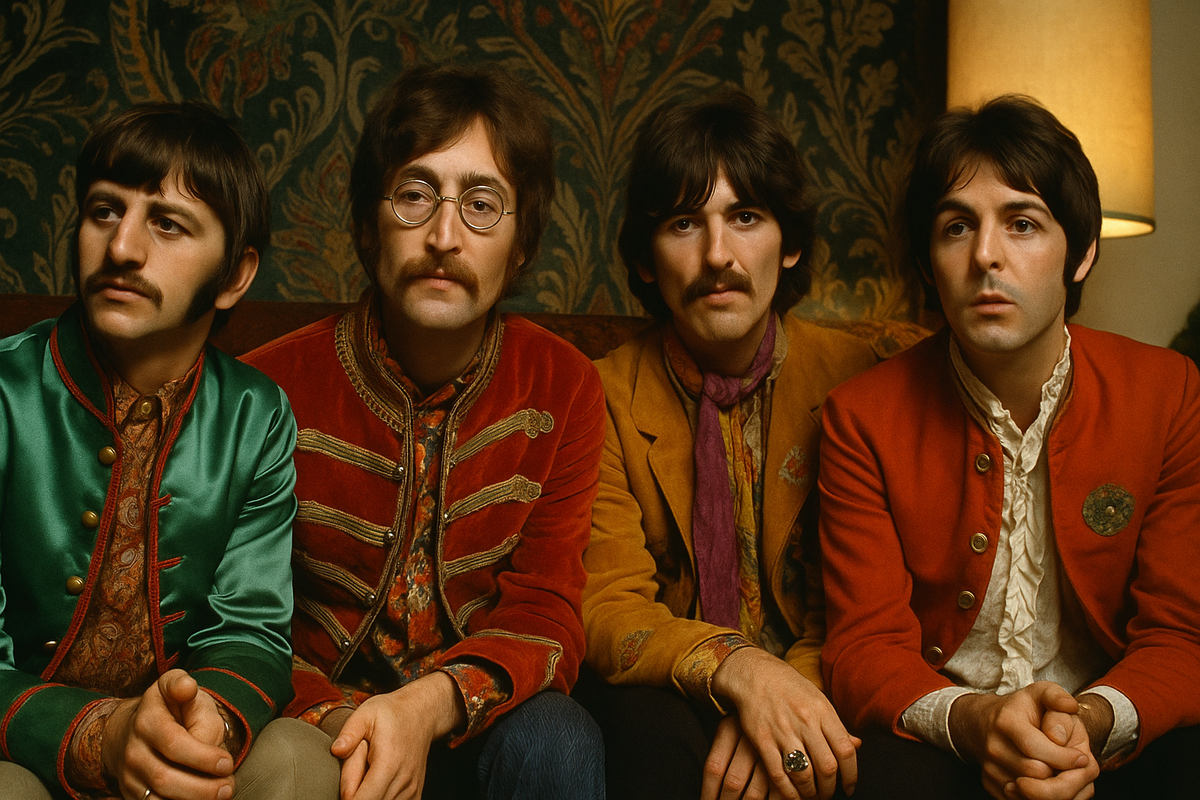
The Week America Held Revolution in Its Hands
How Time Magazine's September 22, 1967 issue legitimized The Beatles, Sgt. Pepper, and the counterculture that terrified Middle America
When the mailman delivered the September 22, 1967 issue of Time Magazine to suburban doorsteps across America, he wasn't just dropping off the weekly news. He was delivering a manifesto. Inside that issue—past the advertisements for Plymouth sedans and Virginia Slims—sat the most dangerous thing middle-class America had encountered all year: a serious, analytical defense of The Beatles as artists, philosophers, and architects of a new social order.
This wasn't a puff piece. This was Time—the magazine that had chronicled World War II, the atomic age, and the Cold War—declaring that four British musicians had created something that mattered as much as anything happening in Washington or Saigon. The feature on Sgt. Pepper's Lonely Hearts Club Band didn't just review an album. It announced that the rules had changed, that popular culture now carried the weight of intellectual discourse, and that your children's record collection might be more important than your bookshelf.
For anyone who lived through 1967, this issue was a mirror. For anyone who collects it today, it's a time capsule sealed at the exact moment when rock and roll stopped being entertainment and became scripture.
Archive Details
Publication: Time Magazine
Issue Date: September 22, 1967
Featured Subject: The Beatles and Sgt. Pepper's Lonely Hearts Club Band
Historical Context: Published three months after the album's release, during the Summer of Love
Cultural Significance: Establishment media's validation of counterculture as legitimate artistic movement
The Summer Everything Shifted
By September 1967, the Summer of Love had already happened. San Francisco's Haight-Ashbury district had transformed from a neighborhood into a pilgrimage site. Psychedelic drugs had moved from laboratory experiments to mass spiritual practice. The Vietnam War had escalated from a distant conflict to a moral crisis splitting families at dinner tables nationwide. And somewhere in that chaos, The Beatles—who just three years earlier had been singing "I Want to Hold Your Hand"—released an album that sounded like nothing American radio had ever broadcast.
Sgt. Pepper's Lonely Hearts Club Band arrived in June 1967 as both prophecy and manifesto. The album cover alone was revolutionary: a collage of historical figures, surreal typography, and the Beatles themselves disguised as a fictional Edwardian military band. The music inside matched the cover's ambition. "Lucy in the Sky with Diamonds" drifted through lysergic dreamscapes. "A Day in the Life" built from gentle morning melancholy to an orchestral apocalypse. George Harrison's sitar had already introduced Eastern philosophy to Western pop; now it was woven into the fabric of the counterculture itself.
The Beatles had stopped being entertainers. They had become translators of a new consciousness that older Americans couldn't quite decode—and that's precisely why Time's coverage mattered so profoundly.
When the Establishment Took the Revolution Seriously
By 1967, Time Magazine had spent four decades as America's most trusted interpreter of current events. Founded by Henry Luce in 1923, it had pioneered narrative journalism that made complex topics accessible without dumbing them down. Time didn't just report news; it explained what the news meant. When Time covered something, it wasn't a trend anymore—it was history.
The September 22nd Beatles feature represented something unprecedented: the establishment press treating rock music not as youth rebellion to be dismissed, but as cultural transformation to be analyzed. Time approached Sgt. Pepper the way it would approach a new symphony by Leonard Bernstein or a novel by Saul Bellow. The magazine explained how The Beatles had evolved from mop-topped pop sensations into something far more complex—artists synthesizing rock and roll, Indian classical music, avant-garde experimentation, and pharmaceutical mysticism into a single, cohesive statement.
For readers who had never heard a sitar before George Harrison made it ubiquitous, for parents who didn't understand why their teenagers kept playing the same album on repeat, Time served as a cultural translator. It validated what young people already knew and explained to their elders why this moment mattered. When Time took The Beatles seriously, it gave permission for everyone else to do the same.
Inside the Architecture of an Era
The issue itself was a masterclass in visual journalism. The cover design captured the moment's aesthetic—bold, colorful, unapologetically modern. Inside, the Beatles feature wove straightforward reporting with prose that occasionally matched the psychedelic subject matter without tipping into parody. Where lesser publications treated rock and roll as disposable teenage noise, Time granted it the dignity of serious criticism.
The article explored several interlocking themes that now read as a blueprint for understanding the late 1960s:
Cultural Prophets Emerge
The Beatles were positioned not merely as musicians but as spokesmen for a generation questioning authority and demanding authenticity. They had transcended entertainment to become voices of social transformation.
The Album as Art Form
Time analyzed Sgt. Pepper as a landmark achievement—noting its layered production techniques, surreal lyricism, and experimental instrumentation that redefined the boundaries of what rock albums could accomplish.
Psychedelic Consciousness
The psychedelic influence received frank acknowledgment. Time didn't dance around the connection between the Beatles' new sound and the rising popularity of LSD and Eastern spirituality among youth culture.
Collapsing Cultural Boundaries
The magazine documented something subtler but equally important: how Sgt. Pepper collapsed the boundary between popular entertainment and high art, between commercial product and philosophical statement.
The Personal Made Universal
Readers glimpsed the Beatles' personal lives—their relationships, fashion choices, daily routines—adding human intimacy to their mythological status and making the revolution feel accessible.
What makes this coverage so valuable today isn't just its historical accuracy. It's the fact that Time captured the moment while it was still unfolding, before anyone knew whether the counterculture would fade or fundamentally reshape society. The magazine documented uncertainty disguised as analysis, hope disguised as journalism.
Why This Issue Endures
For collectors of vintage magazines, the September 22, 1967 issue of Time occupies a special tier. It's not just memorabilia. It's a primary source document from one of the 20th century's most consequential cultural moments.
Perfect Historical Timing
Published just three months after Sgt. Pepper's release, the issue captures The Beatles at their absolute creative and cultural peak, before the White Album's internal tensions and before the fractures that would eventually dissolve the band.
Iconic Subject Matter
Beatles-related issues of major publications consistently rank among the most sought-after vintage magazines, and this one coincides with their most influential album during the most transformative year of the 1960s.
Cultural Battleground
To own this issue is to hold the same magazine that sparked dinner table debates across America about whether The Beatles were visionary geniuses or dangerous corrupters of youth. It's a snapshot of a nation arguing with itself about the future.
Sustained Collector Demand
Beatles historians, 1960s culture scholars, and serious magazine collectors all pursue this issue, keeping its value and significance alive decades later. Unlike ephemeral digital content, this magazine exists as a physical artifact you can hold.
The Document That Survived the Revolution
Time's Beatles coverage endures because it accomplished something rare in journalism: it recognized a revolution while it was still happening. Most cultural shifts only become clear in retrospect, but Time understood in real time that something fundamental had changed, that The Beatles weren't just successful musicians but architects of a new way of thinking about art, identity, and possibility.
In our current era of algorithmic news feeds and vanishing digital content, these vintage magazines serve as reminders that history once arrived in weekly installments, studied over coffee tables, debated at workplaces, and saved in family archives. The September 22, 1967 issue bridges journalism and cultural memory, offering not just information but the emotional texture of how the 1960s felt as they unfolded.
The magazine documented a moment when four musicians from Liverpool convinced the world's most powerful nation that revolution could arrive through a recording studio, that consciousness could be expanded through music, and that popular art could carry the weight of philosophy. Whether you agreed with that vision or feared it, you couldn't ignore it—and Time made sure you understood it.
Access History As It Happened
The September 22, 1967 Beatles issue represents just one week in decades of cultural documentation. Thousands of original Time magazines spanning from the 1920s through the 1970s are available for exploration—each one a window into how previous generations understood their present moment.
Browse Time Magazines CollectionThe Magazine That Changed Everything
The September 22, 1967 issue of Time Magazine remains one of the most significant cultural artifacts of its decade. Its coverage of The Beatles and Sgt. Pepper's Lonely Hearts Club Band transcended music journalism to become a historical document—proof that someone, somewhere, recognized the revolution while it was still happening.
Holding this issue today means holding a direct connection to the moment when The Beatles reshaped not only music but the very definition of what popular culture could achieve and express. Thanks to Time's rigorous reporting and cultural insight, that moment survives—in preserved copies, in collectors' archives, and in the understanding that rock and roll didn't just entertain a generation. It transformed one.