
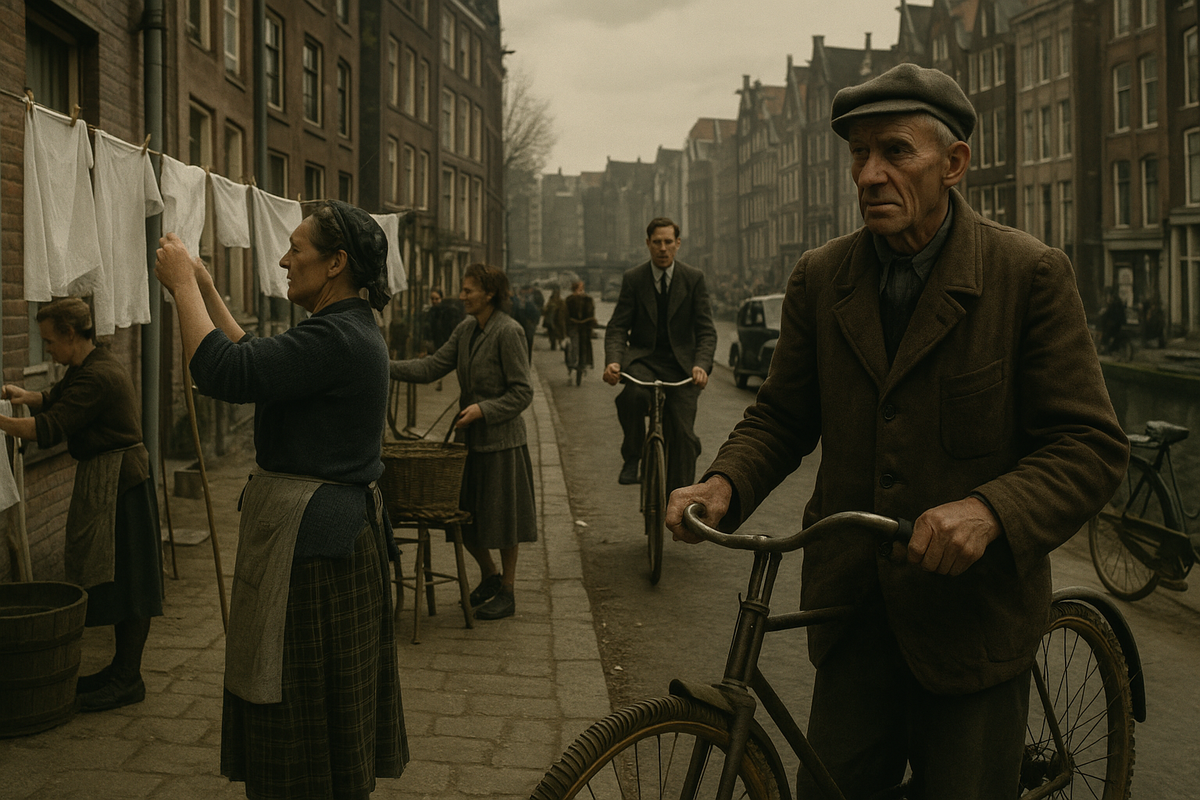
Nobody Beats the Dutch
When The Saturday Evening Post Showed America How a Starved City Came Back to Life
The diamond cutter's hands were steady.
Just eighteen months earlier, those same hands might have trembled from starvation during Amsterdam's Hunger Winter, when 20,000 Dutch citizens died waiting for liberation. Now, in the autumn of 1946, they were back at the bench, cutting stones with the precision that had made the Netherlands the gem capital of Europe before the Nazis deported or murdered most of the city's Jewish master craftsmen.
This image—published in the November 9, 1946 issue of The Saturday Evening Post—was more than photojournalism. It was proof of resurrection.
Ernest O. Hauser's article "Nobody Beats the Dutch" gave American readers their first sustained look at postwar Amsterdam: not as a victim frozen in trauma, but as a trading hub clawing its way back to commercial life with the same grit that had built a global empire from a swamp. The piece arrived at a moment when the United States was still deciding what role it would play in Europe's recovery. Should Americans invest in rebuilding former allies? Could free-market democracies survive the economic chaos that bred fascism in the 1930s?
Amsterdam's answer, according to Hauser, was already visible in the harbor traffic, the reopened diamond exchanges, and the improvised bicycle wheels rolling through streets still scarred by occupation.
This was not propaganda. It was reportage with stakes.
The Context: Europe in Ruins, America Uncertain
November 1946 was seventeen months after V-E Day. The Marshall Plan was still a year away. Rationing continued across Western Europe. Displaced persons camps held hundreds of thousands with nowhere to go. The Nuremberg trials were entering their final phase. Winston Churchill had just delivered his "Iron Curtain" speech in Missouri, and the term "Cold War" was beginning to circulate in Washington policy circles.
The Netherlands had been hit harder than most Allied nations. The German occupation stripped the country's industries, deported over 100,000 Jews (three-quarters of the prewar population), and imposed a transport embargo in the winter of 1944–45 that created famine conditions in the western provinces. Tulip bulbs became food. Trees were felled for firewood. Mortality spiked.
By the time Canadian forces liberated Amsterdam in May 1945, the city's infrastructure was gutted, its Jewish diamond trade decimated, and its population exhausted. Colonial tensions in the Dutch East Indies—which would erupt into full independence war by 1947—added political instability to economic crisis.
Yet when Hauser walked Amsterdam's streets in late 1946, he found something American editors knew would resonate with their audience: a refusal to accept defeat as permanent.
Issue Profile
Publication: The Saturday Evening Post
Issue Date: November 9, 1946
Feature Article: "Nobody Beats the Dutch" by Ernest O. Hauser
Cover Artist: Mead Schaeffer
Historical Context: 17 months post-V-E Day, one year before Marshall Plan
Archive Significance: Early documentation of European postwar recovery for American audience
The Saturday Evening Post as Cultural Barometer
To understand why this article mattered, you have to understand what The Saturday Evening Post represented in 1946.
With a circulation approaching 4 million, the Post was the most widely read weekly magazine in the United States. It was the publication that gave Norman Rockwell a platform to define the visual grammar of American identity. It serialized major fiction, ran investigative journalism, and mixed high-middlebrow cultural commentary with humor columns and advertisements that chronicled the rise of American consumer prosperity.
The Post was not The New Yorker's literary salon or Life's raw photojournalism. It was the magazine of American optimism, read at kitchen tables from Maine to California by families who believed in progress, self-reliance, and the redemptive power of hard work.
When the Post chose to run a feature-length article on Amsterdam's recovery—illustrated with photographs of canal traffic, diamond cutters, improvised bicycles, and nightclub crowds—it was signaling to its readers that Europe's fate was not just a distant policy question. It was a story about values Americans recognized: resilience, ingenuity, and the determination to rebuild without waiting for permission.
The article's placement mattered, too. Hauser's Amsterdam report appeared alongside serialized fiction, essays on domestic life, and advertisements for new automobiles and household appliances. The juxtaposition was deliberate. American prosperity was rising; European recovery was underway. The postwar world was not static. It was in motion.
The Article: "Nobody Beats the Dutch"
Hauser opened with Amsterdam's identity as the "cockpit of civilization"—a phrase that carried both historical weight and contemporary urgency. For centuries, Amsterdam had been a nexus of global trade, finance, and cultural exchange. The Nazis tried to extinguish that role. Hauser's thesis was that they failed.
His evidence was concrete:
The harbor was active again. Ships moved through Amsterdam's canals, carrying goods that connected Dutch merchants to international markets. The infrastructure of trade—warehouses, exchanges, brokerages—was being rebuilt without waiting for full economic recovery.
The diamond industry was reviving. This was the most poignant detail. Amsterdam's diamond trade had been dominated by Jewish craftsmen, most of whom were murdered in concentration camps. Yet survivors and new apprentices were returning to the cutting houses, resuming work that required years of training and unshakable precision. The industry would never fully recover its prewar scale, but it refused to disappear.
Daily life mixed hardship with normalcy. Soap remained rationed—a detail Hauser illustrated with photographs of laundry lines strung across alleys, a visual shorthand for both scarcity and the Dutch obsession with cleanliness. Bicycles, the Dutch transportation staple, rolled on improvised wheels cobbled together from scavenged materials. Food remained limited, but cafés and nightclubs were crowded, jazz bands played, and merchants reopened shops even when inventory was sparse.
Thrift and ingenuity defined the Dutch response. Hauser emphasized that the Dutch were not waiting for external rescue. American aid—including Red Cross shipments of soap and other essentials—was welcomed, but the primary engine of recovery was local initiative. Shopkeepers reopened without full stock. Manufacturers restarted production lines with improvised parts. The Dutch were trading their way back to stability.
Colonial wealth remained a factor. Hauser acknowledged the economic significance of the Dutch East Indies, though he wrote before the full eruption of Indonesia's independence war. This colonial dimension adds a layer of complexity for modern readers: Amsterdam's recovery was partly financed by an empire that was already collapsing, a fact that would reshape Dutch identity within a generation.
The article did not romanticize. Rationing, unemployment, and political uncertainty were plainly described. But Hauser's conclusion was unambiguous: the Dutch had survived worse before, and they would outlast this crisis too.
The Cover: Mead Schaeffer's Oklahoma Oil Fields
The November 9, 1946 cover, painted by Mead Schaeffer, depicted roughnecks working an Oklahoma oil derrick—gritty, physical, unapologetically industrial. This was not Norman Rockwell's sentimental Americana. It was a portrait of postwar American power: energy, extraction, the machinery of prosperity.
Schaeffer's choice carried symbolic weight. While Europe struggled with fuel shortages and rationing, American oil fields were pumping at full capacity, feeding the industrial engine that would define the Cold War era. The cover positioned American readers as beneficiaries of abundance, even as the magazine asked them to consider the fate of allies still climbing out of deprivation.
The backstory added texture: Schaeffer and his wife were greeted in Oklahoma with the mayor's proclamation and a fire chief's red car escort—a civic welcome that reflected mid-century American pride in regional industry. Placed alongside Hauser's Amsterdam reportage, the cover created a visual argument: American strength and European resilience were not competing narratives. They were complementary forces in the postwar order.
What Made This Article Extraordinary
Published just seventeen months after V-E Day, this was one of the earliest sustained portraits of European recovery written for a mass American audience.
Hauser did not traffic in abstractions. He described soap rationing, improvised bicycle wheels, diamond cutters returning to work, and crowded nightclubs. These details gave readers a tactile sense of what recovery looked like on the ground.
This was the emotional center of the article. The Nazis had systematically murdered Amsterdam's Jewish craftsmen, trying to erase an entire sector of Dutch economic life. The fact that diamond cutting was resuming—however diminished—was not just economic news. It was moral vindication.
The photographs accompanying Hauser's text were essential. Images of canal traffic, laundry lines, and nightclub crowds gave American readers evidence that Amsterdam was not frozen in victimhood. Life was resuming, however imperfectly.
Hauser's article carried an implicit argument: free societies could recover from catastrophic damage without succumbing to authoritarian solutions. This message had particular resonance in 1946, as Communist parties gained influence across Western Europe and American policymakers debated how to prevent a repeat of the 1930s.
Hauser emphasized Dutch cleanliness, thrift, and commercial acumen as enduring national traits. This framing reassured American readers that their wartime allies had not been fundamentally broken by occupation.
Hauser's references to the Dutch East Indies added economic context, though he could not anticipate how quickly Indonesia's independence struggle would unravel that dimension of Dutch recovery.
Red Cross soap shipments and other assistance were noted, but Hauser made clear that Dutch recovery was primarily self-generated. This avoided the paternalism that sometimes colored American coverage of postwar Europe.
The inclusion of cultural revival—jazz bands, crowded cafés—signaled that recovery was not purely material. Amsterdam was reclaiming its identity as a cosmopolitan hub, not just a port city.
"Nobody Beats the Dutch" was not just bravado. It was a statement of historical pattern. The Dutch had survived Spanish occupation, French invasion, and economic collapse before. This was continuity, not miracle.
A Document That Endures
When digital media dissolves into algorithmic feeds, physical magazines become counterarguments. They insist that journalism, illustration, and cultural commentary once occupied a tangible form—something you could hold, annotate, and preserve.
The November 9, 1946 Saturday Evening Post is not just reading material. It is a record of how Americans understood their role in the world during the first full year of peace after global war. It is evidence of what journalism looked like when magazines had the time, space, and editorial confidence to send reporters abroad and publish 3,000-word features illustrated with original photography.
It is also a reminder that resilience is not abstract. It is diamond cutters returning to work. It is laundry lines in alleys. It is bicycles with improvised wheels. It is the refusal to let catastrophe define the future.
Ernest O. Hauser gave American readers a portrait of Amsterdam that honored both its suffering and its determination. Seventy-eight years later, that portrait remains accurate: nobody beats the Dutch.
Why This Issue Matters to Collectors
Historical Proximity
This issue appeared when the outcome of Europe's recovery was still uncertain. It documents optimism at the earliest stage of postwar reconstruction, before the Marshall Plan or the Cold War's full crystallization.
Cultural Artifact
The magazine captures American self-understanding at a pivotal moment: prosperous, globally engaged, confident that free-market democracies could outperform authoritarian alternatives.
Visual Impact
Mead Schaeffer's oil field cover and the Amsterdam photographs create a visual narrative that still resonates. These are not generic images. They document specific places at a specific moment of transformation.
Journalistic Quality
Hauser's reporting meets standards that remain relevant. He provided detail, context, and narrative arc without sensationalism or false comfort.
Rarity and Condition
While Saturday Evening Post issues from this era are not uncommon, high-quality copies with intact covers and unfaded interiors are increasingly scarce. Collectors prize examples that retain the tactile and visual qualities of the original printing.
Tangible History
Physical magazines are counterarguments to digital ephemera. They insist that journalism once occupied a form you could hold, annotate, and preserve—a record that endures beyond algorithms.
Explore the Archive
Original copies of this issue are still available to collectors who value tangible history.
Browse Saturday Evening Post CollectionFrom the Great Depression through World War II, from postwar recovery to the Civil Rights era, The Saturday Evening Post documented American and global history as it unfolded. Each issue is a time capsule—holding not just articles and advertisements, but the assumptions, anxieties, and aspirations of the moment it was printed.