
The Night Maarten Schmidt Broke the Universe
How Time Magazine's March 11, 1966 Issue Brought Quasars and the Big Bang to Main Street
In 1963, a Dutch-American astronomer at Caltech stared at a photographic plate and realized he was looking at something that should not exist. The object—later designated quasar 3C 273—was emitting more energy than an entire galaxy of 100 billion stars, yet it appeared as a single point of light. Worse, it was receding from Earth at nearly 16% the speed of light, placing it billions of years in the past. Maarten Schmidt had just shattered the cosmic ceiling.
By March 11, 1966, when Time Magazine devoted its Science feature to Schmidt's discovery, the implications were still reverberating through astronomy departments worldwide. Quasars—quasi-stellar radio sources—defied every model of the universe then in circulation. They were too bright, too distant, and too violent. And for ordinary Americans picking up that week's issue at newsstands, it was the first time many would encounter the radical idea that the universe itself might have had a beginning.
This wasn't just science reporting. It was a cultural inflection point—the moment when cosmology escaped the observatory and entered the public imagination.
When the Cosmos Became Front-Page News
The 1960s were defined by exploration. While NASA raced the Soviets to the Moon and the Beatles crossed the Atlantic, a quieter revolution was unfolding through the lenses of terrestrial telescopes. Schmidt's identification of quasar 3C 273 in 1963 proved that the universe was far larger, older, and more chaotic than the Steady State model—which had dominated cosmology since the 1940s—could accommodate.
Three competing theories vied for acceptance:
The Steady State Universe, championed by Fred Hoyle, proposed an eternal cosmos with no beginning or end, continuously creating matter to maintain constant density as space expanded.
The Big Bang, advanced by George Gamow and others, argued for a singular explosive origin roughly 10-20 billion years ago, with the universe expanding and cooling ever since.
The Oscillating Universe offered a cyclical compromise: an eternal series of expansions and contractions, Big Bangs followed by Big Crunches, death and rebirth on a cosmic scale.
For Americans living under the shadow of Cold War existentialism and nuclear anxiety, these weren't just scientific abstractions. They were philosophical referendums on whether existence had a beginning, an end, or neither. And quasars—those impossibly bright, impossibly distant objects—were threatening to settle the debate.
Issue Details
Historical Figure: Maarten Schmidt, Dutch-American astronomer
Issue Date: March 11, 1966
Archive Source: Time Magazine Science Feature
Discovery Year: Quasar 3C 273 identified in 1963
How Time Translated the Cosmos for Main Street
The March 11, 1966 issue is a masterclass in science communication, striking a balance between technical accuracy and narrative accessibility that modern outlets rarely achieve. Time didn't just report Schmidt's findings—it staged them.
The Human Scale of Discovery
Schmidt wasn't presented as a lab-coated abstraction. Readers saw him at home in Pasadena with his wife and children, a domestic tableau that normalized the man who was rewriting the universe's biography.
Visual Pedagogy
Time deployed full-page diagrams to demystify cosmology. The "Three Theories of the Universe" graphic compared the Big Bang, Steady State, and Oscillating models side-by-side using simple visual metaphors.
Authoritative Yet Accessible Prose
The article avoided both condescension and jargon. It explained redshift, spectroscopy, and light-year distances without dumbing down the science, trusting readers to follow rigorous reporting.
The Controversy as Story Engine
Time foregrounded the debates raging among astronomers: Were quasars evidence of the Big Bang? Were they powered by supermassive black holes? The article presented Schmidt as the opening salvo in a mystery still unfolding.
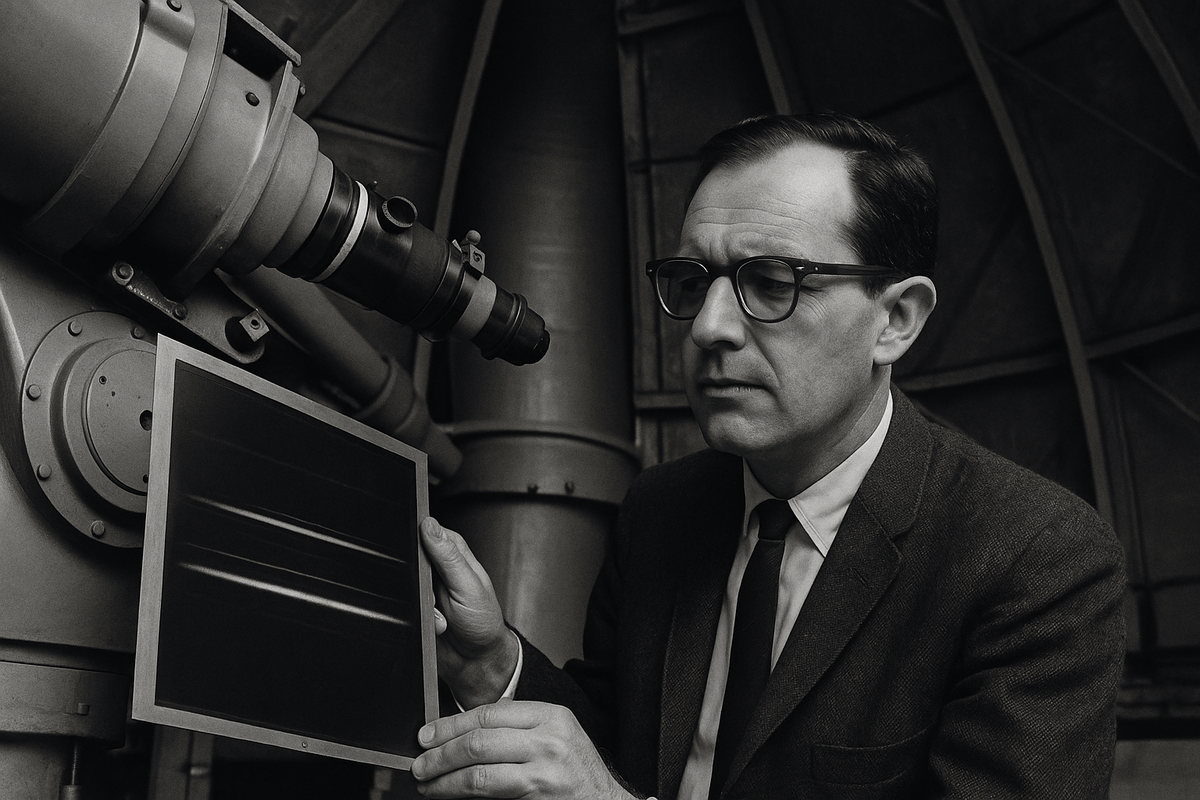
Other photographs captured Schmidt analyzing spectral lines through magnifying lenses, standing beneath the colossal 200-inch Hale telescope at Palomar Observatory, and studying photographic plates that held images of objects formed when the universe was a fraction of its current age. This wasn't science as cold data—it was science as human endeavor.
What the March 1966 Issue Captured
The Quasar Enigma
Quasars emitted radio waves and visible light with an intensity that baffled explanation. 3C 273 alone outshone the Milky Way, yet occupied a space no larger than our solar system. The sheer energy density implied processes more violent than anything observed in "normal" galaxies. Were they colliding galaxies? Nascent black holes devouring stars? Or something cosmology hadn't yet imagined?
A New Cosmic Yardstick
Because quasars were so luminous, they could be detected across vast distances—farther than any galaxy previously observed. Their existence pushed the observable universe's boundaries outward by billions of light-years, revealing a cosmos far more ancient and expansive than mid-century astronomy had dared propose. The Steady State theory, which required the universe to look roughly the same at all times and distances, couldn't explain why quasars appeared only in the distant (hence ancient) universe and not nearby.
The Big Bang's Smoking Gun
Though the article presented all three cosmological models evenhandedly, quasars were quietly tipping the scales. If the universe had evolved from a denser, hotter state billions of years ago—as the Big Bang predicted—then distant observations should reveal a younger, more violent cosmos. Quasars fit that profile perfectly. The Steady State couldn't account for them. The debate wasn't over, but the evidence was mounting.
Bridging Two Cultures
Time framed cosmology not as esoteric physics but as the latest chapter in humanity's oldest questions: Where did we come from? Where are we going? Is the universe eternal, or does it share our mortality? By profiling Schmidt's family life alongside his professional triumphs, the article grounded cosmic philosophy in everyday experience. Readers didn't need a PhD to feel the weight of discovering that the universe had a history.
Design as Editorial Statement
The Cover
Featuring Maarten Schmidt and the quasar discovery on the cover signaled that science had earned equal billing with politics, war, and celebrity. In an era when Time's covers were cultural arbiters, this was a declaration: the universe's origins were now headline-worthy news.
Interior Visual Language
The magazine's layout married the mechanical sublime with the intimate. Wide shots of the Hale telescope's interior—a cathedral of steel and glass—contrasted with close-ups of Schmidt examining photographic plates, his face illuminated by backlit spectra. The Big Bang diagram used clean, mid-century modernist lines, reflecting the era's faith in rational design and visual clarity. Every element reinforced the message: this is important, this is comprehensible, this is for you.
Typography and Hierarchy
Bold sans-serif headers and justified columns of text embodied Time's authoritative voice. The article was structured to guide readers from the accessible (Schmidt's biography) to the conceptual (cosmological models) to the speculative (the universe's fate), building confidence at each stage.
Why Collectors Covet This Issue
A Cosmological Rosetta Stone
It documented the early years of quasar research, capturing the discipline of cosmology at a pivot point. This issue froze the moment before certainty, when the universe's biography was still being written in real time.
Space Age Zeitgeist
The feature reflects 1960s America's obsession with frontiers—not just the Moon, but the cosmic horizon itself. Schmidt's work represented a parallel conquest: mapping the universe's edge through light and mathematics.
Visual and Editorial Excellence
The Palomar photography, cosmological diagrams, and Schmidt family portraits make this issue aesthetically striking. It's not just readable—it's displayable, a piece of mid-century graphic design as much as journalism.
Scarcity and Condition
Science-focused covers from Time's mid-1960s run are less common than political or celebrity issues. Copies in collectible condition—minimal wear, intact binding, vibrant color—are increasingly rare.
The March 11, 1966 Time Magazine occupies a rare intersection of scientific, cultural, and design significance. Within a decade, the Big Bang would achieve consensus, the cosmic microwave background would be confirmed, and black holes would transition from mathematical curiosities to observational targets.
The Artifact as Time Machine
Every vintage magazine is a primary source, but some issues transcend their moment. The March 11, 1966 Time doesn't just report what scientists knew—it captures how the public learned to think about the universe as a knowable, historical entity.
In 1966, black holes were still called "frozen stars." The cosmic microwave background had been detected only a year earlier. The term "dark matter" hadn't entered circulation. Quasars were mysteries bordering on impossibilities.
For collectors, historians, and astronomy enthusiasts, this issue offers something rare: a window into the psychology of discovery. It shows a culture grappling with the idea that existence itself might be finite, that the stars overhead held clues to a beginning billions of years ago, and that a single astronomer's insight could rewrite the cosmic story.
It's not nostalgia—it's intellectual archaeology.
Own the Moment the Universe Opened Up
If you collect the history of science, the Space Age, or the evolution of American media, the March 11, 1966 Time Magazine belongs in your archive. This is the issue that brought quasars, the Big Bang, and the expanding universe to Main Street—translating the cosmos for a generation on the threshold of the Apollo era.
Browse Time Magazine CollectionFrom the Space Race to lunar landings, from Cold War brinkmanship to the search for cosmic origins, Time documented the 20th century as it unfolded. Each issue is a fragment of history, preserved in ink and paper.
The Universe Had a Witness
The March 11, 1966 Time Magazine remains one of the most consequential science issues of its decade. Its coverage of Maarten Schmidt, quasars, and competing cosmological theories didn't just inform—it inducted ordinary readers into humanity's grandest investigation.
Holding this issue today is holding a piece of the moment when the universe revealed its biography. For collectors, it's not merely a magazine. It's an artifact of the night we learned the cosmos had a story—and that we were finally equipped to read it.