
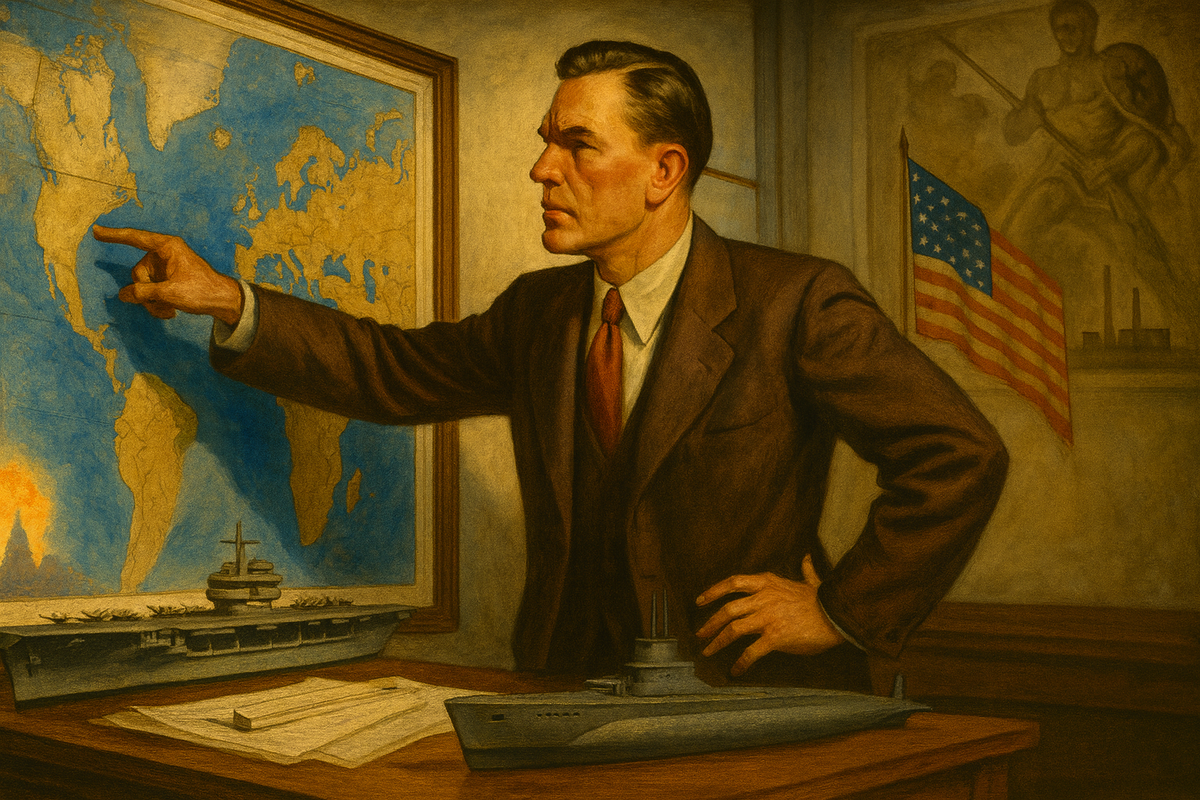
When America Dreamed of Conquering the Oceans
Inside the May 4, 1946 Saturday Evening Post and the audacious proposal to annex 50 million square miles of sea
In May 1946, two academics stood before the American public with a proposal so audacious it bordered on science fiction: the United States should claim 50 million square miles of ocean as its own territory.
Not metaphorically. Not eventually. Now.
Harold F. Clark and George T. Renner weren't fringe theorists. They were respected scholars writing in The Saturday Evening Post—the magazine that reached more American households than any publication of its era. And their argument, titled "We Should Annex 50,000,000 Square Miles of Ocean," wasn't positioned as speculation. It was presented as national necessity.
For a country that had just conquered two oceans militarily, the idea of conquering them economically didn't sound radical. It sounded inevitable.
The Hunger Beneath the Headlines
Spring 1946 marked one of history's strangest moments: total victory shadowed by creeping dread.
The United States had emerged from World War II with its industries intact, its military unmatched, and its global influence unprecedented. Europe and Asia lay in ruins. America stood alone as the world's economic colossus.
Yet beneath the triumph, anxiety simmered. Coal reserves had been pushed to their limits. Farmland showed signs of exhaustion. Timber supplies had dwindled. Even before Japan surrendered, American strategists worried whether the Earth's traditional resources could sustain modern industrial civilization—particularly with the Soviet Union mobilizing its own vast territory.
Clark and Renner framed this tension in stark terms: America could either find new frontiers of production or risk stagnation. The 19th century had been defined by westward expansion. The early 20th by aviation and automobiles. The mid-century, they argued, would be defined by whoever claimed the seas first.
This wasn't abstract futurism. To readers who had just witnessed radar, jet engines, and atomic energy reshape warfare, the idea of industrializing the oceans felt less like fantasy than logical progression. The Post had a genius for translating complex policy into dinner-table conversation, and this article transformed ocean annexation from a think-tank proposal into a question every reader could debate: Should America claim the seas?
The Magazine That Shaped American Thought
By 1946, The Saturday Evening Post wasn't merely a magazine—it was a cultural institution with circulation in the millions, reaching every corner of the country. It blended fiction, humor, Norman Rockwell covers, and hard-hitting journalism in a format that felt both comforting and authoritative.
This dual nature defined the May 4, 1946 issue perfectly. Doris Lee's cover showed a mother quietly sewing while her children played—domestic tranquility incarnate. But inside, readers encountered a blue-shaded world map that reimagined the oceans not as empty space but as territory waiting to be claimed. A photograph of Clark and Renner standing before a giant octopus exhibit underscored the untapped mystery beneath the waves.
The contrast was intentional. The cover reassured readers that normal life had returned. The article reminded them that normal life depended on bold action. Between serialized fiction and short stories like "Mr. Chinnuns and the Night Growlers," Americans absorbed a manifesto for remaking civilization itself.
The Post served as a bridge between elite policy debates and mass consciousness. It didn't just reflect American thought—it actively shaped it, translating grand visions into accessible narratives that millions could imagine, debate, and potentially demand their leaders pursue.
Inside the May 4, 1946 Issue
Publication: The Saturday Evening Post
Date: May 4, 1946
Cover Artist: Doris Lee
Featured Article: "We Should Annex 50,000,000 Square Miles of Ocean" by Harold F. Clark and George T. Renner
Historical Context: Published less than one year after V-J Day, during America's transition from wartime mobilization to postwar reimagination of its global role
The Argument for Ocean Empire
Clark and Renner's proposal combined scientific fact, patriotic rhetoric, and Cold War pragmatism:
This wasn't philosophical musing. It was a call to action, written with urgency and delivered to millions of homes through the most influential magazine of the era.
Why This Issue Matters to Collectors
The May 4, 1946 Saturday Evening Post has become highly collectible for reasons beyond its historical boldness:
Timing. Published less than a year after V-J Day, it captures America's transition from military victory to existential questions about its postwar role—a hinge moment in 20th-century history.
Audacity. Few mainstream magazines published proposals as sweeping as annexing the oceans. This issue represents postwar futurist thinking at its most ambitious, before Cold War realities narrowed the scope of public imagination.
Doris Lee's cover art. Known for her warm, detailed scenes of American domesticity, Lee's work makes this issue appealing to both art collectors and cultural historians studying mid-century visual culture.
Scarcity of vision. By the 1950s, American magazines had largely shifted toward consumer culture and Cold War anxiety. Issues from 1945-1947 that still dared to imagine utopian futures have become increasingly sought after.
Owning this issue means holding an artifact that embodies both reassurance and ambition—the twin poles of American identity in 1946.
Why Original Magazines Endure
These publications weren't disposable media. They were read, reread, clipped, debated, and saved. Every advertisement, editorial, and illustration captures not just information but the texture of American thought at a specific moment.
Unlike today's fleeting digital content, a 1946 magazine carries weight—literally and culturally. To open this issue is to step directly into the concerns and dreams of postwar America. To read "We Should Annex 50,000,000 Square Miles of Ocean" is to witness one of the most ambitious proposals ever published in a mainstream American periodical.
That's why collectors and historians return to these magazines repeatedly. They aren't just documenting history—they're preserving the living record of how Americans thought about their place in the world.
Collector Significance
If you want to explore this issue or discover others like it, thousands of original Saturday Evening Post magazines spanning the 1910s through the 1970s are available in our collection. You can trace the entire arc of American history—war, peace, prosperity, anxiety, and transformation—as it unfolded in real time.
For Collectors
Investment-grade issues from pivotal moments in American history, authenticated and professionally graded. This May 4, 1946 issue represents a unique artifact of postwar futurist thinking.
For Historians
Primary source materials for researching postwar American thought, Cold War origins, and the evolution of national identity during the transition from war to peace.
For Enthusiasts
Authentic magazines that honor earlier generations and preserve the living record of how Americans saw themselves and imagined their future across seven decades of the 20th century.
Explore the Complete Archive
Whether you're a serious collector hunting investment-grade issues, a cultural historian researching postwar American thought, or someone honoring the memory of earlier generations, these magazines offer more than reading material. They're living artifacts of how America saw itself and its future.
Browse Saturday Evening Post Collection →A Nation's Restless Imagination
The May 4, 1946 Saturday Evening Post remains one of the most striking publications of the postwar era. In their article, Harold F. Clark and George T. Renner gave readers not only a vision of abundance but a challenge: to think beyond land, beyond borders, beyond the limits of Earth itself.
Holding this issue is like holding a turning point—a moment when Americans, confident in victory but uncertain about tomorrow, dared to imagine the oceans as the next great frontier.
For anyone who values history, culture, or collecting, this magazine transcends paper. It's a living document of ambition, imagination, and America's perpetual drive to explore what lies beyond the horizon.