
The Office Assassin and the War at Home
Inside The New Yorker's November 14, 1942: James Thurber, Wartime Anxiety, and the Birth of an American Classic
On November 14, 1942, American readers opened their mailboxes to find something unexpected: a magazine cover that turned fine china into a battlefield. Chas Addams had reimagined the delicate "Willow Pattern" porcelain design—that peaceful tableau of bridges and pagodas—into a theater of war. Fighter planes replaced birds. Bombs nestled where blossoms once bloomed. Tanks rolled through landscapes meant for contemplation.
Six days earlier, Allied forces had stormed the beaches of North Africa in Operation Torch. The war wasn't coming—it had arrived. And inside this issue of The New Yorker, James Thurber had written a story about murder.
Well, attempted murder. Office murder. The kind plotted by a man so mild-mannered that his colleagues barely noticed him. "The Catbird Seat" would become one of the most anthologized American short stories of the century, but in November 1942, it landed as something else entirely: a domestic dispatch from the home front, where battles over authority and identity were being waged in filing rooms and break areas across the country.
Archive Details
Featured Author: James Thurber
Issue Date: November 14, 1942
Cover Artist: Chas Addams
Historical Context: Published six days after Operation Torch, marking America's deepening involvement in the European theater of World War II
When Meek Men Plot Revenge
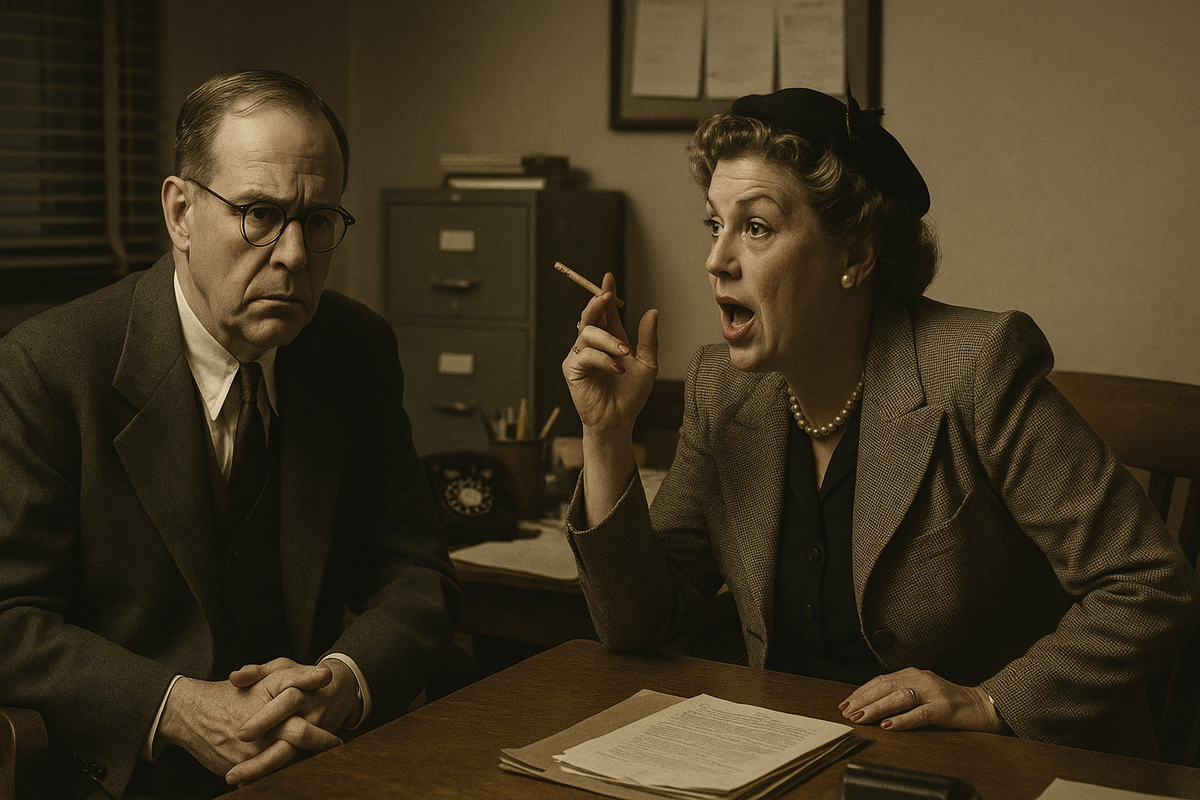
Mr. Martin works in the filing department. He drinks milk. He has never smoked. For twenty-two years, he has arrived at the office punctually, performed his duties without complaint, and maintained what Thurber calls "a neat, precise, and impeccable manner." He is invisible by design.
Then Mrs. Barrows arrives.
She is everything Martin is not: loud, aggressive, unapologetically present. She speaks in baseball slang—"Are you tearing up the pea patch?" "Are you sitting in the catbird seat?"—and she's reorganizing the office with the fervor of a general. Martin decides she must be stopped. Permanently.
The plot he hatches is elegant in its simplicity and devastating in its execution. But the genius of Thurber's story isn't the twist—it's the mirror he holds up to wartime America, where women had flooded into factories and offices, where traditional hierarchies were collapsing, and where quiet men like Martin suddenly found themselves displaced.
The Cultural Battlefield of 1942
The America that read "The Catbird Seat" was unrecognizable from the one that had existed three years earlier. Women weren't just working—they were welding, riveting, managing. Rosie the Riveter wouldn't appear on propaganda posters until 1943, but she was already at her station in November 1942, doing work that men like Mr. Martin had assumed belonged to them alone.
Rationing had begun. Coffee, sugar, gasoline—all required stamps and sacrifice. Blackout curtains hung in windows. Gold stars appeared in others. The nation had mobilized completely, and with mobilization came upheaval.
Thurber captured this anxiety with surgical precision. Mrs. Barrows isn't a villain—she's competent, perhaps even necessary. But her presence destabilizes everything Martin has built his identity upon: order, predictability, masculine authority in professional space. His plot against her is absurd, but the rage beneath it is real.
The New Yorker as Cultural Seismograph
By 1942, The New Yorker had evolved from a sophisticated metropolitan weekly into something more vital: a cultural seismograph recording the tremors of a society at war. Editor Harold Ross understood that readers didn't need another newspaper recounting battles and casualty figures. They needed context. Reflection. And occasionally, laughter that didn't trivialize the darkness but acknowledged it.
The November 14 issue delivered exactly this balance. Alongside Thurber's story ran cartoons that found humor in rationing and air raid drills. Poetry explored loss without sentimentality. The "Talk of the Town" section captured New York's peculiar wartime rhythm—a city simultaneously urgent and determined to maintain its character.
This wasn't escapism. It was a different kind of war reporting: dispatches from the psychological front, where Americans were negotiating new identities, new fears, and new social arrangements while trying to preserve some sense of normalcy.
The Phrase That Stuck
"Sitting in the catbird seat"—a position of advantage, of control, of power. The phrase existed before Thurber (borrowed from baseball broadcaster Red Barber), but Thurber launched it into the national vocabulary. Within years, politicians used it. Businessmen deployed it. It became linguistic currency for describing anyone who had gained the upper hand.
The irony, of course, is that in Thurber's story, the catbird seat is contested territory. Mrs. Barrows thinks she occupies it through her organizational reforms. Mr. Martin believes he claims it through his plot. The reader understands that neither truly controls anything—they're both responding to forces larger than office politics.
Just like the nation in November 1942.
Layers of Meaning in "The Catbird Seat"
The Power of the Ordinary
Mr. Martin, known for his meticulous, predictable life, becomes the unlikely agent of rebellion. In a world of upheaval, he embodies the fantasy of quiet resistance—the overlooked man who turns invisibility into his greatest weapon.
Changing Gender Roles
Mrs. Barrows, loud, brash, and unapologetic, represented the new, assertive female presence in workplaces of the 1940s. Thurber's satire captured both the humor and the discomfort of this cultural shift with remarkable precision.
Language and Culture
The story popularized the phrase "sitting in the catbird seat," turning a baseball colloquialism into enduring cultural shorthand. The New Yorker became the vehicle for its migration into mainstream American vocabulary.
Subtle Social Critique
Beneath the comedy lay commentary on power, conformity, and survival. Just as nations were struggling for dominance abroad, individuals were finding ways to assert control in their daily lives at home.
The Endurance of Wartime Wit
What makes The New Yorker's wartime issues more than historical curiosities is their refusal to simplify. The November 14, 1942 issue doesn't offer easy answers about gender roles, workplace authority, or social change. It presents the conflict with intelligence and humor, trusting readers to navigate complexity.
Thurber's story never mentions the war explicitly, yet it's suffused with wartime anxiety—the fear of displacement, the struggle for control, the question of who gets to occupy positions of power when all the old rules have been suspended. Mrs. Barrows and Mr. Martin aren't arguing about filing systems. They're negotiating the future.
The magazine understood what many contemporary publications didn't: that culture during wartime isn't a distraction from the real story. It is the real story. How a society entertains itself, what it laughs at, which voices it amplifies—these reveal more about national character than troop movements ever could.
The War Inside the Office
When Mr. Martin finally executes his plan against Mrs. Barrows, the weapon he chooses isn't the knife he originally considered. It's performance. Theater. He behaves so wildly out of character—smoking, drinking, threatening—that when he returns to his normal self the next day, Mrs. Barrows' accurate account of his behavior sounds like delusion. She's dismissed as unstable. He wins by weaponizing his own invisibility.
It's a dark story, darker than it initially appears. But in November 1942, as American soldiers fought in North Africa and families rationed at home, Thurber offered readers something valuable: acknowledgment that smaller wars mattered too. That the battles for dignity, autonomy, and identity in offices and homes were real, even if they'd never make the front page.
The New Yorker understood this. The November 14, 1942 issue proved it. And holding that issue today means holding a moment when American culture was honest enough to laugh at its own anxiety—even as the world burned.
Why This Issue Matters to Collectors
Literary Significance
First edition of "The Catbird Seat," a story that appears in virtually every anthology of 20th-century American literature. Thurber's fiction remains essential reading, and this is where one of his masterpieces debuted.
Artistic Importance
The Chas Addams cover is a definitive example of his darkly comic genius. Before The Addams Family made him a household name, he was perfecting the art of beautiful unease—making horror elegant, making war aesthetic.
Historical Timing
Published six days after Operation Torch, when the war's outcome remained uncertain, when American society was being fundamentally restructured, and when artists were finding ways to document the transformation.
Rarity and Condition
Wartime paper quality was poor due to rationing, and many copies have deteriorated. Clean examples with intact covers and unfaded pages carry significant value among collectors and cultural historians.
For Collectors and Cultural Explorers
Original issues of The New Yorker from the 1940s represent more than vintage magazines. They're primary sources—unfiltered documents of how Americans processed the most consequential decade of the 20th century through art, fiction, and satire.
Whether you're building a research library, honoring a family member who lived through the era, or simply drawn to the wit and intelligence of mid-century American culture, these issues offer something contemporary publications cannot: the authentic voice of their moment, preserved in ink and paper.
Browse The New Yorker Magazines Collection