
When Quarters Ruled America
The Forbes Cover Story That Captured the Exact Moment Pinball Died
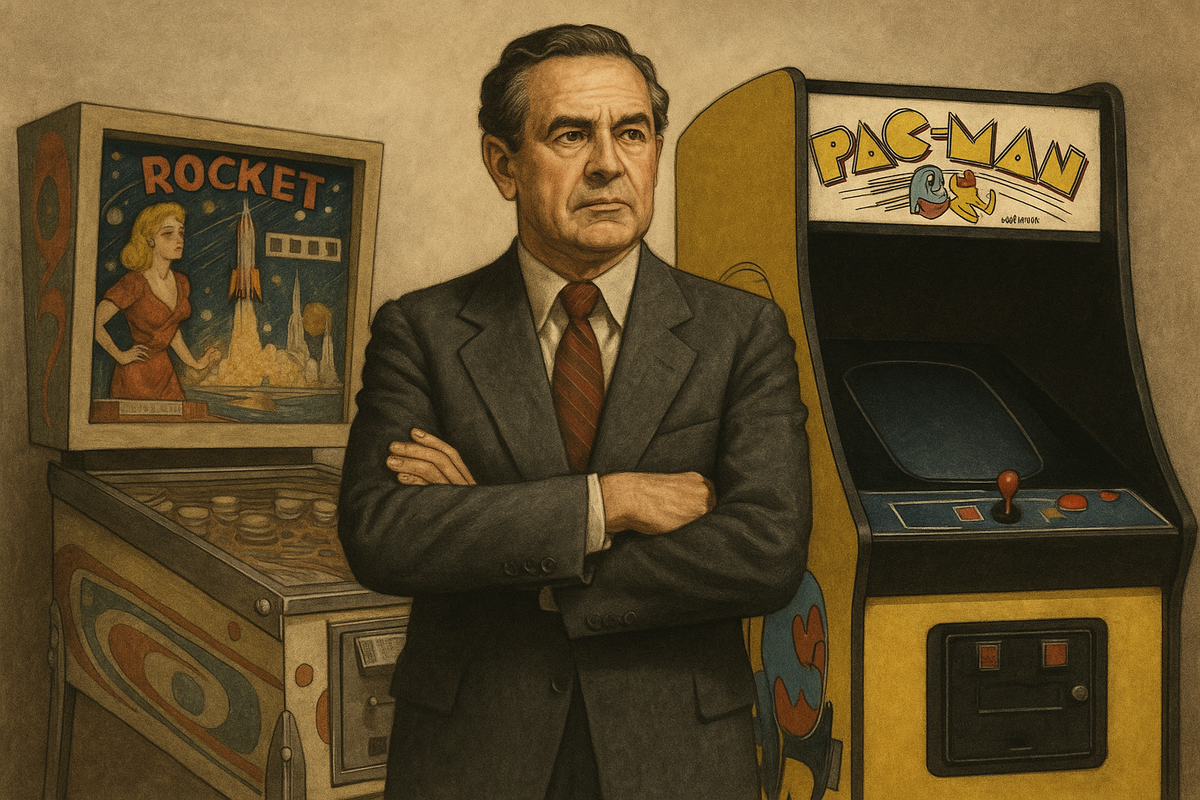
October 12, 1981. Robert Mullane stood for a photograph between two machines that represented the death and birth of an industry. On one side: the pinball cabinets that had built Bally Manufacturing into an entertainment empire. On the other: a Pac-Man arcade unit—designed in Japan, licensed by Bally, swallowing American quarters at a rate no pinball machine could match.
The photographer clicked. Forbes Magazine had its cover image. And Mullane, Harvard MBA and chairman of one of America's most iconic gaming companies, knew exactly what that photograph meant: his company was caught between a profitable past and a terrifying future.
The feature inside—titled "Luck Has Nothing to Do With It"—wasn't a celebration. It was an autopsy of American innovation, performed while the patient was still breathing.
Archive Details
Historical Figure: Robert Mullane, Chairman of Bally Manufacturing Corp.
Issue Date: Forbes Magazine, October 12, 1981
Archive Source: Original Forbes business publications collection
Historical Context: Golden Age of Video Games, Atlantic City casino expansion era
The Golden Age Was a Trap
By 1981, the arcade boom had reached fever pitch. Pac-Man, released the previous year by Namco and distributed in the United States through Bally's Midway subsidiary, had become a cultural phenomenon. Teenagers lined up outside arcades. Pac-Man appeared on lunch boxes, Saturday morning cartoons, and pop songs. The quarters poured in.
Bally's numbers reflected the mania: revenues up 33% in the first half of 1981, profits up 36% from the prior year, with record gross revenues of $756.6 million in 1980. Wall Street loved it. Investors loved it.
Mullane didn't.
He understood what the market refused to see: video games were financial nitroglycerine. A pinball machine could generate revenue for years, slowly depreciating while operators squeezed profit from every flip and tilt. But an arcade cabinet? Eighteen to twenty-four months of peak earnings, then obsolescence. The hit-driven cycle was ruthless, expensive, and—most dangeringly—dependent on constant innovation.
And Bally wasn't innovating. It was licensing.
The Japanese Problem
Pac-Man wasn't Bally's creation. Neither were the other titles keeping the company's coin-op division alive. Japanese companies—Namco, Taito, Nintendo—were flooding the American market with hits while U.S. manufacturers scrambled to keep pace. Bally had built its empire on American engineering and design, dominating pinball through the 1960s and 1970s with machines that became cultural icons.
Now it was distributing someone else's vision.
Forbes didn't soft-pedal this reality. The article noted that Bally had "stayed too long with pinball," a polite way of saying the company had missed the transition entirely. The accompanying factory photographs—workers testing Pac-Man machines on the Bally floor in Chicago—told the brutal truth: Japanese imports had become the lifeblood of an American manufacturer.
Mullane knew it. He admitted it. His candor was striking for a corporate executive in 1981, when admitting vulnerability could tank a stock price. "Current good earnings hide the real challenge," he told Forbes. The translation: we're making money today, but the foundation is crumbling.
The Atlantic City Gamble
Bally's response to arcade volatility was diversification: casino gambling. The company had opened Bally's Park Place Casino in Atlantic City, betting that steady casino revenue could offset the boom-and-bust cycles of coin-operated amusements.
It was a logical hedge. It was also enormously capital-intensive and far from guaranteed. In 1981, Atlantic City's transformation from decaying seaside resort to East Coast Las Vegas was still unproven. The city had legalized casino gambling only three years earlier. The infrastructure was incomplete. The tourist flow was unpredictable. And Bally was pouring millions into a market that could collapse if the experiment failed.
So there stood Mullane: running a company straddling two of the most volatile industries in American business, both dependent on consumer whims, both capable of generating spectacular profits or catastrophic losses.
The Forbes headline—"Luck Has Nothing to Do With It"—wasn't inspirational. It was a warning.
Why Forbes Got It Right
Business magazines in 1981 often treated corporate profiles as hagiography: celebrate the CEO, tout the quarterly earnings, project endless growth. Forbes took a different approach with Bally. The magazine presented the numbers, yes, but it contextualized them within the structural vulnerabilities of the business model itself.
This wasn't just financial reporting. It was cultural anthropology.
Forbes recognized that the arcade revolution represented something larger than quarterly profits—it was a referendum on American manufacturing, on the speed of technological disruption, on the limits of legacy business models in the face of global competition. The Pac-Man boom wasn't sustainable, and the magazine said so. The pinball decline was irreversible, and Mullane confirmed it.
The article's photographs reinforced this narrative with surgical precision: Mullane positioned between old and new, factory workers assembling Japanese-designed games on American assembly lines, the visual grammar of an industry in transition.
This is why the October 12, 1981 issue matters as a historical document. It captured the inflection point—the exact moment when mechanical amusements yielded to digital entertainment, when American companies realized they were no longer driving innovation but licensing it, when the hit-driven economics of video games began reshaping entire industries.
The Lessons That Outlasted the Quarters
Innovation versus Legacy
Companies that cling to profitable but declining business models get disrupted by those willing to cannibalize their own success. This pattern has repeated in music, publishing, retail, and transportation.
The Outsourcing Question
Bally's dependence on Namco's Pac-Man mirrors every modern debate about whether companies should build innovation internally or license it from those who can. The short-term profits from licensing are real. So is the long-term strategic vulnerability.
Diversification Risk
Bally's casino expansion shows the promise and peril of hedging one volatile business with another. It can work—until both businesses turn south simultaneously.
Leadership in Turbulence
Mullane's realism stands in sharp contrast to the optimism that typically defines corporate communications. His willingness to acknowledge structural challenges, even during a profit surge, represents a rare form of executive courage.
The Collector's Perspective
Arcade Revolution
Documents the arcade industry at its peak, before the 1983 video game crash exposed the fragility of the business model Mullane feared.
Business Leadership
Profiles Robert Mullane during his tenure navigating one of the most disruptive transitions in entertainment history.
Cultural Phenomenon
Captures Pac-Man—the highest-grossing arcade game ever made—as a business phenomenon, not just a cultural one.
Historical Context
Provides a window into how American investors and business leaders viewed Japanese competition in the early 1980s, before that competition reshaped entire industries.
Holding History
When you hold an original copy of the October 12, 1981 Forbes, you're holding the moment American entertainment began its long pivot from mechanical to digital, from domestic to global, from durable goods to disposable hits. You're holding Robert Mullane's photograph, caught between two machines that represented two worlds.
You're holding the story of how innovation doesn't wait for legacy companies to adapt—and how the smartest leaders know when their empires are built on quarters that will stop dropping.
Explore Original Forbes Magazines
Every issue is a time capsule. This one captured the death of pinball and the birth of an industry that still shapes culture today.
Browse Forbes Magazines Collection