
When Eleanor Roosevelt Answered America's Hardest Questions From the Pages of a Women's Magazine
How the May 1948 issue of Ladies' Home Journal captured a nation wrestling with racial prejudice, Middle East conflict, and the meaning of citizenship
The spring of 1948 was a season of reckoning.
Across America, families were still adjusting to peacetime routines when the radio crackled with news that would reshape the century: Israel declared statehood on May 14th. Within hours, five Arab nations invaded. At the United Nations—barely three years old—diplomats scrambled to contain a conflict that threatened to ignite the Cold War powder keg. Meanwhile, at home, President Truman was preparing to desegregate the military, a decision that would fracture his own Democratic Party.
And in the middle of all this—amid the geopolitical chaos and the domestic soul-searching—Eleanor Roosevelt sat down to answer letters from American housewives.
Her column, If You Ask Me, ran in the May 1948 issue of Ladies' Home Journal, a magazine that reached more than four million homes each month. But this wasn't the soft-focus advice readers might have expected from a women's publication. Roosevelt wrote about Palestine and racial prejudice in the same breath as in-law troubles and etiquette questions. She treated her readers not as decorators of domestic space but as architects of democracy itself.
Today, that issue stands as one of the most revealing cultural artifacts of postwar America—a snapshot of the exact moment when private life and public conscience collided on the kitchen table.
Archive Details
Historical Figure: Eleanor Roosevelt, Former First Lady & U.S. Delegate to the United Nations
Issue Date: May 1948
Archive Source: Ladies' Home Journal
Circulation: Over 4 million American homes
Historical Context: Published the same month as Israel's founding (May 14, 1948)
The Woman Who Refused to Whisper
By 1948, Eleanor Roosevelt had already redefined what a First Lady could be. She had flown to war zones, challenged her husband's advisors, and championed civil rights when it was politically dangerous to do so. After FDR's death in 1945, she didn't retreat into quiet widowhood. Instead, she became the U.S. delegate to the United Nations, where she chaired the committee that drafted the Universal Declaration of Human Rights.
But she also kept writing her column for Ladies' Home Journal. And she wrote it with the same unflinching clarity she brought to the U.N. General Assembly.
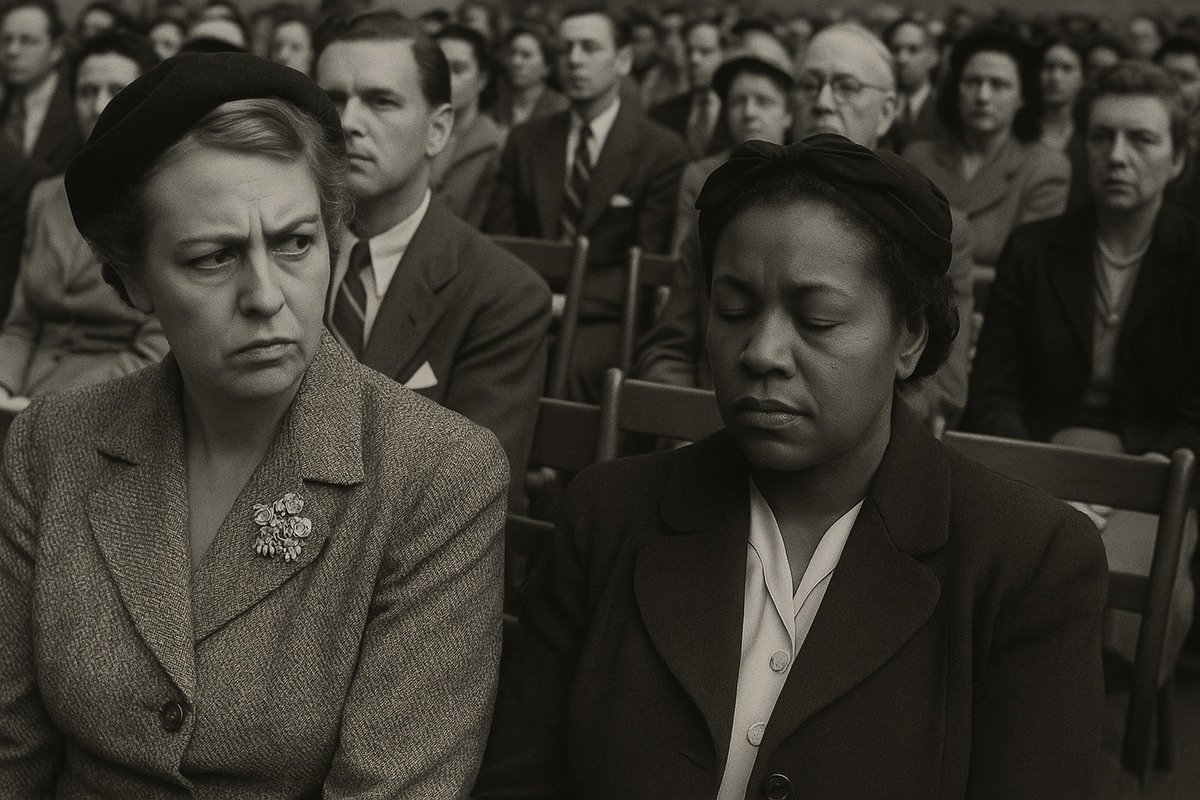
The May 1948 column opened with a stark confrontation: Roosevelt recounted meeting young women who told her, plainly, that they didn't "believe in equal rights for colored and white people." She used the moment not to lecture but to diagnose—calling out the quiet complicity that allowed discrimination to thrive in living rooms and voting booths alike. For a magazine that ran advertisements for Jell-O molds and dish soap, this was radical candor.
Palestine, the U.N., and the Question No One Could Answer
Readers also asked Roosevelt about the Palestinian question—specifically, whether Jewish and Arab factions could form peaceful governments under the U.N.'s partition plan. Her answer, published the same month Israel was founded, captured the uncertainty of the moment without offering false comfort. She didn't pretend the solution was easy. She reminded readers that international cooperation was the only path forward, even when that path looked impossibly narrow.
This wasn't abstract punditry. Roosevelt was writing from inside the machinery of global diplomacy, translating U.N. debates into language an Iowa schoolteacher or a Boston nurse could understand. She urged readers—especially women—to support the United Nations by teaching, fundraising, and spreading awareness. Peace, she insisted, wasn't something governments achieved alone. It was everyone's responsibility.
The column's visual presentation reinforced this accessibility. Reader questions were marked with stars. Cartoon illustrations lightened the tone—one showed a husband and wife sparring over a mother-in-law moving in, with the husband quipping: "I know why you're inviting your mother—to make me fight on two fronts." The humor made the serious content approachable, a bridge between global crisis and kitchen-table reality.
The Domestic Front Was Still a Battlefield
Roosevelt also answered the questions that kept women awake at night: How do you handle in-laws moving into a crowded postwar home? How do you bridge generational divides when the world has changed so fast?
These weren't trivial concerns. Millions of American families were navigating cramped quarters after years of war rationing and housing shortages. Young couples were living with parents, veterans were adjusting to civilian life, and everyone was trying to figure out what "normal" looked like now. Roosevelt treated these struggles with the same gravity she brought to geopolitics. She empathized with the real stress, offered reassurance that such tensions were manageable, and—crucially—never suggested that domestic challenges were less important than world affairs.
The message was clear: to be a good parent or neighbor was also to be a good citizen. The private and the public were inseparable.
The Themes That Defined a Moment
Confronting Prejudice
Roosevelt recalled young women saying they didn't "believe in equal rights for colored and white people." She used the moment to call out the danger of everyday bias.
The Palestine Question
Readers asked whether Jewish and Arab factions could form peaceful governments under the U.N.'s plan. Roosevelt's answer reflected the uncertainty of the times.
Supporting the United Nations
She urged readers to help by teaching, fundraising, and spreading awareness, underscoring that peace was everyone's responsibility.
Family Tensions
She addressed struggles with in-laws moving into small homes, empathizing with the real domestic stresses of postwar families.
Each of these responses combined into a larger message: the private and the public were deeply connected. To be a good parent or neighbor was also to be a good citizen.
The Personal Was Always Political
Much like Life magazine's wartime photo-essays, Roosevelt's Ladies' Home Journal columns endure because they are time capsules. They show us what mattered most in American homes at a moment of change, before the narratives were polished by historians or distorted by myth.
Today, when debates over racial equality, international conflict, and the role of women in public life continue, her words remain uncomfortably relevant. They remind us that the personal is political—and the political is personal. The woman arguing with her in-laws about space and the diplomat arguing at the U.N. about borders are both negotiating the same fundamental question: How do we live together?
Roosevelt believed young Americans needed to embrace democracy and equality if they were to become full citizens of a changing nation. She wrote that not from an ivory tower but from the pages of a magazine that also featured advertisements for refrigerators and face cream.
That contradiction—the radical and the domestic, side by side—is what makes this issue extraordinary.
Why This Issue Matters to Collectors
Historical Synchronicity
Published the same month Israel was founded, it captured the debates of that exact moment in real time, not in retrospect.
Civil Rights Documentation
Roosevelt's acknowledgment of racial prejudice, printed in a mass-market magazine, marks a turning point in how mainstream publications addressed inequality.
Eleanor Roosevelt's Unfiltered Voice
This was one of the few places where everyday readers could "converse" directly with the former First Lady, bypassing the filter of press conferences and official statements.
Cultural Cross-Section
The mix of recipes, fiction, fashion spreads, and world politics shows how women's magazines reflected—and shaped—the American zeitgeist.
Owning this issue isn't nostalgia. It's holding a piece of evidence from the trial of postwar America—a trial still ongoing.
Start Your Collection
If you're passionate about cultural history, women's voices, or postwar politics, the May 1948 issue of Ladies' Home Journal is essential. It represents a time when one of the most important women in the world sat down, month after month, to answer letters from ordinary readers—and treated those readers as co-authors of history.
Browse Ladies' Home Journal Magazine CollectionEvery issue captures a piece of American life—from fashion trends to world debates—exactly as they were first reported. These aren't reprints. They're the real thing: ink on paper, history you can hold.
Coda
The May 1948 issue of Ladies' Home Journal remains one of the most fascinating publications of its era because it refused to separate the trivial from the essential. Through Eleanor Roosevelt's If You Ask Me column, readers were guided through both the struggles of home life and the demands of global citizenship with equal seriousness.
Her words on racial prejudice, the United Nations, and postwar family tensions delivered clarity at a time of staggering uncertainty. Today, this issue is not only a collectible artifact but also a reminder of the enduring power of women's voices in shaping both households and history.
Holding this magazine is holding a moment when everyday Americans were asked to think bigger—to see that the fight for equality, peace, and understanding begins in the choices we make at home.