
When Zodiac Signs Ruled the Makeup Counter
Teen Magazine's Starry-Eyed Revolution of February 1970
In February 1970, teenage girls across America opened their mailboxes to find something extraordinary: a blueprint for becoming cosmic.
The issue of Teen Magazine that landed on suburban doorsteps that month wasn't just another beauty tutorial. Tucked inside its glossy pages was "Starry-Eyed Beauty," a twelve-part makeup manifesto that married astrology to eyeliner, transforming the makeup mirror into a portal for self-discovery. For a generation caught between the conformity of the 1950s and the chaos of Vietnam, these colorful spreads offered something radical: permission to see beauty as destiny written in the stars.
This wasn't superficial. It was survival.
The Cultural Earthquake of 1970
By the time Teen went to press, American adolescence had become a battlefield. The optimism of the early 1960s had shattered against the Vietnam War protests, the women's liberation movement, and a counterculture that promised freedom but delivered uncertainty. For teenagers navigating this landscape, astrology emerged as an anchor—a system of meaning in a world that seemed to have lost its script.
The numbers tell the story. Linda Goodman's Sun Signs, published in 1968, became a publishing phenomenon, selling millions of copies and legitimizing astrology as mainstream youth culture rather than occult fringe. Horoscope columns proliferated in newspapers and magazines. Zodiac symbols migrated from fortune teller parlors to jewelry counters, T-shirts, and now—thanks to Teen—the cosmetics aisle.
For teenage girls especially, this convergence mattered. Beauty and fashion weren't frivolous pursuits but laboratories of identity. Teen Magazine understood this instinctively, recognizing that the question "What's your sign?" had become as fundamental to teenage self-definition as "What's your favorite band?"
The "Starry-Eyed Beauty" feature crystallized this cultural moment with surgical precision.
The Architecture of Aspiration
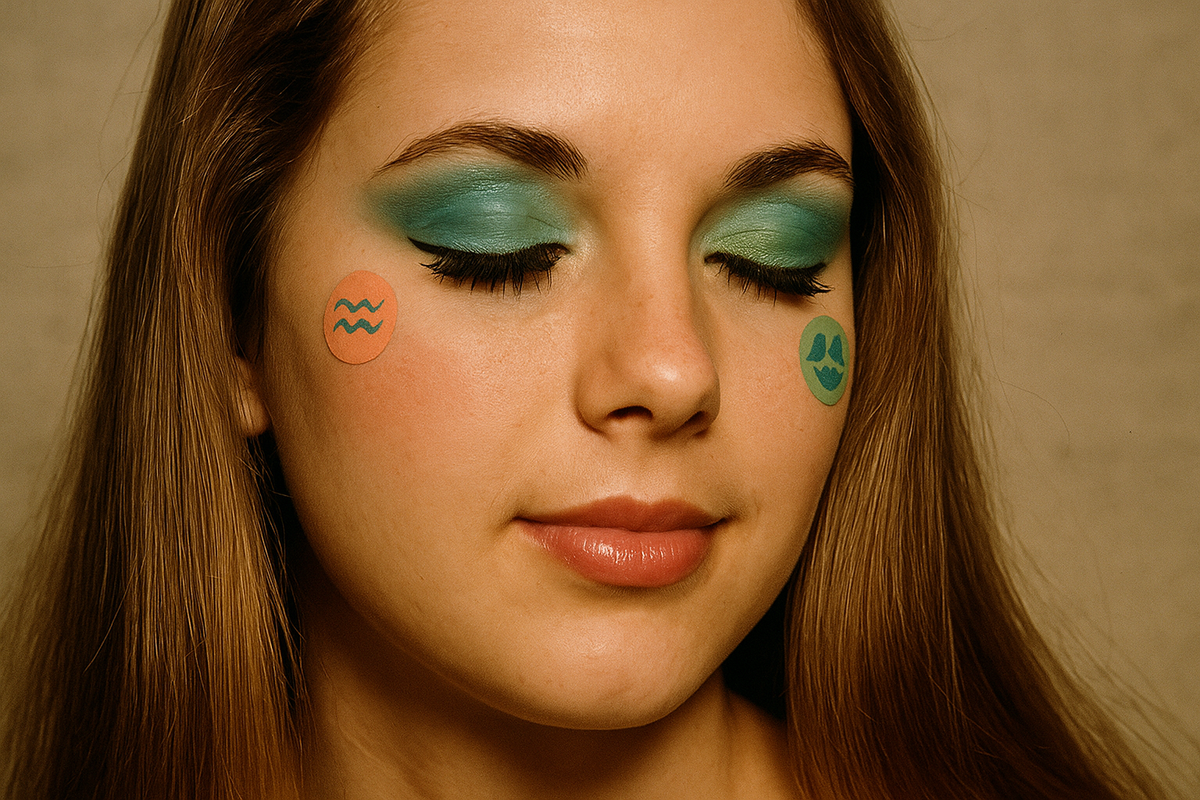
Open the February 1970 issue and the spread announces itself immediately. Twelve close-up photographs of models' eyes stare back at you, each styled according to its corresponding zodiac sign. The photography alone—sharp, intimate, unapologetically bold—elevated the feature beyond typical beauty advice into editorial art.
The visual design married pop-art zodiac illustrations with makeup photography in a layout that felt both modern and mystical. Bold, psychedelic colors typical of late-1960s graphic design framed each image. The effect was intoxicating: part beauty tutorial, part personality test, part invitation to transformation.
Feature Credits
Photographer: Bud Fraker (Hollywood photographer who captured Audrey Hepburn and Marilyn Monroe)
Makeup: Yardley of London
Design: Christina, Christine's Beautique, Los Angeles
Publication: Teen Magazine, February 1970
Behind the camera stood Bud Fraker, the Hollywood photographer who had captured Audrey Hepburn and Marilyn Monroe. His involvement wasn't accidental. This was Teen positioning zodiac makeup not as teenage experimentation but as legitimate glamour—beauty advice worthy of Hollywood's visual standards.
The makeup itself came from Yardley of London, the reigning champion of the teen cosmetics market. With its mod aesthetic and celebrity endorsements, Yardley lent the feature brand authority. Design credit went to Christina of Christine's Beautique in Los Angeles, anchoring the spread in California's emerging beauty culture.
This wasn't just content. This was infrastructure.
Twelve Ways to See Yourself
The genius of "Starry-Eyed Beauty" lay in its specificity. Each zodiac sign received tailored advice that fused personality with palette:
Capricorn earned earthy greens and golds—steady, grounded, reliable charm made visible. Aquarius got bright aqua blues and seafoam shades to match their reputation for originality. Pisces swam in soft greens and shimmering sea colors, their dreamlike nature reflected in iridescent finishes.
Aries blazed with watercolor blends of orange, gold, and green—fiery energy translated into bold gradient techniques. Taurus settled into gentle pinks and earthy greens, the magazine noting their practical yet romantic sensibility. Gemini sparkled in frosty blues and silvers, capturing their playful duality through metallic contrasts.
Cancer brooded in moody violets and silvery tones, emotional depth rendered in cool, reflective shades. Leo commanded attention with golds and bronze—glamour and sun-like warmth befitting their theatrical reputation. Virgo embodied "less is more" with cool greys and understated elegance.
Libra achieved balance through lilacs, silvers, and shimmering blues—harmony as aesthetic principle. Scorpio smoldered in dark smoky eyes and metallic greys, intensity and allure distilled into shadow placement. Sagittarius adventured in bold silvers and dramatic lash lines, optimism expressed through fearless application.
This wasn't makeup advice. This was personality codified in cosmetics—a system where looking in the mirror meant seeing your cosmic identity staring back.
Why Teen Magazine Mattered
Teen Magazine didn't just report on adolescent culture. It shaped it.
Founded as a voice for American teenagers, the magazine built its authority through intimate understanding. It published readers' questions, showcased their style in reader contests, and treated teenage concerns with the seriousness mainstream media often denied them. Fashion spreads, advice columns, celebrity profiles, and music reviews combined into a package that made readers feel seen.
By the late 1960s, Teen had mastered the art of cultural timing. It recognized when astrology shifted from novelty to necessity, when zodiac symbols became identity markers rather than party tricks. The magazine tapped into food trends, party culture, and social movements as they emerged, ensuring it felt essential rather than reactive.
"Starry-Eyed Beauty" epitomized this editorial instinct. It captured teenagers at the precise moment they needed beauty advice that doubled as existential guidance—when makeup became a language for expressing the parts of yourself you were only beginning to understand.
The Enduring Appeal
Vintage teen magazines persist in collecting circles because they document something essential: how young people negotiated identity in real time. They reveal marketing strategies, gender expectations, and generational aspirations with an honesty that retrospective histories often miss.
For contemporary readers, they offer a window into the optimism and experimentation that characterized the late 1960s and early 1970s—a period when teenagers believed self-expression could be revolutionary. They show us how youth culture shaped and was shaped by commercial forces, how beauty advice carried ideological weight, how something as simple as eyeshadow could become a statement.
In an era where astrology has surged again among Gen Z—where Co-Star notifications and birth chart analysis dominate social media—Teen's zodiac makeup advice feels less like a relic and more like a prophecy that's come full circle.
The "Starry-Eyed Beauty" feature reminds us that teenage girls in 1970 weren't just following trends. They were building a visual language for becoming themselves—one constellation at a time.
The Collector's Perspective
Cultural Documentation
This issue captures the exact convergence of astrology's mainstream peak with beauty culture, making it essential source material for historians studying 1970s youth movements and gender expression.
Visual Archive
The spread represents quintessential early-1970s graphic design—pop-art illustrations, psychedelic color palettes, and mod photography that makes it desirable beyond its editorial content.
Brand History
Featuring Yardley of London at the height of its cultural influence ties this issue to one of the defining cosmetics brands of the youth market. For collectors of beauty industry history, this documentation is invaluable.
Photographic Provenance
Bud Fraker's involvement adds a layer of Hollywood photography history. His work is celebrated independently, making any publication featuring his images significant to photography archives.
Material Rarity
Teen magazines were disposable by design—read, shared, discarded. Survival rates for issues in good condition are low, which elevates their value for collectors of ephemera and popular culture.
Time Capsule Value
Owning this issue means possessing a moment where zodiac signs and eye makeup merged to define teenage self-expression at a pivotal cultural moment.
Find Your Piece of History
Whether you're searching for cultural documentation, design inspiration, or a window into 1970s beauty culture, the February 1970 issue of Teen Magazine represents a singular moment in American publishing. From the 1950s through the 1980s, every issue of Teen captures youth history with unprecedented intimacy—making these magazines essential artifacts for collectors, cultural historians, and anyone interested in how American teenagers defined themselves across three transformative decades.
Browse Teen Magazine Collection