
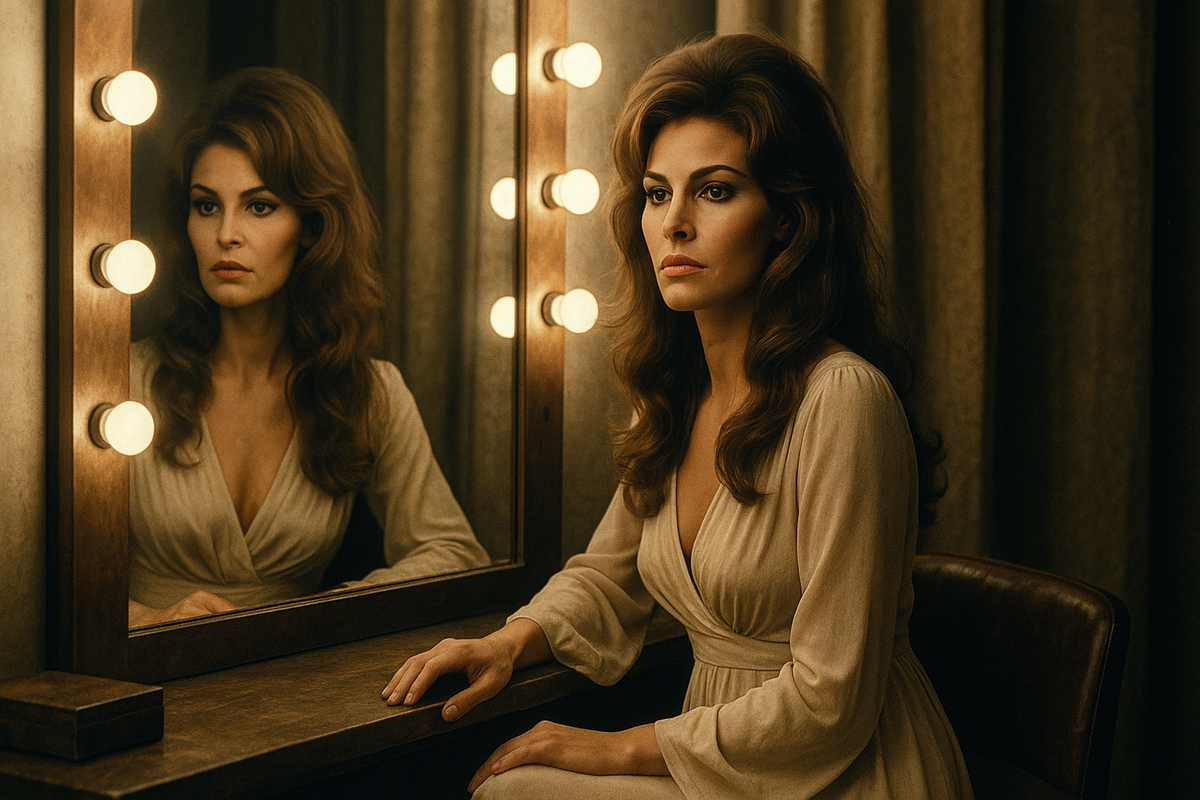
The Sex Symbol Who Refused to Play Along
Raquel Welch's 1970 Playboy confession and the contradictions of Hollywood stardom
January 1970. America stood at a crossroads it didn't yet understand. The previous decade had burned itself out in riots, assassinations, and a war nobody could explain. Now, as the calendar turned, millions of men opened their mailboxes to find the Holiday Anniversary issue of Playboy—and on the pages inside, Hollywood's reigning sex goddess was about to break character.
Raquel Welch wasn't supposed to complain. She was the woman in the fur bikini, the fantasy sold in millions of posters, the body that launched a thousand adolescent dreams. But in that January interview, she did something unexpected: she spoke like a human being trapped inside an icon.
What emerged was more than celebrity gossip. It was a document of collision—between the sexual revolution's promises and its casualties, between Hollywood's worship of female beauty and its contempt for female intelligence, between the image America wanted and the woman who had to live inside it.
Archive Details
Historical Figure: Raquel Welch
Issue Date: January 1970 (Holiday Anniversary Issue)
Archive Source: Playboy Magazine
Cultural Context: Sexual Revolution, Second-Wave Feminism, Hollywood Star System
The Moment Playboy Caught on Film
By 1970, Playboy had perfected a dangerous alchemy. Hugh Hefner's magazine wasn't just selling centerfolds—it was selling the idea that a man could be sophisticated and carnal, intellectual and libidinous, all at once. The magazine's interviews with Malcolm X, Miles Davis, and Fidel Castro gave it cultural credibility that Penthouse and Hustler could never match. When you read Playboy, you weren't just looking at naked women. You were participating in the national conversation.
The Raquel Welch interview fit this mission perfectly. Here was the decade's most photographed actress, famous for saying almost nothing in public, suddenly willing to speak at length. Playboy's editors knew what they had: not just another starlet promoting a film, but a woman who had grown exhausted with her own image.
The setup was pure Playboy theater. The January 1970 cover featured a cartoonish white bunny puppet in a plaid jacket, leaning against a table with framed images of nude and semi-nude women hanging behind it—a cheeky wink at the magazine's own reputation as high-class smut. Inside, Welch appeared in stark black-and-white portraits: beautiful, yes, but the photography emphasized her face, her eyes, her expression. This wasn't the fur bikini. This was the woman who had opinions about the fur bikini.
What She Actually Said
Welch had become famous almost by accident. Fantastic Voyage (1966) cast her as a miniaturized scientist injected into a human body—she wore a wetsuit for most of the film. One Million Years B.C. (1966) made her a global sensation despite having maybe three lines of dialogue. The image consumed everything: Raquel Welch as prehistoric bombshell, as the body that needed no voice.
By 1970, she was done pretending this was enough.
On the prison of beauty
Welch described the exhaustion of being treated as a "walking body" rather than an actress. She wasn't naive about her looks—she understood they had opened doors—but those same doors kept slamming shut once producers got what they wanted from her.
On fame as loneliness
Perhaps the interview's most striking revelation was Welch's description of objectification as isolation. When millions of men fantasize about you, genuine human connection becomes nearly impossible. The pedestal, she suggested, was just another word for solitary confinement.
On the sexual revolution's broken promises
America in 1970 congratulated itself for loosening up, for embracing "free love" and permissiveness. But Welch questioned whether the revolution had actually liberated women or simply repackaged their exploitation.
On Hollywood's shallow mathematics
Welch didn't mince words about the industry's treatment of actresses. Looks equaled opportunity, but also erasure. A beautiful woman could become famous, but rarely respected. The studios wanted bodies, not people.
What made the interview powerful wasn't anger—it was clarity. Welch spoke with the precision of someone who had spent years thinking about her own commodification and finally found an audience willing to listen.
Why This Magazine Still Matters
The January 1970 Playboy occupies a specific moment in cultural history that's impossible to replicate. It arrived as the 1960s—that decade of supposed liberation—curdled into something more complicated. The Vietnam War raged on. The civil rights movement had fractured. Feminism's second wave was gaining strength, asking harder questions about what "freedom" actually meant for women.
Welch's interview captures this tension perfectly. She was the sexual revolution's poster child, literally, and she was calling bullshit on the revolution itself. Not because she opposed sexual freedom—but because she understood that freedom without dignity was just a different kind of cage.
Collector Significance
Historical Significance
A primary source document of the sexual revolution, told not by academics but by one of its central figures. Welch's testimony carries the weight of lived experience.
Celebrity at the Breaking Point
Few interviews capture the moment when a star stops performing and starts confessing. Welch's candidness was unusual for 1970, when actresses typically stuck to studio-approved talking points.
Playboy at Its Peak
This issue showcases the magazine at the height of its cultural influence, when it could still claim to be more than a skin magazine—when it was a legitimate forum for uncomfortable truths.
Visual and Editorial Craft
The anniversary styling, the black-and-white portraiture, the interview's length and depth—everything about this issue demonstrates Playboy's production values before the 1980s rushed toward explicitness and away from context.
The Archive Worth Holding
Vintage Playboy magazines occupy a strange position in cultural memory. To some, they're relics of sexism that should be forgotten. To others, they're artifacts of a more sophisticated era, when eroticism and intellectualism weren't considered mutually exclusive.
The truth, as usual, resists simplification. These magazines documented their moment with a precision that few other publications attempted. Yes, they objectified women—but they also gave women like Raquel Welch space to articulate what that objectification felt like from the inside. The contradiction is the point.
The January 1970 issue remains a collector's priority not despite its complications but because of them. It shows us an America arguing with itself about sex, celebrity, and gender—and refusing to reach easy conclusions.
Explore the Archive
Whether you collect for investment, research, or the simple pleasure of holding history in your hands, these magazines serve a purpose beyond nostalgia. They are evidence of how Americans once thought, desired, and questioned themselves.
Browse Playboy Magazine CollectionThe Woman Who Wouldn't Disappear
More than fifty years later, the Raquel Welch interview endures because it refuses the easy narrative. She didn't reject her sexuality or apologize for her beauty. She simply insisted on being more than the sum of her measurements.
In 1970, that counted as revolution.
The magazine's genius was recognizing this and giving her the room to say it. Playboy built its empire on fantasy, but occasionally—in interviews like this one—it made space for reality to crash the party.
For anyone who studies celebrity culture, gender politics, or the gap between image and identity, this issue remains essential. Not as a relic, but as a mirror. The questions Welch asked—about beauty as burden, fame as isolation, liberation as commodification—haven't gone away. We've just found new vocabularies to ask them.
The January 1970 Playboy Magazine with Raquel Welch sits on collectors' shelves not because it's scandalous, but because it's honest. And in the world of Hollywood mythology, honesty has always been the rarest commodity of all.