
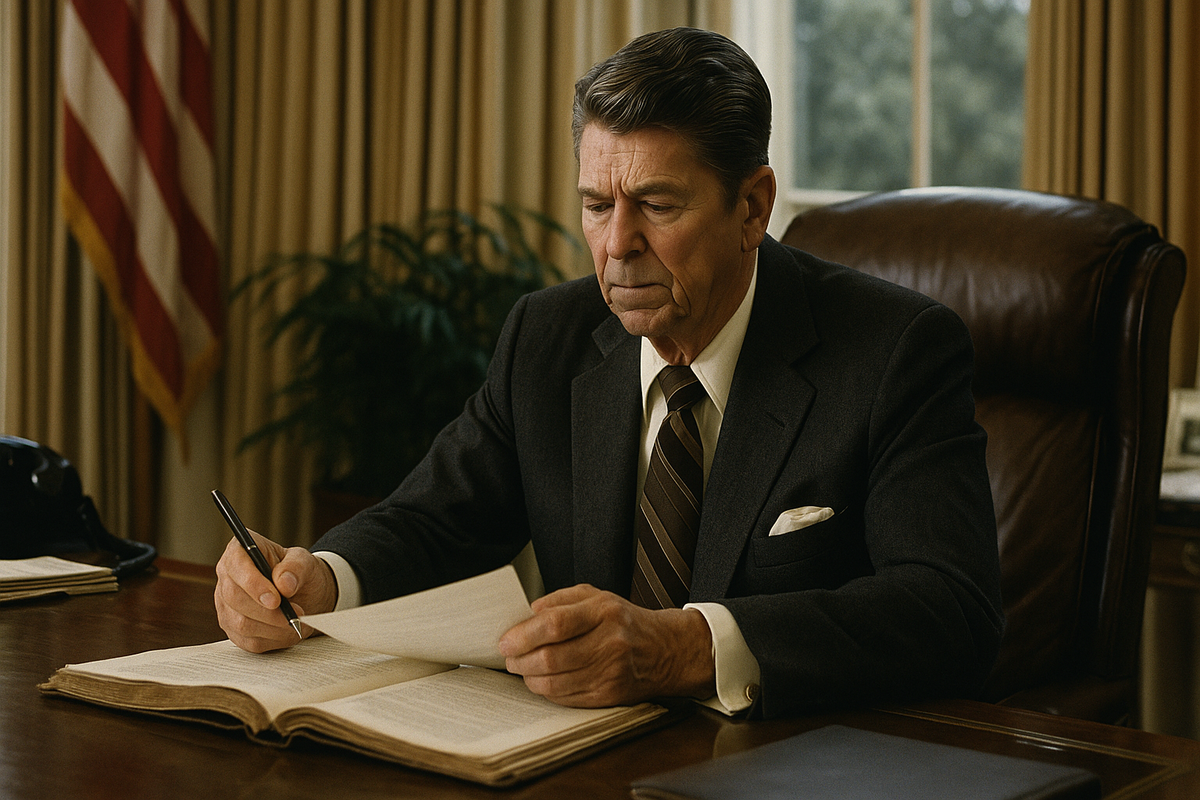
The March 2, 1981 Time Magazine: When Reagan Declared War on Big Government
Inside the cover story that captured the birth of the Reagan Revolution and transformed American conservatism
The photograph on the cover was deceptively simple: Ronald Reagan at his desk in the Oval Office, reviewing his speech with reading glasses perched on his nose. No patriotic bunting. No triumphant gestures. Just a newly inaugurated president, alone with the most radical economic agenda proposed by an American leader in half a century.
For the millions who bought the March 2, 1981 issue of Time Magazine, this wasn't just another political profile. It was a blueprint for revolution.
Archive Details
Historical Figure: Ronald Reagan, 40th President of the United States
Issue Date: March 2, 1981
Cover Story: "Challenge to Change"
Archive Source: Time Magazine
Historical Context: Reagan's first major policy address, 6 weeks into his presidency
America on the Brink
The country Reagan inherited was broken in ways that defied easy diagnosis. Stagflation—that economic chimera economists had insisted was impossible—was ravaging the middle class with double-digit inflation and unemployment climbing toward 8%. The energy crises of the 1970s had turned gas stations into battlegrounds and left Americans bitterly cynical about their government's competence. And looming over everything was the Soviet Union, a nuclear-armed rival that seemed ascendant while America stagnated.
Reagan's victory in November 1980 wasn't just a political realignment. It was a verdict: the postwar consensus had failed.
Time's "Challenge to Change" cover story captured the precariousness of that moment. The magazine understood it was documenting not merely a new administration, but a philosophical rupture with nearly fifty years of American governance. Reagan intended to dismantle the architecture of the New Deal and Great Society—programs that had defined the Democratic Party's identity and shaped the relationship between Washington and ordinary citizens since the Depression.
To his supporters, this was liberation. To his critics, it was sabotage.
"Government Is Not the Solution—Government Is the Problem"
Reagan's State of the Union–style address, delivered just weeks into his presidency, landed like a manifesto. Time dissected it with the forensic precision that made the magazine essential reading in an era before cable news saturation.
The policy centerpiece was audacious: a 30% reduction in individual income taxes over three years. Reagan's economic team argued this would trigger a surge of private investment, unleashing entrepreneurial energy that had been suffocated by high tax rates. Supply-side economics—derided by George H.W. Bush during the primaries as "voodoo economics"—was now the official doctrine of the United States government.
But tax cuts were only half the equation. Time documented Reagan's proposed budget with side-by-side comparisons that made the scale of his ambition unmistakable. Where Jimmy Carter's final budget had maintained decades of domestic spending patterns, Reagan proposed slashing social programs while simultaneously increasing defense expenditures. The magazine's infographics transformed abstract billions into visual shock: entire categories of federal assistance were being zeroed out or gutted.
Congress gave Reagan standing ovations. Even skeptics recognized they were witnessing something rare in American politics—a president who actually meant to do what he'd promised on the campaign trail.
Tax Revolution
Reagan's proposal for a 30% reduction in individual income taxes over three years promised to unleash private investment and fundamentally reshape the American economy.
Budget Discipline
Massive cuts to domestic spending paired with increases in defense spending represented a complete reversal of Carter-era fiscal policy.
The End of Big Government
Reagan's philosophical attack on federal power challenged the New Deal and Great Society consensus that had dominated for half a century.
Cold War Escalation
Increased military spending signaled a more aggressive stance toward the Soviet Union and a rejection of détente.
Time's Editorial Mastery
What distinguished Time's coverage was its refusal to resort to simple hero worship or reflexive opposition. The magazine's editors understood their role: provide the depth television couldn't, the analysis newspapers didn't have space for, and the visual storytelling that would help readers grasp the magnitude of what Reagan was proposing.
The Oval Office cover image worked because of what it didn't show. No flags, no stagecraft, no Reagan the Hollywood performer. Instead: Reagan the executive, doing the lonely work of governance. It was a deliberate counter to the campaign imagery that had saturated 1980, a signal that Time would cover this presidency seriously.
Inside, the magazine deployed its signature combination of sharp prose and data visualization. The Carter-versus-Reagan budget charts weren't just informative—they were arguments rendered in graphic form, making Reagan's break with the past impossible to miss. Readers could see, in columns of numbers and shifting bars, exactly how radical the proposed changes were.
The editorial voice struck a balance between admiration for Reagan's boldness and honest skepticism about whether such sweeping changes could work. Time wasn't endorsing Reaganomics. It was documenting a gamble—one that would either rescue America from malaise or deepen the inequalities that were already fracturing the social contract.
The Echo Chamber of History
Reagan's declaration that "Government is not the solution to our problem; government is the problem" didn't end when he left office in 1989. It became conservative orthodoxy, repeated in countless congressional speeches, campaign ads, and think tank position papers. The debates that Time documented in March 1981—about the proper size and role of government, about whether tax cuts pay for themselves, about the trade-offs between social spending and military strength—are still the debates consuming Washington today.
What makes this issue so valuable, both as a collector's item and as historical documentation, is its immediacy. History books can tell you what Reagan did. This magazine shows you what he promised, before anyone knew if it would work. It captures the uncertainty, the hope, the fear, and the sense that America was about to change in ways no one could fully predict.
Why This Issue Matters to Collectors
Historical Milestone
The first major newsweekly profile of Reagan's economic vision, published when the outcome was still uncertain and the stakes couldn't have been higher.
Economic Turning Point
The policies outlined in these pages became the template for conservative governance for the next generation—the birth of Reaganomics.
Cultural Time Capsule
A window into an America where weekly print magazines shaped national discourse and the political conversation moved at a different pace.
Condition & Rarity
Copies with intact covers, clean pages, and no musty library smell command premium prices among serious collectors of political ephemera.
Four decades later, the March 2, 1981 issue has become something more than vintage journalism. It's a historical artifact that captures the exact moment when American conservatism moved from the margins to the mainstream. These were magazines people read, argued over, passed around offices and dinner tables. The wear is part of the story.
Acquiring a Piece of the Reagan Revolution
For historians and collectors serious about understanding the 1980s, the March 2, 1981 Time Magazine isn't optional—it's foundational. This single issue contains more insight into Reagan's opening strategy than dozens of retrospective analyses written years later. It shows you not just the policies, but the pitch: how Reagan and his team sold the American people on a vision that upended half a century of political consensus.
The issue is part of a broader archive of 20th century journalism that documents America's political, cultural, and social evolution through the magazines that shaped public opinion. From the Great Depression through the Cold War, from civil rights to Watergate to Reagan's conservative restoration, these newsweeklies were the primary lens through which millions of Americans understood their country.
A Magazine That Defined an Era
The March 2, 1981 Time Magazine endures because it captured a turning point with clarity and intelligence. Reagan's first great challenge—to cut taxes, shrink government, and restore American confidence—was audacious enough to merit the magazine's full attention. Time delivered, producing a cover story that helped millions of readers understand what was at stake.
Holding this issue today means holding a fragment of 1981, when the future was unwritten and Reagan's revolution was just beginning. It's a reminder that the political debates we think of as timeless actually have origin points—moments when someone stood up and said "everything is going to change now," and the country had to decide whether to believe them.
For collectors, it's more than ink and paper. It's a primary source, a conversation starter, a window into the day when Ronald Reagan looked into the camera and told America that government had grown too large, too expensive, and too intrusive—and that he intended to do something about it.
The nation is still arguing about whether he was right.
Explore the Archive
Discover thousands of original Time magazines from the 1920s through the 2000s, preserving America's political, cultural, and social history.
Browse Time Magazine Collection