
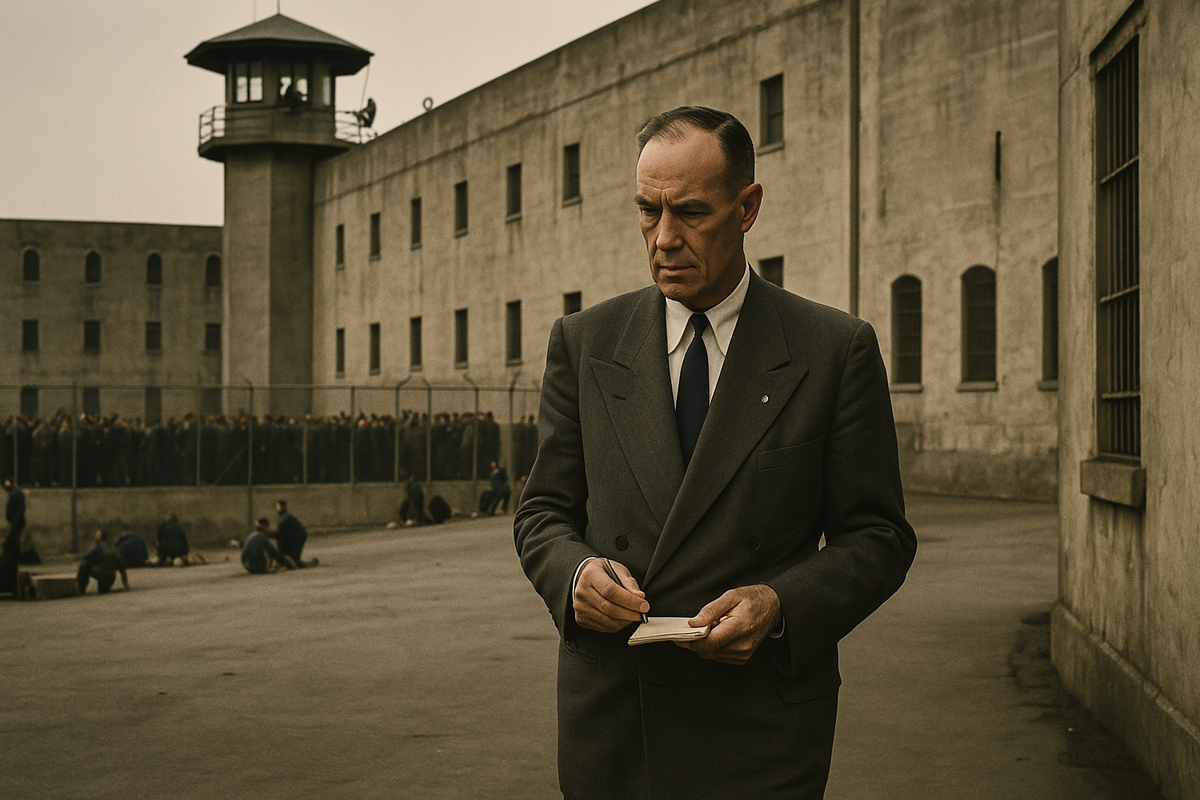
The Chocolate Factory and the Gas Chamber
Inside the March 25, 1950 Saturday Evening Post—Where Warden Clinton Duffy's San Quentin Testimony Forced America to Confront Its Conscience
On March 25, 1950, millions of Americans reached into their mailboxes and pulled out the latest issue of The Saturday Evening Post. On the cover: Stevan Dohanos's warmly lit painting of Pennsylvania women hand-crafting Easter bunnies in a chocolate factory—pastel confections for the season, wholesome as Sunday dinner.
Turn the page, and you were inside San Quentin State Prison, staring at the gas chamber where Warden Clinton T. Duffy had just executed his 82nd prisoner.
This wasn't editorial whiplash. It was The Saturday Evening Post at the height of its cultural power—delivering the full contradictions of American life into six million living rooms without apology. Chocolate bunnies and cyanide pellets. Spring renewal and state-sanctioned death. The magazine understood what many publications have forgotten: a nation's conscience isn't revealed in its certainties, but in its conflicts.
The Warden Who Wouldn't Look Away
Clinton T. Duffy didn't fit the mold of a 1950s prison warden. He took office at San Quentin in 1940 with a radical premise: that a man sentenced to prison was still, in fact, a man. In a decade that would see Joseph McCarthy's witch hunts and the hardening of Cold War absolutes, Duffy insisted on something unfashionable—nuance.
His article, "San Quentin Is My Home" (as told to Dean Jennings), pulls no punches. Duffy had overseen 82 executions, including two women. Armed convicts had twice attempted to kidnap him. He walked the yard alone each day while thousands of inmates watched, jotting notes on a pad that could've been a grocery list or a death sentence. Larry Keighley's photographs—still shocking today—showed the arsenal tower bristling with machine guns, the rock pile where men spent years pulverizing stone, and the gas chamber itself, gleaming and clinical as an operating theater.
Yet Duffy's voice in the piece carries no swagger, no tough-guy posturing. He describes executions as "the most terrible duty" of his office. He acknowledges the human wreckage around him—men who longed for dignity, families who visited with desperate hope, a system designed more for warehousing than redemption.
This was progressive talk in 1950, when "law and order" meant exactly that: law, then order, with little room for rehabilitation between them.
Archive Details
Historical Figure: Warden Clinton T. Duffy (San Quentin State Prison, 1940-1952)
Issue Date: March 25, 1950
Article Title: "San Quentin Is My Home" (as told to Dean Jennings)
Photography: Larry Keighley
Cover Artist: Stevan Dohanos
Archive Source: Original Saturday Evening Post Collection
Why This Magazine Mattered
By 1950, The Saturday Evening Post had been the country's town square for nearly a century. It didn't just cover American life—it framed it. The magazine blended Norman Rockwell sentiment with hard investigative reporting, serialized fiction alongside policy debates, humor columns next to war correspondence. If you wanted to understand what middle America was thinking, you read the Post.
The March 25 issue demonstrates this editorial genius perfectly. Readers encountered:
The Cover: Dohanos's chocolate factory scene—warm lighting, women in aprons, Easter bunnies on conveyor belts. Pure Americana, the kind of image that reassured a nation still finding its footing after the war.
The Juxtaposition: Flip inside and Keighley's stark black-and-white photographs shatter the pastoral mood. San Quentin's fortress walls rising from the Bay. The gas chamber's porthole windows. Prisoners breaking rocks under guard. The arsenal tower, its machine guns trained on the yard.
The Editorial Architecture: The Post never asked readers to choose between comfort and confrontation. It delivered both, trusting its audience to hold contradictions in mind. This wasn't cynicism—it was editorial sophistication.
The magazine also included short stories, serialized fiction, editorials, and verse in this same issue, creating a portrait of American consciousness that no single-focus publication could match. You finished the Duffy piece, turned the page, and found yourself reading humor or romance or adventure. The effect was cumulative: this is all part of the same America.
Inside San Quentin: What Readers Saw
Duffy and Keighley delivered details that no press release could sanitize:
These weren't abstract policy debates. They were testimonies from the frontlines of American justice, delivered in plain language that readers across the country could grasp.
The Conversation Across Time
What makes this issue endure isn't just its historical value—it's its living relevance. In 1950, Americans debated whether prisons should punish or rehabilitate, whether executions served justice or satisfied vengeance, whether society bore responsibility for redemption.
Those debates never ended. They intensified.
Reading Duffy's words today feels less like archaeology and more like overhearing an argument that's been running in the American family for generations. The gas chamber has given way to lethal injection in most states, but the moral questions remain identical. Should prisons reform or warehouse? What do we owe the convicted? When does punishment become cruelty?
The Saturday Evening Post didn't answer these questions in 1950, and we haven't answered them now. But the magazine did something more valuable: it refused to look away. It placed the chocolate factory and the gas chamber side by side and said, This is us. All of it.
Why Collectors Covet This Issue
Explore the Archive
We maintain an extensive collection of original Saturday Evening Post issues spanning decades of American history—from the Great Depression and World War II through the postwar boom and Civil Rights era. Each issue preserves not just stories, but the cultural atmosphere of its moment.
Browse The Saturday Evening Post Magazine CollectionThese aren't reprints or digital facsimiles. They're the actual magazines that Americans held in 1950, their pages carrying the texture of mid-century paper stock, their advertisements revealing what the culture valued, their editorial choices showing what the nation was willing to confront.
Final Word
The March 25, 1950 issue of The Saturday Evening Post stands as one of the most consequential publications of its era. With Warden Clinton Duffy's "San Quentin Is My Home," it forced millions of Americans to peer inside a place they'd never see—and to reckon with what they found there.
It wasn't comfortable reading. It wasn't meant to be.
To hold this issue today is to hold a document of American honesty at a time when popular media still trusted its audience with complexity. The chocolate bunnies are still on the cover. The gas chamber is still inside. Neither negates the other.
That's the contradiction we inherited. That's the conversation that continues.
1 comment
R. G. Olson
San Quentin as told by Clinton Duffy is of great interest to me as I am in the process of writing a book about my uncle who was a guard at Alcatraz from 1946 to 1948 and then became a guard at San Quentin for several years. Later in life, my uncle wrote a 99 page detailed manuscript about his experiences as a prison guard. The way his story was told vs the Duffy version is mind boggling. My impression is the guard wrote about how San Quentin really was while the Warden wrote how he would like San Quentin and other prisons to be.
I realize there are all kinds of requirements to be a Warden; however, he was still a government appointee and wrote accordingly on top of his personal feelings on how a prison should be run and he had a large following in his thoughts and he had significant influence on changes in prison systems.