
Red and Yellow, 17,189 Votes, and the Unstoppable Rise of Hulk Hogan
How Pro Wrestling Illustrated's March 1986 Achievement Awards Captured the Moment Hulkamania Became Measurable History
In March 1986, wrestling fans opened their mailboxes to find something extraordinary: proof that Hulkamania wasn't hype—it was measurable, quantifiable dominance.
Pro Wrestling Illustrated had just released its annual Achievement Awards, and for the third consecutive year, Hulk Hogan claimed the Most Popular Wrestler crown with a staggering 17,189 votes. Not 17,000. Not "approximately 17,200." Exactly 17,189 fans—each one filling out a ballot, licking a stamp, and mailing their choice to PWI's offices—had spoken. In an era before internet polls and social media metrics, this was the sound of a cultural earthquake.
The number itself tells only part of the story. What made this issue essential reading wasn't just Hogan's victory—it was what the magazine captured around it: the fault lines of a sport in transformation, the voices of fans who saw the change coming, and the documentation of a moment when regional wrestling gave way to something unprecedented.
Archive Details
Historical Figure: Hulk Hogan (Terry Gene Bollea)
Issue Date: March 1986
Archive Source: Pro Wrestling Illustrated Achievement Awards
Award Year: 1985 (Third Consecutive Win)
1985: The Year Wrestling Stopped Being Wrestling
The calendar year 1985 rewrote the rules. WrestleMania I brought Muhammad Ali, Cyndi Lauper, and Mr. T into the same building as Roddy Piper and Paul Orndorff. Vince McMahon's WWF abandoned the gentleman's agreement of territorial boundaries and went national, steamrolling local promotions with cable deals and syndication packages. Wrestling moved from armories to arenas, from regional curiosity to pop culture juggernaut.
Pro Wrestling Illustrated occupied unique territory in this upheaval. Unlike WWF Magazine, which functioned as corporate propaganda for a single promotion, PWI maintained editorial independence. Its pages covered Ric Flair's NWA title defenses with the same rigor as the Von Erich dynasty in Texas. When PWI named Hogan Most Popular Wrestler of 1985, it wasn't WWF PR—it was journalism acknowledging a performer who had transcended the business itself.
But the vote totals revealed the complexity beneath Hogan's dominance. Magnum T.A. pulled 12,102 votes. Kerry Von Erich earned 11,347. Tito Santana captured 8,515. Even in Hogan's moment of supremacy, the runners-up proved that regional loyalty still mattered. Wrestling wasn't yet monolithic. It was fractured, competitive, and about to be consolidated by the figure standing on top.
The Magazine as Historical Document
What separated this PWI issue from standard celebrity puffery was its editorial sophistication—the way it documented Hogan while simultaneously interrogating his appeal.
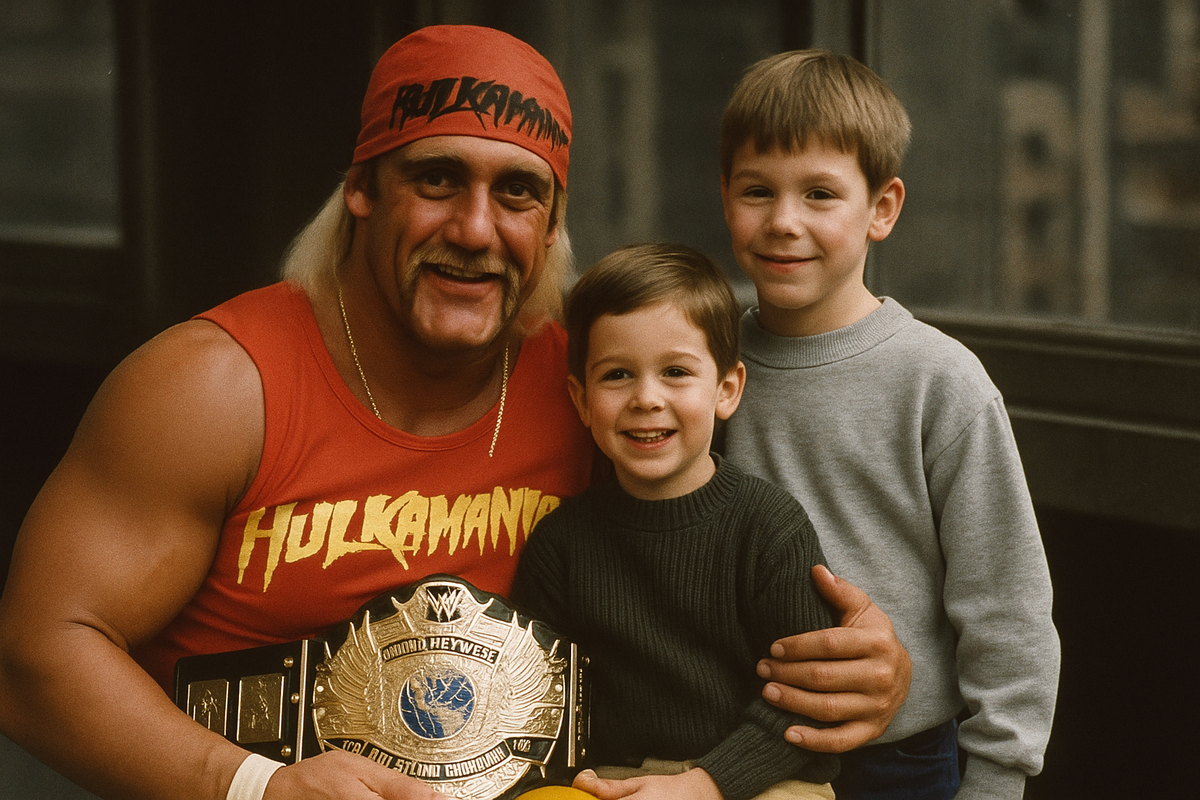
The centerpiece photograph said everything: Hogan in his red Hulkamania shirt and yellow trunks, WWF Championship belt cinched at his waist, flexing for a camera that had become his natural habitat. Beside it, a second image: Hogan with two grinning children on his lap, captioned with calculated sincerity: "Hulk Hogan always sets aside time for the people responsible for his popularity."
The subtext was brilliant. In one spread, PWI established Hogan as both conquering champion and approachable hero—the duality that made him marketable to networks, toy companies, and morning talk shows.
The magazine didn't stop at hagiography. It included a letter from a New York fan that cut through the mythology: "A lot of wrestling fans may not like Hogan, and personally I have reservations about the kind of wrestling skills he displays. However, the category is based on popularity, and even people who don't like Hogan have to admit that he has a great deal of it."
That single quote validated the entire feature. PWI wasn't asking readers to love Hogan—it was asking them to recognize what was happening in real time. The magazine understood that Hogan's significance wasn't technical mastery; it was cultural penetration. Sports Illustrated covers. The Tonight Show with Johnny Carson. Saturday Night Live. Saturday Night's Main Event. Hogan wasn't just winning matches—he was colonizing mainstream media.
The Architecture of a Landslide
The full vote breakdown painted a portrait of wrestling fandom in 1985:
Hulk Hogan – 17,189 votes
Magnum T.A. – 12,102 votes
Kerry Von Erich – 11,347 votes
Tito Santana – 8,515 votes
Others – 10,913 votes (including Rick Steamboat, Dusty Rhodes, Hacksaw Duggan, Rick Martel, Terry Taylor)
Magnum T.A.'s second-place finish carries tragic weight in retrospect—his career would be cut short by a car accident in October 1986, erasing one of the NWA's brightest futures. Kerry Von Erich's ranking reflected the enduring power of World Class Championship Wrestling, a regional empire that briefly rivaled the WWF's reach in the early '80s. Tito Santana's votes honored a workhorse—technically sound, consistently excellent, and utterly overshadowed by Hogan's spectacle.
The "Others" category is equally revealing. Nearly 11,000 votes scattered across names like Dusty Rhodes and Rick Steamboat proved that wrestling fandom in 1985 remained diverse, passionate, and divided by geography and taste. WWF was winning, but it hadn't won yet.
PWI also contextualized Hogan within wrestling's lineage, listing past winners: Dusty Rhodes, Tommy Rich, Mil Mascaras. The implicit argument was clear—Hogan wasn't an aberration. He was the latest incarnation of wrestling's archetypal people's champion, scaled up for a television age.
Deep Dive: What This Issue Reveals
Hogan's 17,189 votes marked the highest of any category, making his victory decisive and demonstrating unprecedented fan engagement through physical mail-in ballots.
Hogan's television appearances and magazine covers pushed wrestling into pop culture like never before, bridging sports entertainment with network television.
Hogan with children emphasized his image as a family-friendly hero, crucial for WWF's expansion into toy markets and Saturday morning programming.
By including both fan adoration and skepticism, PWI gave the award credibility beyond promotional material, functioning as legitimate journalism.
The presence of Magnum T.A., Kerry Von Erich, and Tito Santana in top rankings reflected wrestling's still-competitive territorial environment.
Rick Steamboat and Dusty Rhodes among the vote-getters showed that fan loyalty extended beyond WWF's national programming push.
Why This Issue Matters to Collectors
This issue captures Hogan at the apex of his cultural influence, when his name recognition rivaled any athlete in America.
PWI's annual awards issues are among the most collectible in wrestling publishing, functioning as fan-driven historical records rather than promotional material.
The vote totals document WWF, NWA, and World Class stars in a single frame—a snapshot of wrestling's last multi-territorial moment.
The images of Hogan with his championship belt and young fans crystallize the "Rock 'n' Wrestling" era's visual language.
This issue memorializes the year of WrestleMania I and WWF's national expansion—the inflection point between old wrestling and modern sports entertainment.
Well-preserved copies with bright covers, intact spines, and unfaded photographs command premium prices due to decades of handling.
Where to Find Authentic PWI Archives
If you're serious about wrestling history, the March 1986 Pro Wrestling Illustrated belongs in your collection. It captures Hulk Hogan's statistical dominance while preserving the voices of fans who witnessed—and debated—his ascent in real time.
Browse PWI Magazine CollectionFrom the territorial stars of the 1970s through the national expansion of the 1980s and beyond, PWI chronicled wrestling with journalistic rigor that company publications couldn't match. These aren't reprints or digital scans—they're original issues, preserved artifacts of fan culture and independent sports journalism.
The Verdict
The March 1986 PWI Achievement Awards issue naming Hulk Hogan the Most Popular Wrestler of 1985 remains essential reading for anyone studying 1980s pop culture, wrestling's mainstream breakthrough, or the mechanics of celebrity in the pre-internet age.
Seventeen thousand, one hundred and eighty-nine votes. Each one a fan who believed enough to participate. Each one a data point in wrestling's transformation from regional sport to national spectacle.
Holding this issue today means holding evidence—not of Hogan's greatness as a wrestler, but of his undeniable power as a cultural force. It's not just collectible. It's historical testimony.