
When Stalin's War Plans Landed on America's Coffee Tables
The Saturday Evening Post, July 2, 1949: A Lobster Shack, a Soviet Threat, and the Magazine That Captured Cold War America
On a summer weekend in 1949, millions of Americans reached for their mailboxes and pulled out the latest issue of The Saturday Evening Post. The cover promised easy pleasures: a sun-drenched lobster shack on Martha's Vineyard, vacationers in light clothing, the kind of Norman Rockwell Americana that reassured a nation still catching its breath after six years of war.
Then they turned the page.
Inside was an article that would lodge itself in the national consciousness like shrapnel: "I Saw Russia Preparing for World War III," written by Nicholas Nyaradi, the former Finance Minister of Hungary. This was not editorial speculation or State Department briefing. This was testimony from a man who had sat across the table from Stalin's deputies, watched them redraw maps, and heard them speak openly about the next war—a war they were scheduling for 1951.
The date on the cover read July 2, 1949. The doomsday clock, according to the Kremlin's own timeline, had just over eighteen months left.
Archive Details
Historical Figure: Nicholas Nyaradi, Former Finance Minister of Hungary
Issue Date: July 2, 1949
Cover Artist: Stevan Dohanos
Archive Source: The Saturday Evening Post
Historical Context: Published during NATO's formation and immediately following the Berlin Airlift
The Man Who Escaped Stalin's Shadow
Nicholas Nyaradi was no exile journalist filing reports from a safe distance. Until 1948, he had been Hungary's Finance Minister, operating inside the machinery of Soviet domination. He knew the budget allocations. He attended the meetings. He signed the documents that transformed Hungarian factories from peacetime production to armament quotas set by Moscow.
And when it became clear that knowledge like his made him expendable—or worse, a liability—he fled.
The opening photograph in the Post article shows Nyaradi with his wife, both looking directly at the camera with the worn expressions of people who have crossed borders in the night. It is not a posed studio portrait. It is the face of survival. For American readers comfortable in their postwar prosperity, this image carried weight: here was a man who had everything to lose by speaking, and who spoke anyway.
A Soviet Deputy's Confession: "War in 1951 is Inevitable"
The most explosive revelation in Nyaradi's account came not from leaked documents or intercepted cables, but from direct conversation. Soviet Deputy Foreign Minister Vladimir Dekanozov had told him, without pretense or euphemism: "War in 1951 is inevitable."
This was not a prediction. It was a schedule.
Nyaradi described how the Kremlin's satellite strategy was never about creating buffer states or political alliances. It was about assembling an industrial war machine across Eastern Europe—factories retooled for munitions, transportation networks rerouted for military supply lines, populations conscripted into labor forces that served Soviet strategic goals. Hungary, Poland, Czechoslovakia: these were not allies. They were forward operating bases.
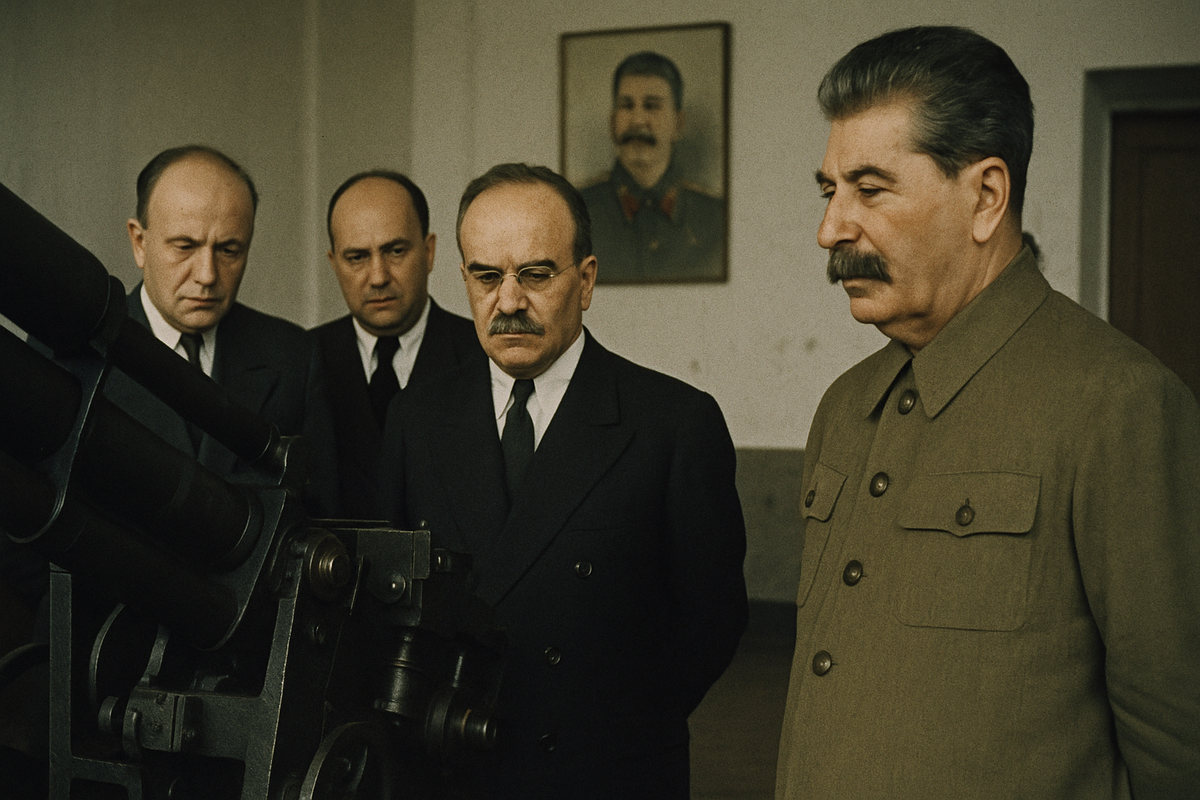
The article included photographs that gave faces to the machinery of subjugation. Stalin, overseeing Vyacheslav Molotov as he signed Hungary's so-called Treaty of Friendship—a document that stripped Budapest of autonomy and bound it to Moscow's will. Ernest Gero, captured mid-harangue before a Hungarian crowd, described by Nyaradi as "the man to do what the Kremlin wanted." Michael Farkas, "Moscow-taught," installed as Hungary's military commander to ensure the army answered to Soviet officers, not Hungarian citizens.
These were not abstractions. They were portraits of a takeover.
The Remaking of Hungary: From Nation to Weapon
Nyaradi's account was forensic in its detail. He described how Hungary's economy was surgically repurposed: steel mills redirected toward tank production, textile factories converted to uniform manufacturing, grain harvests requisitioned to feed Soviet garrisons. Hungarian independence was not merely curtailed—it was dismantled and reassembled as an extension of the Red Army.
The cultural dimension was equally deliberate. Propaganda flooded schools, newspapers, and radio broadcasts. Western books were purged from libraries. Soviet ideological officers embedded themselves in universities and government ministries. The goal was not just military readiness but psychological alignment: to make Hungarians think of Moscow as the center of their world.
For American readers in 1949, this was a revelation. The Marshall Plan had focused on rebuilding Western Europe. The Berlin Airlift had captured headlines for a year. But Nyaradi's article exposed what was happening behind the Iron Curtain while the West debated aid packages and diplomatic protocols: Stalin was building an empire designed for conquest.
A Magazine That Held the Nation's Contradictions
The Saturday Evening Post was, by 1949, more than a magazine. It was a national institution—read in small-town barbershops and big-city apartments, by factory workers and executives, by soldiers returned from Europe and their children born into peacetime. Its circulation numbered in the millions. Its cultural authority was unmatched.
What made the July 2, 1949 issue extraordinary was not just Nyaradi's exposé, but how it sat within the magazine's larger context. Readers who absorbed his warnings about Soviet war preparations could turn the page and find serialized fiction, humor columns, advertisements for Chevrolet and Coca-Cola—the ordinary texture of American life. The Post never asked its readers to choose between being informed and being entertained. It gave them both, in equal measure.
This was the magazine's genius: it understood that Americans wanted to know about the world's dangers without abandoning their belief in summer vacations and backyard barbecues. The Nyaradi article was serious journalism. The rest of the issue was a reminder of what that journalism was meant to protect.
Stevan Dohanos and the Lobster Shack: An American Counterpoint
The cover painting, created by Stevan Dohanos, depicted Ernest Mayhew, a Martha's Vineyard lobsterman, weighing a fresh catch outside a weathered shack while tourists looked on with vacation-day curiosity. The colors were saturated and warm. The scene radiated contentment.
Dohanos was a master of this mode—the Post illustrators, including Norman Rockwell, specialized in capturing American rituals at their most reassuring. But in the context of the Nyaradi article inside, the cover became something more than nostalgia. It was a statement of values: This is what we are defending. This ordinary, unheroic, deeply human way of life.
The juxtaposition was not accidental. The Saturday Evening Post understood its audience. They did not want to be frightened into paralysis. They wanted to be reminded why vigilance mattered.
Cold War Timing: NATO, Berlin, and the End of Illusions
The timing of this issue could not have been more acute. In April 1949, just two months before publication, NATO had been formally established—a defensive pact that acknowledged the Soviet Union was not a partner but an adversary. The Berlin Airlift, which had kept West Berlin alive through a Soviet blockade, had ended in May. The Soviets had tested their first atomic bomb, though that news would not break until August.
The world Americans thought they had secured in 1945 was gone. The article made that undeniable.
Nyaradi's warning that war could come by 1951 must have landed with particular force. The Berlin crisis had shown how quickly tensions could escalate. The Korean War—though still a year away—would prove that Cold War friction could ignite into open combat. Readers in 1949 had no reason to dismiss Nyaradi's timeline as alarmist. If anything, the evidence suggested he might be right.
Inside the Article: Key Revelations
The Kremlin's War Schedule
Soviet Deputy Foreign Minister Dekanozov's direct statement to Nyaradi: "War in 1951 is inevitable"—not speculation, but Soviet planning.
The Treaty of Friendship
Photographs documented Stalin overseeing Molotov's signing of Hungary's subordination—political domination disguised as alliance.
Economic Transformation
Forensic detail on how Hungary's industries were redirected to armament production, serving the Soviet war machine.
Ernest Gero's Role
The puppet leader "to do what the Kremlin wanted," photographed haranguing Hungarian crowds.
Military Takeover
Michael Farkas, "Moscow-taught," installed to ensure Hungary's army answered to Soviet command.
Cultural Propaganda
Beyond military preparation: Soviet ideological officers embedded in schools, universities, and media to reshape Hungarian consciousness.
Why Collectors Prize This Issue
Cold War Documentation
One of the earliest mainstream American publications to detail Soviet satellite subjugation from an insider's perspective, with journalistic photographs of Stalin, Molotov, Gero, and Farkas.
Stevan Dohanos Artwork
His Martha's Vineyard lobster shack is quintessential Americana illustration—warm, detailed, iconic, and highly sought after by Post cover collectors.
Cultural Snapshot
Few magazines so clearly capture the duality of postwar American life—prosperity shadowed by existential threat, confidence tempered by awareness.
Historical Pivot Point
Published at the exact moment NATO was formed and the Berlin Airlift concluded, this issue sits at the hinge between World War II's end and the Cold War's militarization.
Scarcity and Condition
Seventy-five years have passed. Issues in good condition—particularly with intact covers and no spine damage—are increasingly hard to find.
Dual Significance
The combination of a Dohanos cover and a Stalin exposé makes this issue especially desirable for both art collectors and Cold War historians.
A Magazine That Defined Its Moment
The Saturday Evening Post did not invent American optimism, but it reflected and reinforced it. In an era before television dominated households, the Post was how millions of Americans understood their country and its role in the world. It was trusted. It was ubiquitous. It mattered.
The July 2, 1949 issue is a perfect example of that influence. It did not ask readers to panic, but it did not let them look away. It presented Nyaradi's grim intelligence alongside the comforts of fiction and illustration, trusting that Americans could hold both realities at once: that life was good, and that life was fragile.
Own a Piece of Cold War History
If you are drawn to the artifacts that shaped 20th-century America—if you collect vintage illustration, Cold War ephemera, or simply want to hold in your hands the same magazine that millions of Americans opened on a summer weekend in 1949—this issue is essential.
It is more than a magazine. It is a time capsule. It is a Dohanos painting and a Stalin exposé. It is a lobster shack and a warning about World War III.
Browse Saturday Evening Post Magazine CollectionFinal Reflection: What the Lobster Shack Knew
When you look at the Dohanos cover now, knowing what lies inside, the scene takes on a different resonance. The vacationers examining the lobster, the weathered shack, the summer light—none of them know that in the same issue, a former finance minister is describing how Stalin's deputies are planning the next global war.
But that is exactly the point. The lobster shack does not stop existing because Stalin has plans. American life does not pause for geopolitical dread. The Post understood this. Nyaradi understood this. The magazine's readers—flipping between a beach scene and a Soviet threat assessment—understood this too.
Freedom is not the absence of danger. It is the insistence on living fully in its presence. That is what this issue of The Saturday Evening Post represents. That is why it endures.