
Before the Robes: When Ric Flair's Only Credential Was His Mouth
Inside Wrestling, June 1976 — The interview that captured wrestling's loudest upstart before he became its greatest champion
June 1976. A 27-year-old bleach-blond upstart sits for Inside Wrestling and does what no sensible mid-carder should do: he calls out Bruno Sammartino, dismisses Buddy Rogers as inferior, and tells the world that beating people up isn't just his profession—it's his hobby.
The headline reads like a threat: "My Hobby Is Beating Up Opponents."
Decades before the limousines, the sixteen world titles, and the Hall of Fame induction, Ric Flair was already speaking like a made man. He had no credentials to back it up. Just a mouth, a pair of trunks, and the unshakable belief that everyone else was already losing.
This interview—buried in a magazine most people threw away after reading—captures the exact moment a wrestler stops trying to get over and starts insisting on it.
Archive Document
Historical Figure: Ric Flair (Richard Morgan Fliehr)
Issue Date: June 1976
Publication: Inside Wrestling Magazine
Archive Source: Original Magazines Collection
Feature Type: The Hotseat (Interview Series)
The Man Who Wore Buddy Rogers' Shadow
By 1976, Flair had been wrestling for less than four years. His career nearly ended before it began: a plane crash in October 1975 broke his back and killed the pilot. Doctors told him he might never wrestle again.
He was back in the ring within months.
The comparison to "Nature Boy" Buddy Rogers was inevitable. Rogers had been wrestling's first television superstar—a cocky, peroxide-blond heel who wore robes and made crowds want to riot. Flair had the hair, the strut, and the arrogance. But in this interview, he makes one thing clear: "I am much better than Rogers ever was."
This wasn't homage. It was a hostile takeover.
At the time, Flair was grinding through the Mid-Atlantic territory, one of the NWA's most competitive regions. He hadn't won a world title. He hadn't headlined a major arena. But he was already talking like the business owed him something—and in wrestling, that kind of conviction can manifest into reality.
The Hotseat: Photography as Character Assassination
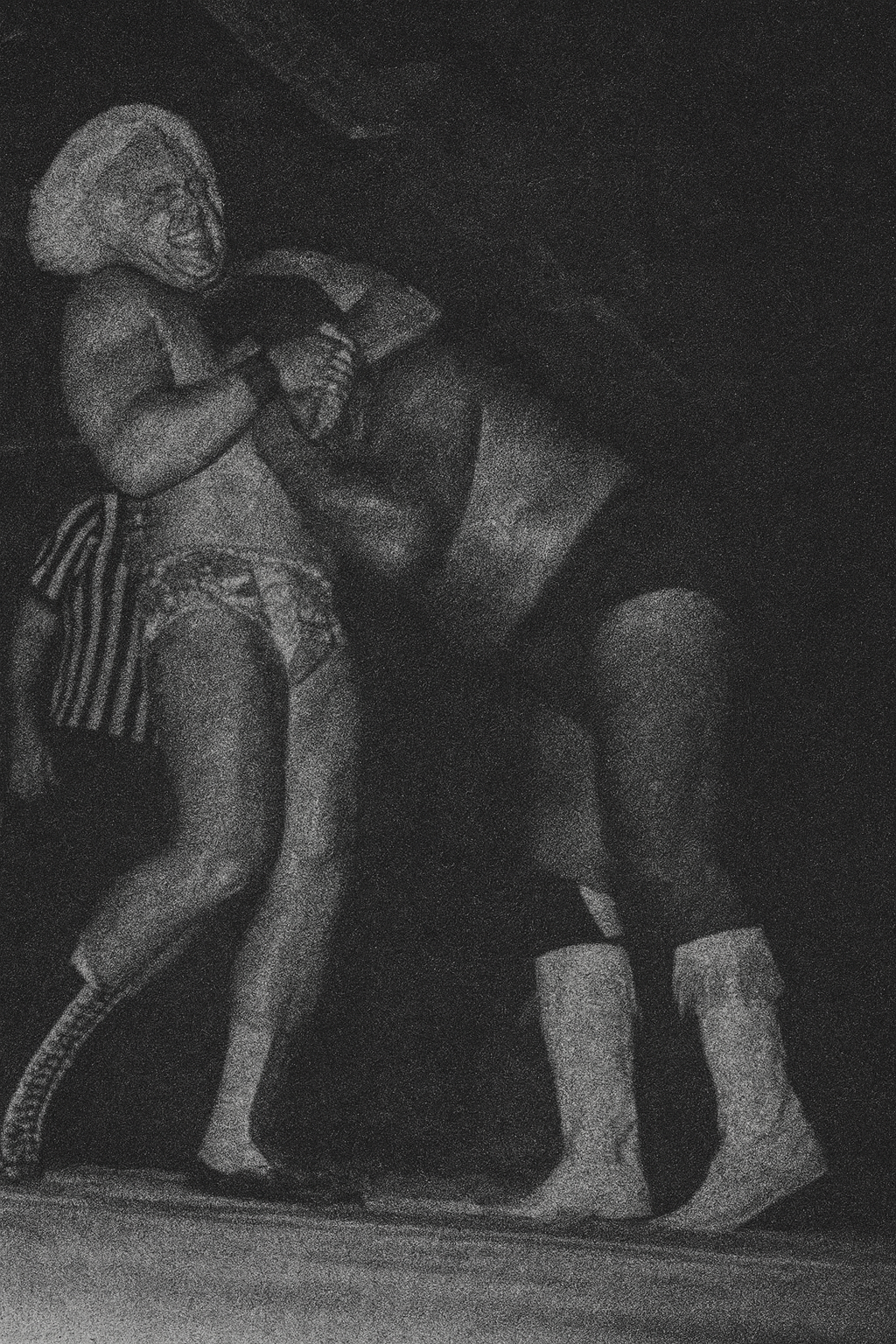
Inside Wrestling didn't just interview wrestlers—it framed them. The Hotseat feature was a visual indictment, pairing action shots with captions that read like prosecutorial evidence.
Flair stomping on Wahoo McDaniel's throat. Caption: "The most despicable act imaginable."
Flair grinding Wahoo in a headlock. The camera catches the sneer, the theatricality of cruelty.
A close-up portrait. Flair grins like a man who knows the fix is in.
Smaller shots show him punishing Paul Jones and Rufus R. Jones—wrestlers whose names have faded, but who were, in that moment, props in Flair's self-mythologizing.
The photos don't document wrestling. They document attitude. And in 1976, attitude was the only currency Flair had.
The Gospel According to Flair
The quotes in this interview aren't just cocky—they're architecturally sound heel promos, built to provoke.
"There isn't one wrestler in the entire world who can teach me a lesson. I am rougher, tougher, and greater than any champion!"
On Bruno Sammartino, the untouchable WWWF Champion:
"I was recently up in New York City taking a look at Sammartino. I wasn't impressed. I could beat him easily!"
On Paul Jones, a respected regional star:
"He's the low man on the totem pole."
On the plane crash that nearly killed him:
"Now I'm much leaner, trimmer, and more active than ever before. I can make history."
This is a man who survived death and decided the only rational response was to talk louder.
Flair doesn't just dismiss his rivals—he erases them. Wahoo McDaniel? A "dummy." Dusty Rhodes? Someone he'll "get around to." The reigning champions? Incapable of "lifting their titles" once they step in the ring with him.
The bravado isn't incidental. It's the product. And Inside Wrestling was selling it by the page.
What This Issue Reveals
The Artifact and the Oracle
What makes this interview remarkable isn't just what Flair said—it's that he was right.
Within five years, he would be NWA World Heavyweight Champion. Within a decade, he would be the industry's most recognizable heel. By the time he retired, "Nature Boy" Ric Flair would be synonymous with professional wrestling itself.
But in June 1976, none of that had happened yet. He was just a man with a microphone, a magazine willing to print his words, and the absolute certainty that history would bend to his will.
This issue of Inside Wrestling is the receipt. Proof that Flair didn't become great and then start talking—he talked first, and greatness followed.
Why This Issue Matters to Collectors
For Collectors: Where Legends Begin
If you want to trace the origin of the "Nature Boy" mythology, this is the text. The June 1976 Inside Wrestling captures Flair at his hungriest—when his only weapon was his voice, and his only strategy was volume.
It's more than a magazine. It's a primary source.
Browse Inside Wrestling Magazine CollectionFrom the territories to the world stage, these magazines document the moments when wrestlers stopped performing and started becoming.
Final Bell
The June 1976 Inside Wrestling issue is a time capsule of ambition. Ric Flair, recovering from a plane crash that should have ended his career, sits down and tells the world he's already the best wrestler alive.
He had no proof. Just conviction.
Looking back, the proof came later. But the conviction? That was always there. And in 1976, Inside Wrestling gave it a stage.
For collectors, this isn't nostalgia. It's evidence. Evidence that some wrestlers don't wait for permission—they just start talking like they've already won.
And sometimes, the world listens.