
The Gambler at 30,000 Feet
When Forbes Caught Richard Branson Between Triumph and Collapse
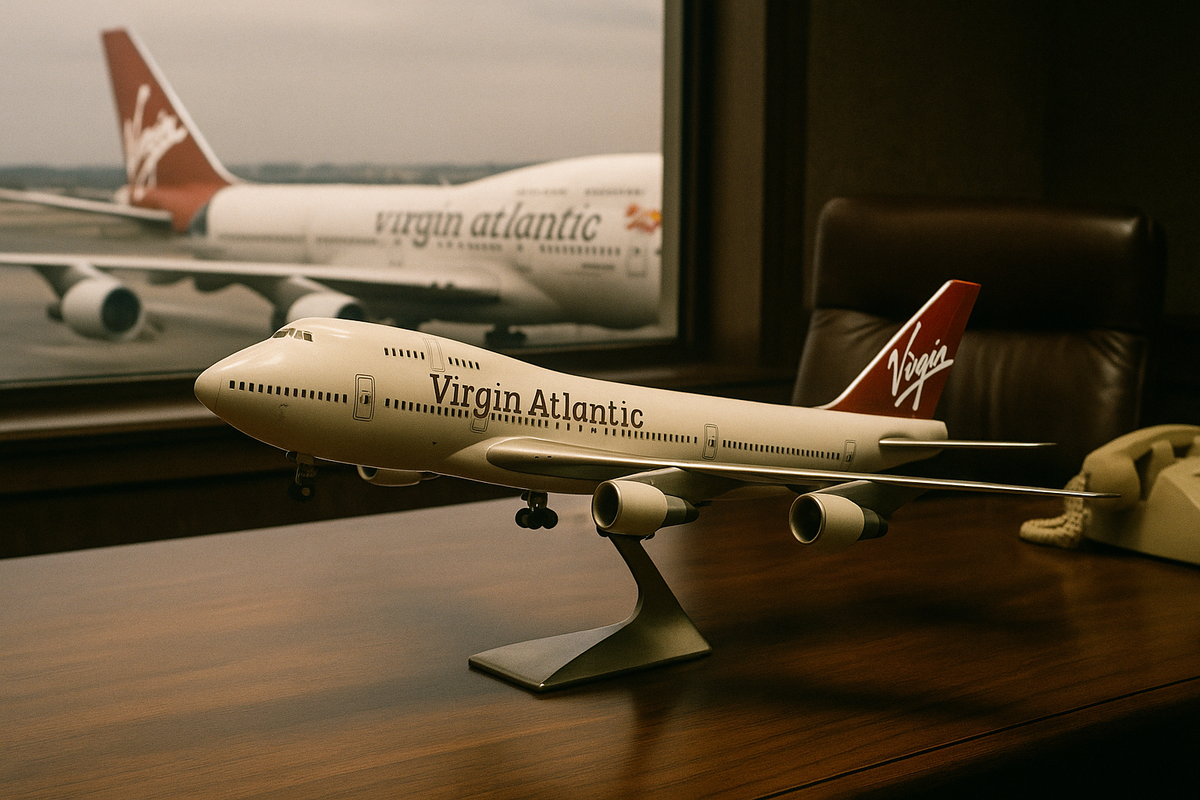
November 14, 1988. Richard Branson sat for a Forbes photographer beside a scale model of a Virgin Atlantic 747, his long hair and casual sweater a deliberate affront to every convention of corporate portraiture. At 38, he had already crashed a hot-air balloon into the Atlantic, signed the Sex Pistols, and launched an airline that was somehow making money. But the magazine's headline told a different story: "If At First You Don't Succeed…"
This wasn't a victory lap. It was an autopsy of ambition in progress.
For American readers picking up that issue, Branson was still an oddity—a British showman whose Virgin Atlantic was thriving in Europe but whose Virgin Records America was hemorrhaging credibility and cash. The article captured him at the exact moment when his global gamble could have gone either way: icon or cautionary tale. Forbes, with its characteristic blend of admiration and skepticism, froze that uncertainty in print.
Archive Details
Historical Figure: Richard Branson, Founder of Virgin Group
Issue Date: November 14, 1988
Archive Source: Forbes Magazine
Featured Article: "If At First You Don't Succeed…"
The World Was Cracking Open
The late 1980s didn't ease anyone into globalization—it threw them in headfirst. The October 1987 stock market crash had just reminded the world that confidence was fragile. Margaret Thatcher's Britain was being rewired through privatization. Ronald Reagan's America was drunk on deregulation but nursing a hangover of heightened competition.
Into this chaos walked Branson, who looked nothing like the men running the show. No gray suit. No MBA. Just relentless nerve and a talent for turning counterculture into commerce. Virgin Atlantic, launched in 1984, was pulling in $231 million in revenue by 1985 with $25 million in profits—a staggering feat for a startup airline. The upper-class passengers got limousines. The brand dripped red-hot attitude. British Airways, the establishment colossus, was rattled.
But across the Atlantic? Branson was stumbling. Virgin Records America couldn't decide whether to overpay for proven stars or gamble on unknowns. Neither strategy was working. Forbes noted the tension with surgical precision: "He has done both, taking on some unproven acts. But he has also paid up — and big." The magazine wasn't asking if Branson would crack America. It was asking if America would break him first.
Forbes Knew How to Tell It
By 1988, Forbes had mastered something rare: making balance sheets feel like battlefields. Readers didn't just get numbers—they got drama. The November 14 issue delivered both.
The Branson feature opened with his 1987 balloon disaster, a stunt that epitomized his entire philosophy: risk everything, make headlines, survive or don't. From there, Forbes traced his arc—from Mike Oldfield's Tubular Bells turning a mail-order record shop into an empire, to the Sex Pistols making Virgin synonymous with rebellion, to Virgin Atlantic rewriting the rules of transatlantic flight.
But the article refused to mythologize. It showed the cracks. Virgin Records America was a mess. Branson's charm worked in London; it confused New York. His instinct for the unconventional—once his greatest asset—was becoming a liability in a market that rewarded predictability.
Forbes didn't need to spell out the stakes. The visuals did it: Branson beside that model jet, the bold red Virgin tail fin branded like a war banner, the pull quotes capturing his high-wire act. This was personality-driven capitalism before the term existed. The celebrity CEO was being born on these pages.
Inside the Feature: Key Moments
Balloon Stunts and Bravado
The article opened with Branson's failed 1987 Atlantic crossing attempt—a symbol of his audacity and willingness to risk it all.
Virgin Records' Rise
From Mike Oldfield's Tubular Bells to the Sex Pistols, Branson turned counterculture into commerce and shook up the music industry.
Virgin Atlantic's Success
By 1985, the airline was thriving with luxury perks like limousine service for upper-class passengers and bold red branding.
The U.S. Challenge
Virgin Records America stumbled badly. Branson had to either pay heavily for proven stars or gamble on newcomers—neither guaranteed success.
The Permanence of Print
Forbes profiles endure because they refuse to simplify. They preserve contradictions: Branson the visionary and Branson the reckless gambler, Virgin Atlantic's success and Virgin Records America's failure, the audacity of the balloon flight and the brutality of market reality.
In an era when business news evaporates in minutes, these printed magazines offer something radical: permanence. The reporting was studied, not speed-written. The analysis had room to breathe. The stakes weren't manufactured for clicks—they were real.
That's why collectors and historians hunt for these issues. They're not just reading about business history. They're holding it.
Why This Issue Became Collectible
Perfect Timing
Captured just before Virgin's global expansion, the issue freezes Branson in a moment of genuine uncertainty—when his empire could have collapsed as easily as conquered.
Cultural Significance
Branson embodied the rise of the celebrity CEO. This article is a primary source documenting that cultural shift in business leadership.
Primary Documentation
The blend of sharp reporting, personality-driven storytelling, and powerful visuals makes this issue a time capsule of 1980s entrepreneurial capitalism.
Educational Value
Business schools, entrepreneurs, and historians seek these milestone issues for their insights into strategy, leadership, risk-taking, and market dynamics.
Explore Decades of Business History
Richard Branson's 1988 gamble is one story. Forbes documented thousands more—decades of risk, ambition, innovation, and collapse preserved in original print.
Browse Forbes Magazine CollectionThe Unfinished Story
The November 14, 1988 Forbes froze Richard Branson mid-leap. He was already legendary in Britain but unproven in America. Virgin Atlantic was soaring. Virgin Records America was sinking. The man himself—part showman, part gambler, part visionary—was walking a tightrope without a net.
Forbes gave readers both the spectacle and the accounting. It showed the triumph of branding and the cost of miscalculation. It captured a moment when Branson's empire could have collapsed as easily as it could have conquered.
More than three decades later, that uncertainty is what makes the issue essential. We know how the story ended. But in 1988, Branson was still writing it—one risk, one stunt, one gamble at a time.
And Forbes was there, camera ready, ledger open, watching to see if the balloon would fly or crash.