
The Last Spring: Time Magazine, Robert F. Kennedy, and the Campaign That Died in Los Angeles
May 24, 1968 — A Document of Hope, Six Weeks Before Tragedy
When Americans pulled the May 24, 1968 issue of Time Magazine from their mailboxes, they held a document of hope. Six weeks later, it would read like a eulogy.
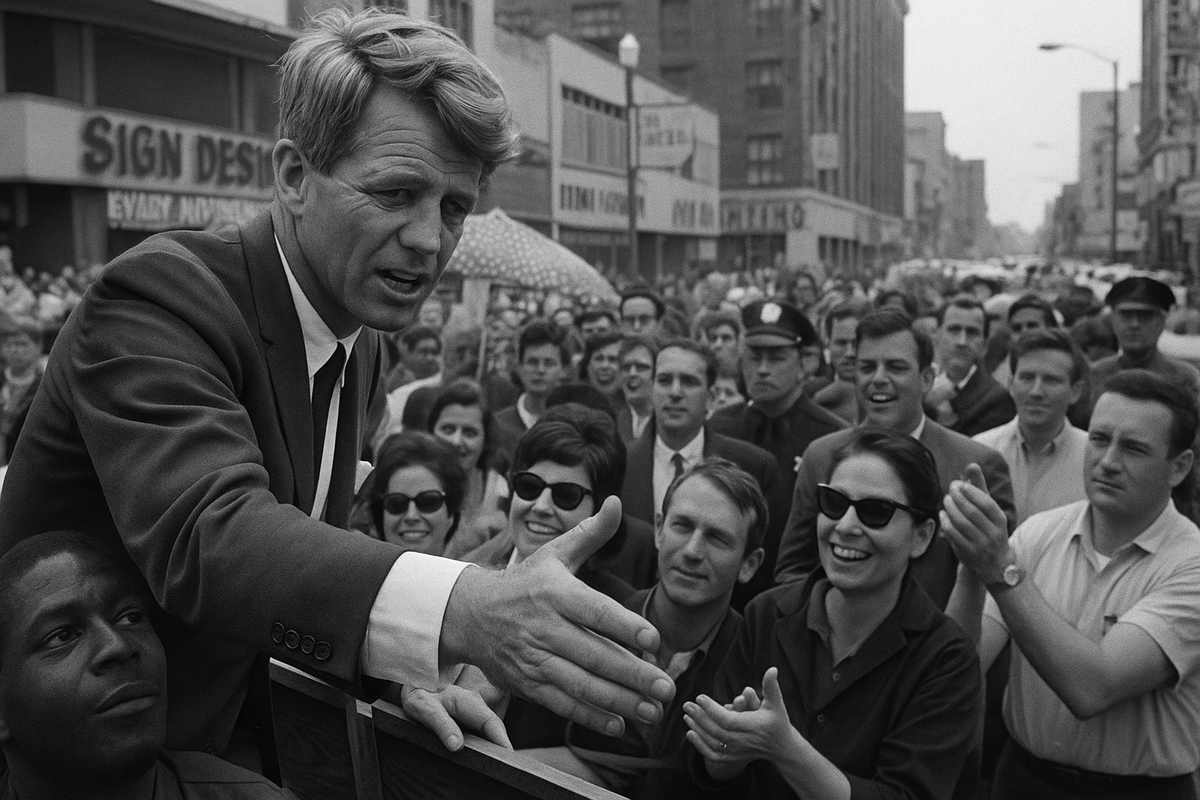
Senator Robert F. Kennedy was everywhere in those pages—gripping hands in California factory towns, slumped in exhaustion aboard campaign planes, eyes blazing during speeches that promised to heal a fracturing nation. Time's photographers and correspondents had captured him at the apex of his quest for the presidency, building a coalition that shouldn't have existed: urban Black voters and working-class whites, Chicano farmworkers and college radicals, all drawn to a man who carried his murdered brother's legacy like both crown and cross.
The article documented a campaign in full stride. The issue became an accidental memorial. On June 5, 1968—barely two weeks after this magazine hit newsstands—Kennedy would be shot in the kitchen of the Ambassador Hotel, moments after winning the California primary. He died the next day.
This issue of Time doesn't just chronicle a campaign. It freezes the last moment when restoration seemed possible.
Historical Archive Details
Featured Figure: Senator Robert F. Kennedy
Issue Date: May 24, 1968
Publication: Time Magazine
Historical Context: Published two weeks before Kennedy's assassination on June 5, 1968
Archive Significance: Primary source documenting RFK's presidential campaign at its apex
The Springtime of American Rage
Spring 1968 was a season of smoke and sirens. Martin Luther King Jr. had been assassinated in Memphis on April 4, igniting riots in over 100 American cities. The Tet Offensive in Vietnam—launched in January—had shattered the Johnson administration's claims of imminent victory, turning public opinion decisively against the war. President Lyndon B. Johnson, besieged by protesters chanting "Hey, hey, LBJ, how many kids did you kill today?" stunned the nation on March 31 by withdrawing from the race.
The Democratic Party had no clear successor. Vice President Hubert Humphrey carried Johnson's baggage and the party establishment's blessing. Senator Eugene McCarthy had ignited the antiwar movement but lacked Kennedy's street-level magnetism. And then there was Kennedy himself—ruthless attorney general turned unlikely champion of the dispossessed, a man whose political instincts were razor-sharp but whose moral evolution seemed genuine.
Time's May 24 issue arrived as Kennedy surged toward the California primary, the make-or-break contest that would determine whether he could wrest the nomination from Humphrey's delegate machine. The magazine gave readers an unvarnished look at what that fight demanded.
Time as Political Theater
By 1968, Time had perfected the art of political portraiture. The magazine didn't simply report campaigns—it gave them texture, personality, contradiction. Long before cable news, before internet live-streams, Time was how middle America understood the machinery of democracy.
The Kennedy feature exemplified this approach. Time's writers captured the candidate's almost supernatural ability to connect across demographic chasms. In one passage, Kennedy works a factory floor, remembering workers' names from previous visits, asking after their children. In another, he electrifies a college crowd with his denunciation of the war. The magazine noted what others missed: Kennedy didn't soften his message for different audiences. He told Black audiences in Gary, Indiana about the struggles of Appalachian whites, and told white union members in Nebraska about police violence in Watts.
The photography was equally revealing. One image shows Kennedy mid-speech, jaw set, finger jabbing the air—pure intensity. Another catches him sprawled across airplane seats between rallies, face slack with exhaustion, surrounded by staffers who look equally destroyed. A third captures the chaos of his crowd encounters: hands reaching, people pressing forward, Kennedy somewhere in the center, both energized and endangered by the crush of bodies.
These weren't curated campaign photos. They were documentary evidence of a man burning himself out for something he might never win.
The Camelot Problem
Time's coverage wrestled with the elephant in every room Kennedy entered: his brother's ghost. The article acknowledged that Kennedy's candidacy could never escape comparison to John F. Kennedy, whose assassination five years earlier had transformed from political tragedy into national mythology. Some supporters followed Robert Kennedy because they wanted 1963 back. Others resented him precisely for that—as if grief alone qualified him for the presidency.
The magazine captured Kennedy's own ambivalence about this inheritance. He invoked his brother's memory when it served him, but bristled when reporters suggested he was merely recycling Camelot. "What this country is for" became one of his signature lines—a conscious echo of JFK's rhetoric, but directed toward harder questions about poverty and racial injustice that his brother had barely begun to address.
Time also documented the coalition Kennedy assembled, which was remarkable precisely because it shouldn't have worked. He won the affection of Cesar Chavez and the United Farm Workers while maintaining support among Irish Catholic cops in Boston. He drew massive crowds of young people energized by his antiwar stance, yet refused to fully break with party elders. He spoke passionately about addressing urban poverty while campaigning in conservative rural districts.
It was a high-wire act, and Time's reporters understood it might collapse at any moment.
The Three-Way Fracture
The Democratic primary had become a three-way philosophical split. McCarthy represented the intellectual antiwar left—articulate, principled, and ultimately too cerebral to win. Humphrey embodied the New Deal coalition and Cold War liberalism—policies that had defined the party for decades but now seemed exhausted. Kennedy occupied the unstable middle: antiwar but not pacifist, progressive but not radical, establishment-connected but running against the establishment.
Time's analysis made clear that Kennedy's path to the nomination required near-perfect execution. He needed to win California decisively to prove his electability, then somehow convince uncommitted delegates that he—not Humphrey—could unite the party and defeat Richard Nixon in November. The magazine documented his frenetic pace: multiple rallies per day, late-night strategy sessions, constant travel across California's sprawling geography.
The article noted Kennedy's physical toll. Aides worried about his weight loss and chronic fatigue. But he refused to slow down, driven by what Time described as an almost compulsive need to prove himself worthy of the moment.
Key Themes from Time's Coverage
The Camelot Inheritance
Time examined how Kennedy's campaign could never escape comparisons to his brother John F. Kennedy, capturing both the burden and advantage of carrying that legacy into the 1968 race.
Impossible Coalition
The magazine documented Kennedy's remarkable ability to unite urban Black voters, working-class whites, Chicano farmworkers, and college radicals—demographics that typically fractured along ideological lines.
Personal Connection
Time's reporters captured Kennedy's almost supernatural talent for remembering names, connecting with factory workers and students alike, and speaking authentically across demographic divides.
The Delegate Mathematics
Beyond emotional appeals, the coverage detailed the cold arithmetic of Kennedy's challenge: wresting the nomination from Humphrey's establishment machine required winning California and converting uncommitted delegates.
The Preservation Imperative
Vintage Time magazines survive as artifacts because they were built to last—heavy paper stock, rich photographic reproduction, substantial page counts. Unlike newspapers, which yellowed and crumbled, Time was designed for coffee tables and archive shelves. The magazine understood its role as the first draft of history.
Today, these issues serve researchers, educators, collectors, and anyone seeking to understand how Americans experienced their own era in real time. They remind us that history wasn't inevitable. In May 1968, Robert Kennedy's presidency was genuinely possible. Time's coverage reflected that possibility without cynicism or excessive sentiment—just hard-nosed reporting on a candidate who might actually pull it off.
He didn't. But for those weeks in May, before Los Angeles, Americans could still imagine otherwise.
Why This Issue Matters to Collectors
Historical Timing
Published barely two weeks before Kennedy's assassination on June 5, 1968, this issue captures a moment of possibility before tragedy struck. It documents his campaign at full stride, making it a poignant and irreplaceable artifact.
Documentary Photography
The campaign trail images remain among the most enduring visuals of Kennedy's career—exhaustion, intensity, connection. They offer a rare window into the human toll of mid-century American politics.
Primary Source Value
For historians and researchers, this issue provides unfiltered contemporary analysis of Kennedy's strategy, coalition-building, and delegate mathematics. It's evidence of how the campaign was understood before hindsight reshaped the narrative.
Cultural Resonance
Owning this issue means holding the same pages Americans read while debating their nation's future in 1968. It's a tangible link to struggles over war, civil rights, and generational change that continue to echo today.
The May 24, 1968 issue isn't just a collectible. It's evidence of the last time Robert Kennedy's campaign felt like destiny rather than tragedy. That distinction—between what was and what might have been—makes it essential.
Explore the Archive
This issue represents one entry point into decades of American history preserved in original print. Our collection spans Time's coverage from the 1930s through the 1970s—the Depression, World War II, the Cold War, civil rights, Vietnam, Watergate, and the social revolutions that redefined the nation.
Browse Time Magazines CollectionEach issue is an original artifact, preserved as it first appeared on newsstands.