
The Confetti and the Crisis
When America's Nurses Vanished: Inside the Saturday Evening Post's 1947 Emergency Report
January 1, 1947. While revelers in Times Square tossed confetti into the frozen air and sanitation workers bent to their brooms, American hospitals were hemorrhaging staff. The champagne had barely gone flat when families across the country discovered a harsh truth: you could have a bed, but no one to change the sheets. You could have a surgery scheduled, but no one to monitor your recovery. Victory in war had been total. Victory at home remained unfinished.
Three days later, The Saturday Evening Post landed on doorsteps with a cover that made people smile—Stevan Dohanos had painted those very sanitation workers, cheerful and industrious, cleaning up the mess of celebration. A tuxedoed reveler pitches in, tie askew, part of the collective effort. Dohanos even painted himself into the scene, exhausted but game. It was the kind of cover that made Americans feel good about being American.
Then they turned the page.
"Where's That Nurse?" by Ben Olds and Dan Herr didn't ease readers into the problem. It struck hard: America was short 65,000 to 75,000 nurses. In New York City alone, 2,100 hospital beds sat empty—not for lack of patients, but for lack of hands. Medicines arrived hours late. Meals went cold. The "pleasant, dependent feeling" between nurse and patient, once the pride of American hospitals, was evaporating under the weight of impossible caseloads.
This wasn't a labor dispute. It was a national emergency, and almost no one had seen it coming.
Archive Details
Publication: The Saturday Evening Post
Issue Date: January 4, 1947
Feature Article: "Where's That Nurse?" by Ben Olds and Dan Herr
Cover Artist: Stevan Dohanos
Historical Context: Post-WWII nursing shortage crisis
The Women Who Served, Then Disappeared
During the war, the nation had mobilized women with ruthless efficiency. The U.S. Cadet Nurse Corps, launched in 1943, recruited over 180,000 young women and funneled them into hospitals and field stations. They learned to suture, sterilize, administer morphine, and hold the hands of men who would not make it home. Nursing was patriotic work, essential work, and it came with a promise: you were serving your country.
But when the war ended, so did the promise.
The GI Bill sent returning veterans to college, to new careers, to homeownership. It sent their sweethearts and sisters back to domesticity. Many nurses married and left the profession entirely. Others, exhausted by 12- to 16-hour shifts and wages that hadn't kept pace with inflation, chose office work or teaching. By 1946, nursing school enrollment had collapsed to 24,000 students—less than two-thirds of what was needed to replace those walking away.
Meanwhile, the baby boom was just beginning. Maternity wards swelled. Surgical advances made procedures safer, which meant more people sought them. Hospitals expanded—adding wings, buying equipment, opening new facilities. But bricks don't care for patients. Only people do. And America was running out of people willing to do the work.
The Magazine That Held the Mirror
The Saturday Evening Post was not The New Yorker. It didn't traffic in irony or literary experiments. It was the magazine of Main Street, the barbershop, the living room couch. Norman Rockwell covers. Serialized fiction. Humor columns. It told Americans who they were, and they trusted it to get the story right.
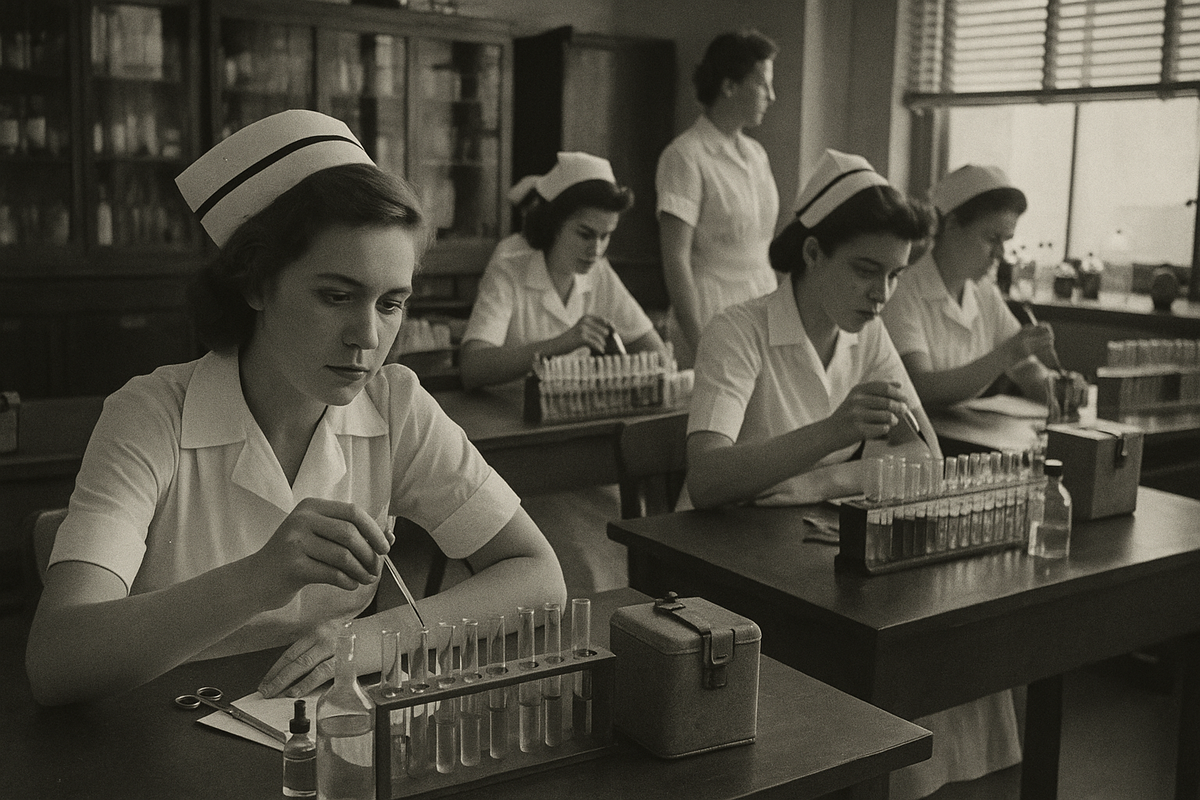
So when the Post devoted significant space to the nursing crisis, readers knew it mattered. The article featured stark photographs: rows of nursing students hunched over benches crowded with glass vials and instruments, their faces serious, their futures uncertain. The images were clinical, almost laboratory-like—a visual echo of the precision and rigor the profession demanded. But the real message was in the empty seats. There weren't enough of them filled.
The juxtaposition was devastating. On the cover, America cleaned up after its party. Inside, America confronted the mess it couldn't sweep away.
What the Reporting Revealed
Olds and Herr didn't traffic in abstraction. Their reporting was specific, damning, and impossible to ignore:
A shortfall of 65,000 to 75,000 nurses meant more than statistics—it meant patients left alone for hours, surgical delays, and care rationed by exhaustion rather than need.
In a city synonymous with medical excellence, 2,100 hospital beds sat unused. Not because the hospitals lacked space, but because they lacked staff. Expansion without personnel was architecture without purpose.
With only 24,000 nursing students enrolled in 1946, the shortage would deepen before it improved. The women who might have filled those classrooms were attending different lectures—or none at all.
Nurses worked shifts that stretched past midnight, into the next day, sometimes 16 hours without relief. The profession ate its own.
Meals arrived cold. Call buttons went unanswered. Elderly patients, disoriented and alone, called out to empty hallways. The emotional labor that had once defined nursing—the reassurance, the presence—became a luxury no one could afford.
The GI Bill didn't just educate veterans; it created households. And postwar culture funneled women toward domesticity with the same intensity it had once funneled them toward war work. Nursing couldn't compete with the white picket fence.
Higher wages. Federal investment in nursing education. Improved working conditions. The remedies were obvious. The political will was absent.
The baby boom meant millions of children would need care, immunizations, school nurses. The postwar generation would age into patients. Demand wasn't plateauing—it was accelerating.
The article ended not with optimism, but with a warning: this crisis was a preview. America had won the war but was losing the peace, one empty hospital bed at a time.
Why This Issue Endures
The January 4, 1947 Saturday Evening Post is more than a magazine. It's a dispatch from the fault line between two Americas—the triumphant nation of victory parades and the exhausted nation of understaffed hospitals. It captures the optimism of Dohanos's Times Square workers and the desperation of nurses working double shifts with no end in sight.
For collectors, this issue represents a rare convergence: exceptional cover art by one of the Post's most beloved illustrators, investigative journalism that documented a national emergency, and historical timing that makes it a primary source for understanding postwar America. It's not nostalgia. It's evidence.
For historians, it's a window into a crisis that never fully resolved. Nursing shortages remain endemic to American healthcare. The same forces—low pay, brutal hours, societal undervaluation of care work—still drive people from the profession. The article Olds and Herr wrote in 1947 could be rewritten today with updated numbers and the same conclusions.
For anyone who wonders how earlier generations lived, worked, and failed to solve their most urgent problems, this issue answers plainly. They documented the crisis. They proposed solutions. And then they moved on, leaving the next generation to inherit the same emergency.
Collector Significance
Historical Timing
Published at the height of the postwar nursing shortage, this issue captures a pivotal moment in America's healthcare history and documents a national emergency still relevant today.
Stevan Dohanos Cover
His Times Square cleanup scene is a charming and humorous slice of Americana, rendered by one of the Post's most celebrated illustrators who even painted himself into the scene.
Social Significance
The feature article "Where's That Nurse?" documented one of the most pressing domestic challenges of the postwar era with unflinching clarity and specific data.
Cultural Appeal
The blend of humor and urgency—a cheerful cover masking a crisis inside—made this issue a true reflection of its time and the contradictions of postwar America.
Experience 1947 Firsthand
Original copies of this issue are available for those who want to hold history rather than read about it.
Browse The Saturday Evening Post Magazines CollectionThese aren't reproductions or digital scans. They're the artifacts themselves—ink on paper, aged and authentic. Whether you collect for investment, research, or the simple pleasure of touching the past, each issue is a portal. The confetti has long been swept away. The crisis remains.