
Rockets, Rivalries, and the Dawn of the Space Age
Inside Time Magazine's Portrait of Wernher von Braun and America's First Steps into the Cosmos
February 17, 1958. Americans pulled that week's Time Magazine from their mailboxes and found themselves staring at the face of a man who had once built weapons for Hitler—now America's best hope for beating the Soviets to space.
Wernher von Braun's cover story arrived at a knife-edge moment in history. Three months earlier, Sputnik's beep had shattered American confidence. Two months earlier, the Navy's Vanguard rocket had exploded on live television, turning a satellite launch into a national humiliation. Two weeks earlier, von Braun's team in Huntsville had finally answered with Explorer I, America's first satellite to reach orbit.
Time didn't just report the news. It crystallized the contradiction at the heart of the Space Race: the United States had handed its cosmic ambitions to a man whose V-2 rockets once rained terror on London. For readers in 1958, this wasn't ancient history—it was a moral bargain made in real time, justified by the existential math of the Cold War.
Issue Archive
Historical Figure: Wernher von Braun
Issue Date: February 17, 1958
Archive Source: Time Magazine
Historical Context: Published two weeks after Explorer I launch, three months after Sputnik
The Sky Was the New Battlefield
By the late 1950s, Americans understood that the Cold War wouldn't be won in Europe or Korea. It would be decided in the atmosphere—and beyond. Sputnik proved the Soviet Union possessed intercontinental ballistic missile technology capable of reaching orbit. Which meant it could reach New York.
The Vanguard disaster in December 1957 compounded the humiliation. Broadcast globally, the rocket rose four feet, toppled, and detonated in a fireball. Soviet Premier Nikita Khrushchev mocked it. American editorial cartoons depicted Uncle Sam in diapers. The world watched the superpower fumble.
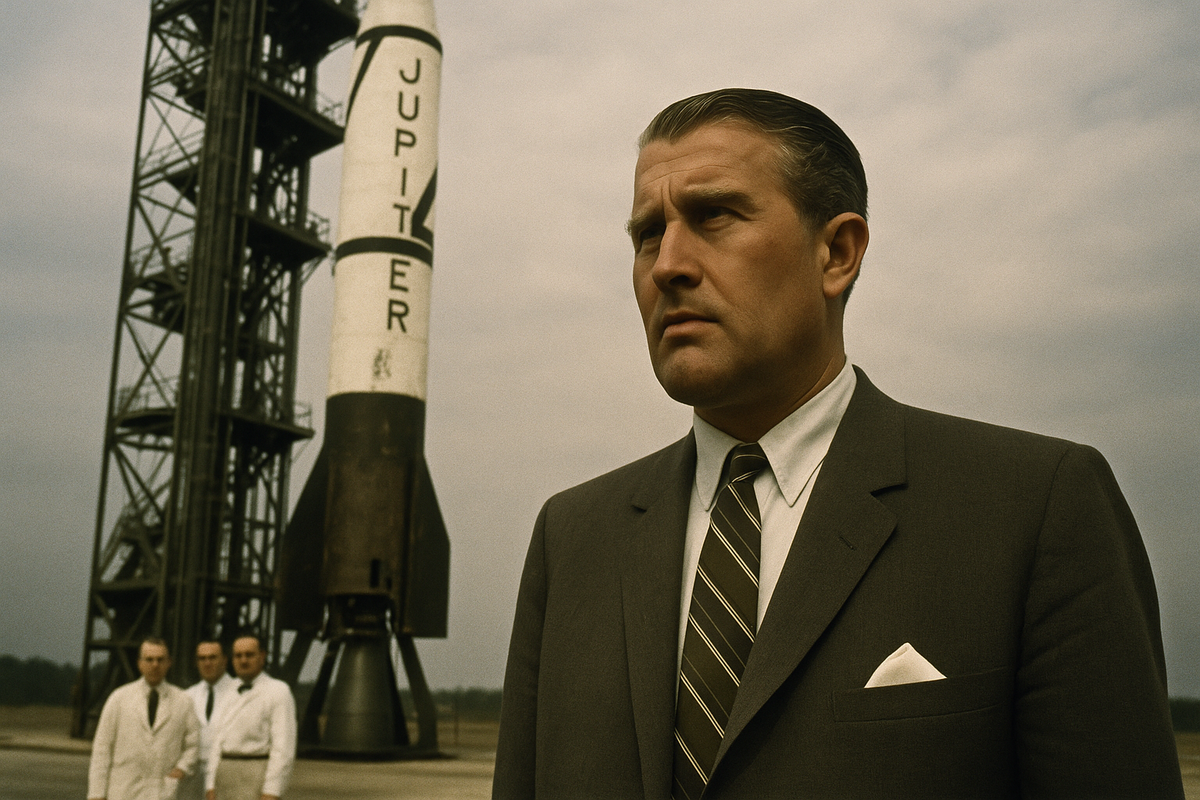
Then came von Braun. His Redstone Arsenal team in Huntsville, Alabama—staffed largely by German engineers captured at the end of World War II—assembled the Jupiter-C rocket in secrecy and haste. On January 31, 1958, Explorer I pierced the sky. America had a satellite. The Space Race was no longer one-sided.
Time's February 17 issue hit newsstands just as the nation exhaled. This wasn't merely reportage—it was reclamation of confidence, wrapped in a profile of the most morally complicated scientist in America.
The Scientist, The Showman, The Shadow
Time excelled at humanizing the abstract, and von Braun was the ideal subject. The magazine traced his boyhood obsession with rockets, his ascent through Nazi Germany's weapons program, his capture by U.S. forces in 1945, and his seamless integration into the American military-industrial apparatus. But what made the profile unforgettable was its portrait of von Braun as both visionary and salesman.
He spoke of space travel with evangelical fervor. Time quoted him bluntly: "His only consuming loyalty is to outer space." For a public still adjusting to the vocabulary of ballistics and telemetry, von Braun translated rockets into romance. He sketched space stations on napkins. He predicted lunar colonies. He made the cosmos feel inevitable.
Yet Time didn't sanitize the ledger. The article acknowledged that von Braun's V-2 rockets—built by slave labor at the Mittelwerk factory—had killed thousands of Allied civilians. The magazine framed this tension with Cold War pragmatism: uncomfortable, perhaps, but necessary. In 1958, moral purity was a luxury America couldn't afford. The Soviets weren't offering von Braun therapy; they were building their own missiles. Time presented him as indispensable, even if that meant swallowing the contradictions.
This balance—celebration laced with unease—is what makes the article a historical document rather than propaganda. Time didn't erase the shadows. It simply argued they were worth the light.
Editorial Craft in the Age of Print Authority
Time's mid-century covers were iconic by design: bold portraits, stark colors, subjects rendered larger than life. The February 17, 1958 issue placed von Braun at the symbolic center of American ambition, his gaze steady, his expression confident. It was a visual declaration: This is the man who will save us.
Inside, the layout blended dense analysis with striking photography—rockets on launchpads, laboratories humming with engineers, von Braun himself gesturing at blueprints. Captions didn't merely describe; they interpreted. A photo of the Jupiter-C wasn't just a rocket—it was "the backbone of America's response to Soviet supremacy." Every image carried weight.
In 1958, television news was still primitive, limited to grainy broadcasts and brief summaries. Time, by contrast, offered depth. Its weekly rhythm allowed for synthesis, context, narrative arc. Readers didn't just learn what happened; they understood why it mattered and how it connected to everything else. Time shaped public opinion not through speed, but through authority.
What the Issue Reveals
The February 17, 1958 Time Magazine is a layered artifact. Strip it down, and you find:
Huntsville's Transformation
The magazine chronicled how a sleepy Alabama town became "Rocket City, U.S.A.," its economy and identity reshaped by von Braun's Army Ballistic Missile Agency.
Explorer I as Turning Point
Time framed the satellite not as a scientific curiosity but as a geopolitical statement: America could compete.
The V-2 Dilemma
The article confronted von Braun's past without resolving it, leaving readers to wrestle with the bargain their government had struck.
The Jupiter-C's Legacy
Technical yet accessible, Time explained how von Braun's design became the foundation for American rocketry, from satellites to eventual moon missions.
Dreams of Mars
Von Braun's speculations about manned spaceflight weren't science fiction to Time's editors—they were prophecy. The magazine treated his ambitions seriously, even when they sounded impossible.
Each section balanced wonder with wariness, presenting the Space Race as both thrilling and terrifying—a high-stakes gamble played out in newsprint.
Echoes Across Decades
We live in another age of space ambition. Private rockets launch with algorithmic precision. Nations eye the Moon's resources. Mars missions move from fantasy to funded programs. Yet the questions Time grappled with in 1958 haven't disappeared—they've just changed costumes.
Who funds exploration, and what do they want in return? When does scientific progress justify ethical compromise? Can visionaries outrun their pasts? The answers remain unsettled.
Vintage magazines endure because they preserve not just events, but the voice of their moment—the assumptions, the anxieties, the unspoken rules. The February 17, 1958 issue of Time speaks in the language of 1958: earnest, confident, uneasy. Every page is a window into how Americans understood their place in a world suddenly larger and more dangerous than ever before.
Why Collectors Seek This Issue
Timing
Published two weeks after Explorer I, it captures American relief and renewed confidence at the exact moment the tide began to turn.
Cultural Snapshot
Few single issues so perfectly encapsulate the blend of pride, anxiety, and moral compromise that defined Cold War America.
Von Braun's Complexity
His story—Nazi scientist turned American hero—remains one of the 20th century's most debated narratives. This issue is ground zero for that debate.
Cold War Artifact
Owning it means holding a piece of the ideological battle that shaped the second half of the century. It's not just journalism; it's evidence.
Hold History in Your Hands
If this glimpse into Cold War journalism resonates, our archive holds more. Each original Time Magazine is a historical artifact—events, culture, and commentary frozen at the moment they mattered most.
Browse Time Magazine CollectionWhether you're building a collection, teaching a course, or simply drawn to the texture of history, these issues offer something no digital scan can replicate: the weight, the scent, the tactile proof that this happened.
A Landmark in Cold War Journalism
The February 17, 1958 issue of Time Magazine stands as a monument to the moment America stopped reeling and started reaching. Its profile of Wernher von Braun, its dissection of "Rocket City, U.S.A.," its sober assessment of Explorer I—all of it gave readers a front-row seat to history as it unfolded.
For those who lived through it, the issue was reassurance and inspiration. For those who study it now, it's a reminder that the Space Race was never just about rockets. It was about identity, survival, and the stories we tell ourselves when the stakes are highest.