
The Night Al Capp Turned Playboy Into a Culture War Battlefield
December 1965. America was tearing itself apart, and Playboy Magazine decided to light the fuse.
Sandwiched between Vladimir Nabokov's prose and a Christmas ornament cover that whispered sophistication, the magazine unleashed one of the most incendiary interviews of the decade: a no-holds-barred conversation with Al Capp, the caustic genius behind Li'l Abner. What readers found inside wasn't just entertainment. It was a declaration of war against the liberal consensus—delivered by a cartoonist who wielded satire like a scalpel and didn't care whose sacred cows he gutted.
This wasn't your typical celebrity puff piece. This was Playboy at its most dangerous: intellectually ambitious, culturally defiant, and utterly unafraid to publish voices that made half its readership want to cancel their subscriptions.
Archive Details
Historical Figure: Al Capp, creator of Li'l Abner comic strip
Issue Date: December 1965 (Gala Christmas Issue)
Archive Source: Playboy Magazine
Contributing Writers: Vladimir Nabokov, Henry Miller, John le Carré, P.G. Wodehouse, Shel Silverstein
The Powder Keg Moment
By December 1965, America had reached a breaking point. The Civil Rights Act was barely a year old, but segregation still strangled the South. The Voting Rights Act had just passed in August, marking a legal triumph while cities burned with racial tension. President Lyndon B. Johnson's Great Society programs promised to eradicate poverty and reshape the social contract—reforms that struck conservative Americans as either salvation or socialism, depending on which side of the barricades you stood.
Vietnam was metastasizing from a "police action" into a full-scale war. Students were marching. Folk singers were singing protest anthems. Bob Dylan and Joan Baez had become the voices of a generation that believed America had lost its moral compass.
Into this volatile landscape stepped Playboy, a magazine that had spent the early 1960s positioning itself as the thinking man's rebellion against puritanical conformity. It wasn't just publishing centerfolds—it was publishing Jean-Paul Sartre, interviewing Malcolm X, and creating a space where sexual liberation and intellectual firepower could coexist on glossy pages.
The Al Capp interview was the perfect embodiment of this contradiction. Here was a man who had built his career on satirizing American hypocrisy, now using Playboy's platform to savage the very movements the magazine's younger readers were championing.
The Cartoonist as Cultural Assassin
Al Capp didn't arrive at Playboy as some dusty comic strip relic. By 1965, he was a cultural institution. Since creating Li'l Abner in 1934, Capp had transformed the adventures of a hillbilly family in Dogpatch into America's sharpest running commentary on politics, poverty, and pretension. His strip reached 60 million readers daily through nationwide syndication. He appeared on television. He lectured at universities. He was, in the parlance of the time, a public intellectual who happened to draw funny pictures.
What made Capp dangerous—and what made Playboy's decision to feature him so provocative—was his willingness to attack from unexpected angles. He wasn't a predictable conservative. He was a contrarian who delighted in puncturing liberal pieties with the same ferocity he'd once aimed at corrupt politicians and corporate fat cats.
The interview format gave him room to run. Playboy's editors didn't lob softballs. They challenged him on Vietnam, on civil rights, on the counterculture. And Capp came out swinging.
The Verbal Grenades
On the Great Society
Capp eviscerated Johnson's poverty programs as engines of dependency disguised as compassion. He argued that welfare checks didn't lift people up—they locked them into a cycle of government reliance and personal degradation. In 1965, when the War on Poverty was the progressive cause célèbre, this wasn't just controversial. It was heresy.
On Humanitarianism
He dismissed much of what passed for progressive virtue as mere sentimentality—soft-headed emotionalism masquerading as moral clarity. Society needed accountability, he insisted, not indulgence.
On the Protest Movement
Capp went for the jugular. He accused student activists and folk singers—Joan Baez by name—of being naive dupes, too blinded by romanticism to see that their anti-war stance played directly into communist hands. For readers who saw the antiwar movement as principled resistance, this was a gut punch.
On Satire Itself
He defended his medium as uniquely suited to truth-telling. Comics, he argued, could say things that "serious" journalism couldn't touch. The exaggeration of satire revealed truths that objective reporting buried under layers of false equivalence.
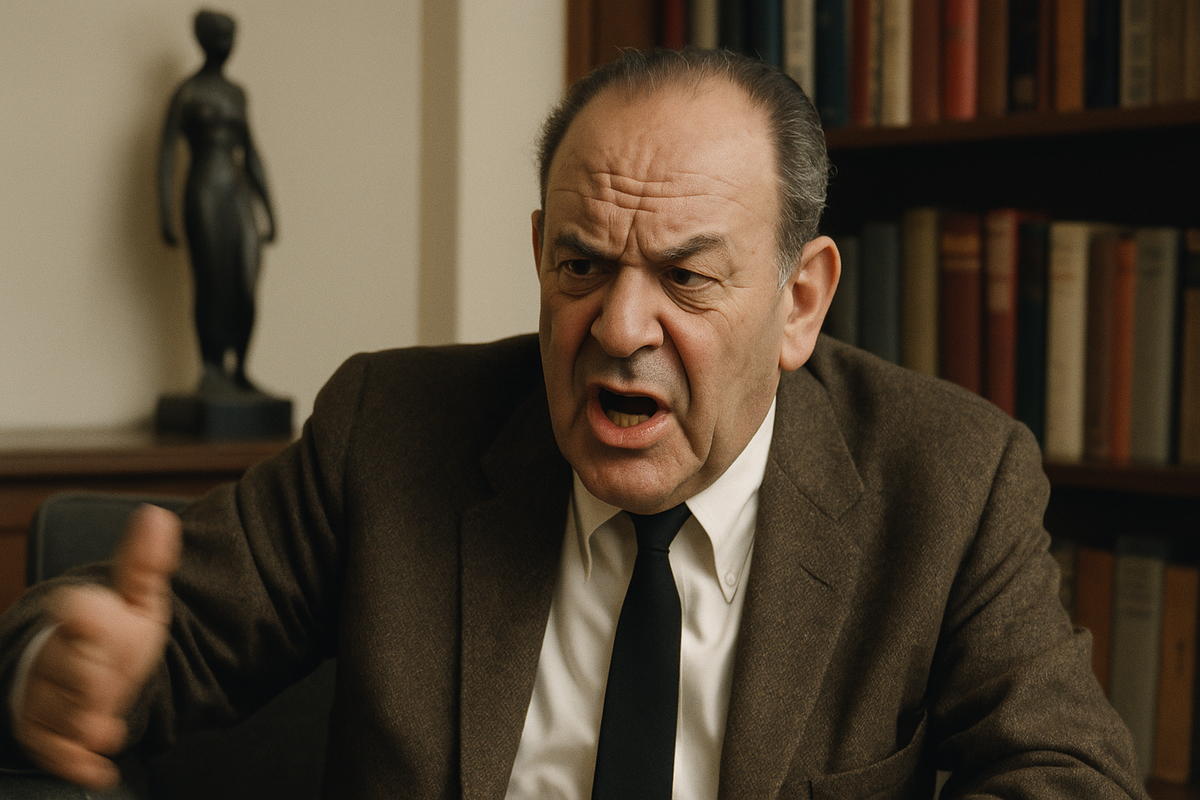
Each answer was photographed in stark black and white, Capp's animated face frozen mid-gesture, visual evidence that this wasn't some carefully managed PR appearance. This was combat.
The Playboy Gambit
What made the December 1965 issue remarkable wasn't just Capp's presence—it was the editorial ecosystem Playboy had constructed around him. This was a magazine that understood the power of juxtaposition.
Flip through this issue and you encounter literary giants: Vladimir Nabokov, Henry Miller, John le Carré, P.G. Wodehouse, Shel Silverstein. The message was clear: Playboy wasn't choosing between highbrow literature and lowbrow entertainment. It was obliterating the distinction entirely.
The cover reflected this sophistication. A minimalist golden background, a dangling Christmas ornament encasing a woman's face—festive, sensual, modernist. No garish come-ons. Just clean design that whispered rather than shouted.
Inside, the layout gave Capp's words maximum impact. The interview sprawled across multiple pages, the typography breathing, the photography sharp. This was journalism as event, designed to be saved, discussed, argued over.
Playboy was doing something revolutionary: elevating a comic strip artist to the same tier as novelists and spies-turned-authors, insisting that cultural commentary could come from anyone with something urgent to say. In doing so, it was making an argument about American culture itself—that the hierarchies between "serious" and "popular" art were arbitrary, that satire could be as penetrating as any essay, that a cartoonist's voice mattered as much as a politician's.
Why Collectors Hunt This Issue
Historical Timing
This issue freezes a specific moment when America's contradictions were most acute—civil rights gains colliding with ongoing racism, military escalation meeting antiwar resistance, sexual liberation challenging traditional morality. To own this magazine is to hold a snapshot of the fracture points that still define American politics.
Literary Pedigree
Few magazines could boast this roster of contributors. Nabokov, Miller, le Carré, Wodehouse—these weren't celebrities slumming in men's magazines. They were masters at their peak, and Playboy was paying them handsomely to reach an audience that wanted more than pin-ups.
The Capp Interview
As one of the most famous and contentious cartoonists of the twentieth century, Capp's appearance here captures both his satirical brilliance and his willingness to alienate. The interview is a case study in how public intellectuals engaged (or enraged) their audiences before Twitter turned every opinion into a grenade.
Cultural Significance
This wasn't just a magazine—it was a weapon in the sexual revolution, a challenge to censorship, a platform where eroticism and intellectualism weren't enemies but allies. Playboy's 1960s issues documented a transformation in American attitudes about pleasure, power, and propriety.
For collectors, historians, and cultural archaeologists, this issue represents the magazine at its most ambitious—when it believed it could reshape American masculinity by making it more literate, more liberated, and more willing to confront uncomfortable truths.
The Legacy of Provocation
Playboy's 1960s run endures because the magazine understood a fundamental truth: the most engaging publications don't just reflect their era—they argue with it.
The Al Capp interview embodied this ethos. Whether readers agreed with his attacks on welfare, his mockery of protesters, or his defense of satire, they couldn't ignore him. And that was the point. Playboy wasn't interested in consensus. It was interested in debate, in friction, in the collision of worldviews.
Decades later, the interview stands as a reminder that American culture has always been a battleground, and that the magazines we preserve tell us as much about our conflicts as our consensus.
For the Serious Collector
If you're building a collection that documents American culture at its most turbulent—or if you simply want to own a piece of the moment when satire, sexuality, and social commentary collided on glossy pages—the December 1965 Playboy Magazine belongs in your archive.
These aren't just back issues. They're historical evidence, cultural artifacts that capture the texture of an era when magazines mattered, when interviews sparked arguments, when a cartoonist's words could ignite a culture war.
Browse Playboy Magazine Collection