
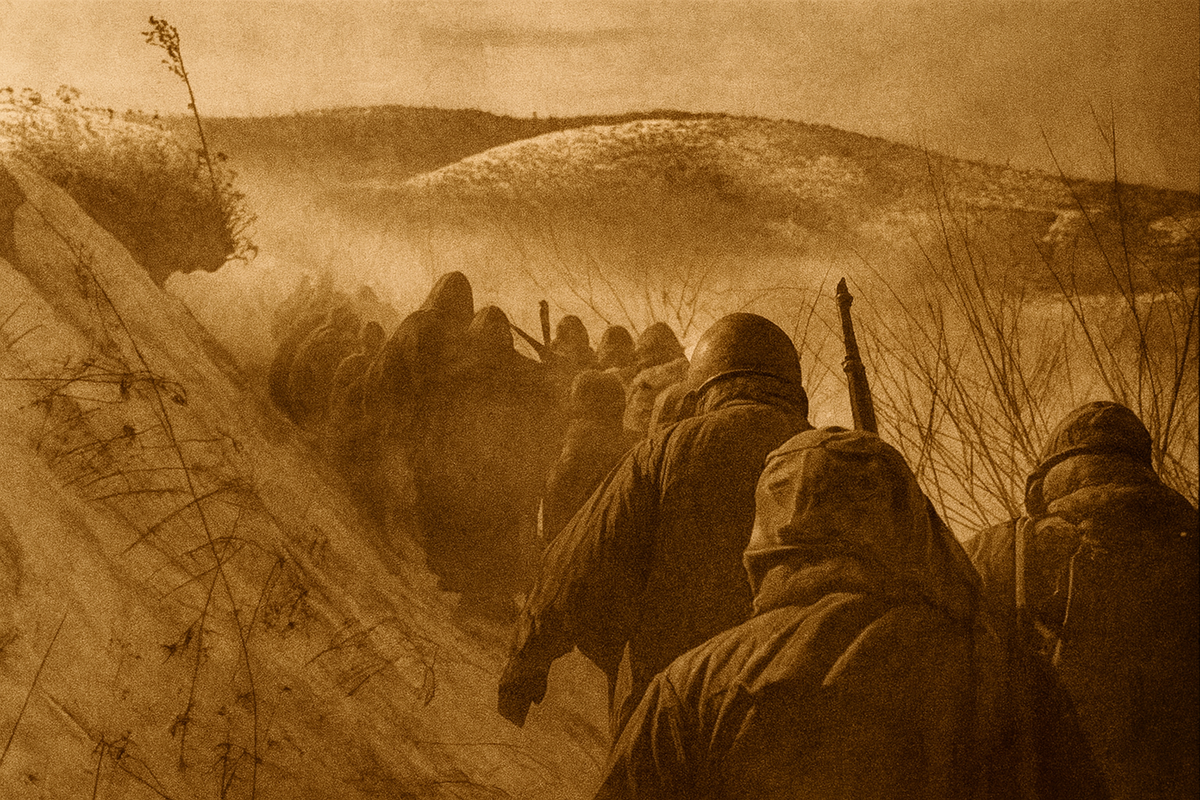
A Frozen Christmas in Korea
The Life Magazine Issue That Brought the Chosin Reservoir Home
Americans opening their mailboxes on December 25, 1950 expected holiday cheer. What they got instead was a glimpse of hell frozen over.
The cover of that week's Life Magazine showed a painting by John Koch—a mother and child bathed in Christmas warmth. But turn the page, and the illusion shattered. Inside waited David Douglas Duncan's searing photo-essay "There Was a Christmas," documenting U.S. Marines fighting their way out of the Chosin Reservoir in Korea. No tinsel. No carols. Just frostbitten faces, frozen rations, and the dead riding alongside the living through twenty miles of mountain hell.
This wasn't war reporting. This was a reckoning.
The Battle That Changed Everything
By late November 1950, the Korean War looked nearly won. United Nations forces had pushed North Korean troops to the Chinese border. Then the calculus changed overnight. Hundreds of thousands of Chinese troops poured across the Yalu River, and suddenly the First Marine Division found itself encircled at the Chosin Reservoir—outnumbered, cut off, and facing temperatures that plunged past thirty degrees below zero.
For two weeks, 15,000 Marines fought through Chinese divisions while temperatures turned rifle oil to sludge and morphine to ice. They carried their wounded. They carried their dead. They carried every weapon they could salvage, refusing to leave a single rifle for the enemy. The march to the evacuation port at Hamhung became one of the most brutal retreats in American military history.
Life brought that ordeal into American living rooms on Christmas morning.
Issue Archive
Publication: Life Magazine
Issue Date: December 25, 1950
Photographer: David Douglas Duncan
Photo-Essay: "There Was a Christmas"
Cover Artist: John Koch
Historical Context: Chosin Reservoir Campaign, Korean War
Duncan's Lens: War Without Filter
David Douglas Duncan didn't photograph war—he inhabited it. A Marine Corps combat photographer in World War II, he returned to Korea in 1950 with Life's backing and a Leica camera. What he captured at Chosin transcended photojournalism. These weren't images meant to inform. They were meant to bear witness.
The faces alone told stories words couldn't carry. Marines stared into Duncan's lens with eyes that had seen too much. Frostbite split their lips. Exhaustion carved lines into faces barely old enough to vote. Each portrait became a study in what the human body can endure when surrender isn't an option.
The march. Column after column of men threading through mountain passes, single file against the snow. Their shadows stretched long across frozen ground, each step a small victory against cold that killed as efficiently as bullets.
The dead among the living. Duncan's most unforgettable images showed Marines trudging past the bodies of fallen comrades laid along the roadside. The caption became iconic: "The living walk and the dead ride." No euphemism. No sanitizing. Just the brutal arithmetic of retreat.
Fleeting humanity. In one frame, a Marine slumped asleep at the wheel of his jeep, a small Korean puppy curled against him for warmth. Duncan's caption read: "at the wheel of his halted jeep, a Marine sleeps while his puppy whines." Amid the carnage, a reminder that tenderness survived.
This was Life's genius laid bare. The magazine had built its reputation on the principle that photographs told truths prose couldn't touch. Duncan's Chosin work proved it.
The Juxtaposition That Defined an Issue
That Christmas cover—Koch's painting of domestic warmth—wasn't an accident. It was editorial strategy. Life's editors understood that the collision between American expectation and Korean reality would hit harder than either image alone.
Readers turned from that peaceful mother and child to Duncan's stark black-and-white reality: Marines eating frozen rations in foxholes. Soldiers shivering through ambushes. Tanks grinding through ice while ammunition dumps exploded in the valley behind them, sending black smoke towers into white sky. The magazine didn't allow readers to look away.
Other publications offered dispatches. Life offered presence. You didn't just read about Korea. You stood in those mountain passes. You felt the cold. You saw the price.
Ten Moments That Made History
Duncan's photo-essay assembled into a narrative of survival built from specific, searing details:
Together, these elements created one of the most powerful wartime narratives Life ever published.
Holding History in Your Hands
The December 25, 1950 issue endures because it preserved more than facts. It captured atmosphere. Emotion. The texture of a moment when Americans confronted the gap between holiday ritual and wartime reality.
Most news now evaporates within hours. These magazines were printed, studied around kitchen tables, discussed, and kept for decades. They function as time capsules—not just of events, but of how those events were presented and understood.
When you hold this issue, you're holding what families read on Christmas morning 1950. You're seeing Duncan's photographs as they first appeared. You're experiencing the editorial choices Life made about what to show and what to withhold.
Why This Issue Endures
Historical Convergence
Published during the Chosin Reservoir campaign, capturing the war's turning point in real time.
Duncan's Mastery
His photographs are considered among the finest war photography of the 20th century—studied in journalism schools, displayed in museums, referenced in military histories.
Cultural Resonance
The issue captured an impossible tension: American Christmas comfort juxtaposed against Marines fighting for survival half a world away.
Collector Demand
Korean War coverage, particularly Chosin material, commands serious interest from veterans, historians, and archivists.
Artifact Status
This isn't a reproduction. It's the original object that sat on American coffee tables in 1950, studied and saved, now a direct link to how that generation understood war.
For collectors and historians, vintage Life magazines offer something digital archives can't: the physical experience of history as it was first consumed.
Explore the Archive
Thousands of original Life magazines spanning the 1930s through the 1970s are available to browse and purchase—decades of culture, politics, war, and art as they were first reported.
Whether you're a collector, military historian, or honoring a family member who served, these magazines offer something rare: the chance to see history exactly as it was presented to the people who lived it.
Browse Original Life Magazines
Explore decades of American history through the original magazines that documented it.
Browse Life Magazine CollectionThe Last Word
Duncan's work at Chosin didn't just document a battle. It redefined what war photography could be—unflinching, humanizing, and devastating in its honesty. The Marines who marched out of those mountains carried their wounded, their dead, and a story that Duncan made impossible to forget.
That Christmas wasn't about celebration. It was about endurance. And thanks to one photographer's refusal to look away, those frozen faces still stare back at us across seventy years, demanding we remember what survival cost.