
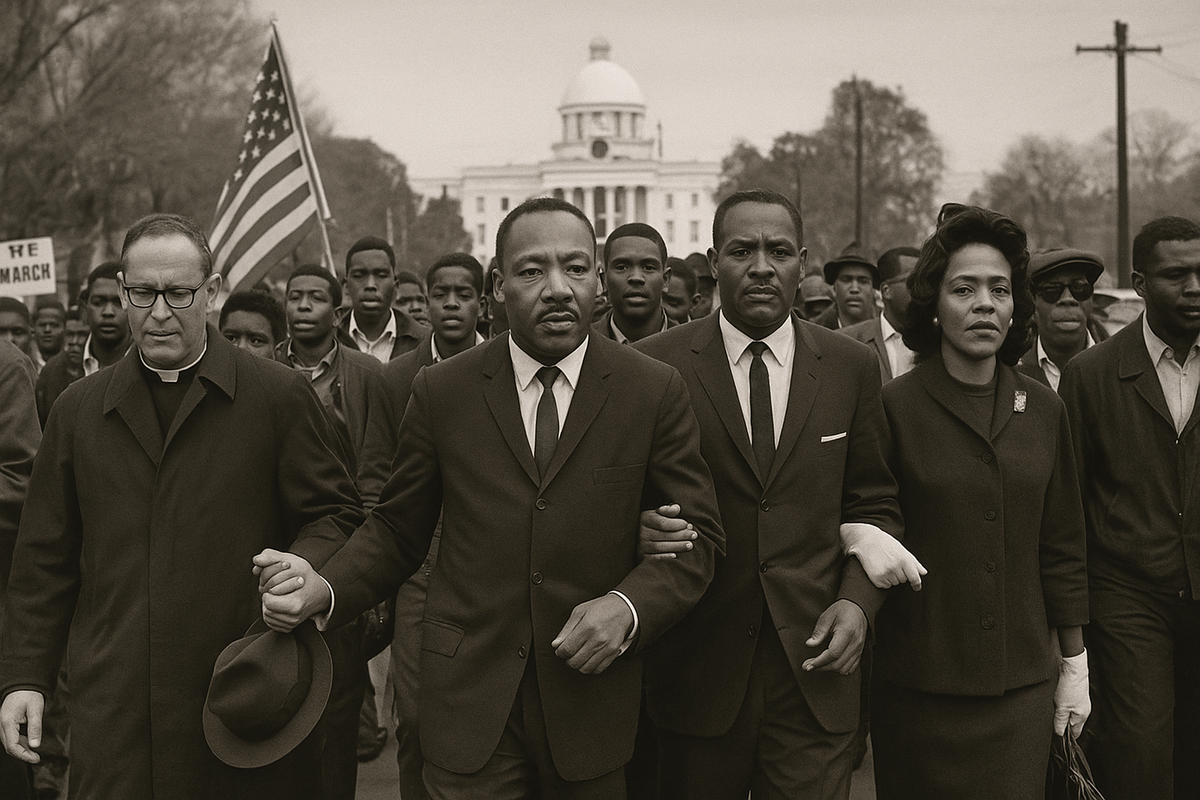
The Magazine That Refused to Look Away
Inside Jet's April 8, 1965 Selma Issue—The Documentation That Network Cameras Missed
On March 25, 1965, fifty thousand people stood before the Alabama State Capitol and dared the South to deny them the vote. Three days later, Viola Liuzzo lay dead on Highway 80, shot by Klansmen for driving marchers home.
By April 8, when Jet Magazine hit newsstands, America was still reeling. And while network cameras had already moved on to the next crisis, Jet did something the mainstream press could not: it stayed.
The April 8, 1965 issue—headlined "The Untold Drama of the March on Montgomery"—wasn't breaking news. It was bearing witness. Page after page, it documented what the marchers endured across 54 miles of Alabama asphalt: the frozen nights in muddy campsites, the state troopers photographing faces for retaliation files, the segregationists in cars painted with slurs. It showed Ralph Abernathy and James Bevel locking arms with Dr. King. It showed nuns walking beside sharecroppers. It showed Jim Leatherer, a white man from Michigan with one leg, refusing to turn back.
This was survival journalism. And for Black families from Harlem to Watts, it was proof that Selma had not been in vain.
When the Networks Looked Away, Jet Looked Closer
By 1965, Jet had become the most trusted publication in Black America—not because it sanitized the movement, but because it refused to. While Life and Look framed civil rights as a distant moral drama, Jet spoke directly to the people living it.
The magazine's founder, John H. Johnson, understood that Black readers didn't need their stories translated. They needed them told—with precision, urgency, and respect.
The Selma-to-Montgomery march was the kind of story that demanded all three.
After Bloody Sunday on March 7—when Alabama troopers tear-gassed and beat marchers on the Edmund Pettus Bridge—the nation watched in horror. President Johnson federalized the Alabama National Guard. A federal court cleared the way for a second march. And on March 21, Dr. King led the procession out of Selma again, this time flanked by soldiers, clergy, and thousands of Americans who had flown in from across the country.
Five days later, they reached Montgomery.
Jet's April 8 issue captured what happened in between.
Archive Details
Publication: Jet Magazine
Issue Date: April 8, 1965
Cover Story: "The Untold Drama of the March on Montgomery"
Historical Context: Published 14 days after the march concluded and 4 months before the Voting Rights Act was signed into law
Key Figures Featured: Dr. Martin Luther King Jr., Coretta Scott King, Ralph Abernathy, James Bevel, Jim Leatherer, Sister Mary Leoline
What the Magazine Showed
The cover is stark: Dr. King mid-stride, arm linked with Coretta Scott King and fellow activists, the Alabama Capitol looming in the distance. Inside, the photographs do not flinch.
You see exhaustion. Marchers slumped in roadside camps, feet blistered, clothes caked in red clay.
You see defiance. Young protesters hoisting American flags and hand-lettered signs demanding the vote—not asking, demanding.
You see solidarity. Sister Mary Leoline, a Catholic nun, walking the full 54 miles. Rabbis from New York. Ministers from Chicago. White college students sleeping in tents beside Black farmers who had never been allowed to register.
You see the enemy. Klansmen jeering from the roadside. State troopers with cameras, compiling files on every face they could capture. Cars smeared with Confederate flags and racist slogans trailing the march like vultures.
And you see the arrival: nearly fifty thousand people flooding the streets of Montgomery, delivering a moral reckoning to the seat of Alabama's white power structure.
Jet didn't editorialize. It didn't need to. The images made the case.
The Details That Made History Personal
What separated Jet from wire service coverage was its refusal to flatten the story into abstractions. The magazine profiled Jim Leatherer, the one-legged marcher from Michigan who hobbled on crutches for days because he believed the cause was worth the pain. It documented the federal protection—troops, marshals, and National Guard helicopters circling overhead—an unprecedented deployment that signaled how far the government had been forced to move.
It reported the bomb threats. The midnight raids on campsites. The jeering crowds who lined Highway 80 with signs that read "Yankee Trash Go Home" and worse.
And it told readers what Dr. King said when the march reached its end: that the arc of the moral universe bends toward justice, but only if people are willing to march it into being.
For a generation that had watched Emmett Till's mother weep over an open casket in Jet's pages a decade earlier, this was not inspiration. It was instruction.
Federal Intervention
The deployment of National Guard troops and federal marshals marked an unprecedented shift in government protection for civil rights demonstrators.
Interfaith Unity
Catholic nuns, rabbis, ministers, and laypeople walked together—a visual rebuke to segregation's moral claims.
Surveillance and Intimidation
State troopers photographed marchers to compile retaliation lists, a practice that would haunt participants for years.
Ordinary Heroism
Jet spotlighted individuals like Jim Leatherer, whose one-legged march symbolized the personal cost of collective courage.
Why Jet's Civil Rights Coverage Endures
Other magazines covered Selma. Only Jet testified.
Every photograph, every caption, every layout choice reinforced a single message: This happened. These people did this. And you cannot look away.
That urgency has not faded. If anything, it has compounded. In an era when access to the past is increasingly algorithmic—where search results bury inconvenient truths and streaming archives erase what doesn't fit the narrative—these physical magazines become acts of resistance.
They cannot be edited. They cannot be memory-holed. They simply are.
Why Collectors Guard This Issue Like Scripture
Historical Timing
Published days after the march concluded and weeks before the Voting Rights Act was signed into law, it captures the turning point in real time—showing the sacrifice before the victory was certain.
Iconic Photography
Features Dr. King, Coretta Scott King, and the ordinary citizens whose names never made textbooks but whose courage built democracy.
Firsthand Reporting
Documents what mainstream outlets missed or minimized—the bomb threats, the surveillance, the interfaith solidarity, and the resilience of everyday marchers.
Cultural Permanence
These pages were studied, saved, and passed down. They are time capsules, not headlines—primary sources that connect us to a history we are still reckoning with.
To own this issue is to hold the same images that steeled a generation in 1965. It is a bridge between a history we are still reckoning with and a present we are still fighting to redeem.
Where to Find the Archive
Thousands of original Jet magazines from the 1950s through the 1970s are preserved in our collection—covering the Montgomery Bus Boycott, the March on Washington, the assassination of Dr. King, the rise of Black Power, and every moment in between.
For historians, educators, and collectors, these issues are not nostalgia. They are evidence.
Explore the Complete Archive
Browse hundreds of original Jet magazines documenting the Civil Rights Movement, from the frontlines to the final victories. Each issue is a primary source—unedited, unfiltered, and irreplaceable.
Browse Jet Magazine CollectionThe March That Bent History
The Selma-to-Montgomery march forced a reckoning. It exposed the brutality of Southern resistance. It shamed a nation into action. And it proved that ordinary people—sharecroppers and nuns, college students and one-legged veterans—could march the moral universe toward justice by sheer force of will.
Jet Magazine didn't just report that story. It preserved it.
Fifty-nine years later, the April 8, 1965 issue remains what it was then: a living artifact of American courage, sacrifice, and refusal.
Hold it in your hands, and the past stops being past.