
When America Woke Up to Find China Lost
The Saturday Evening Post and the Mission That Could Never Succeed
On a winter morning in 1950, millions of American families opened their mailboxes to find the January 21st issue of The Saturday Evening Post. The cover greeted them with a scene of domestic chaos: exhausted parents slumped in bed while their bright-eyed infant daughter sat bolt upright in her crib, ready to conquer the day. The caption joked about this tiny "alarm clock" that couldn't be switched off.
They smiled. They turned the page.
And then they confronted Joseph Alsop's devastating conclusion: "The Foredoomed Mission of General Marshall."
Inside those pages, one of America's most respected journalists delivered his final argument for why the United States had lost China to communism—and why the nation's most revered general had been sent to perform the impossible. For readers still processing the shock of Mao Zedong's victory just months earlier, this wasn't merely analysis. It was a reckoning.
The Mission That Haunted a Nation
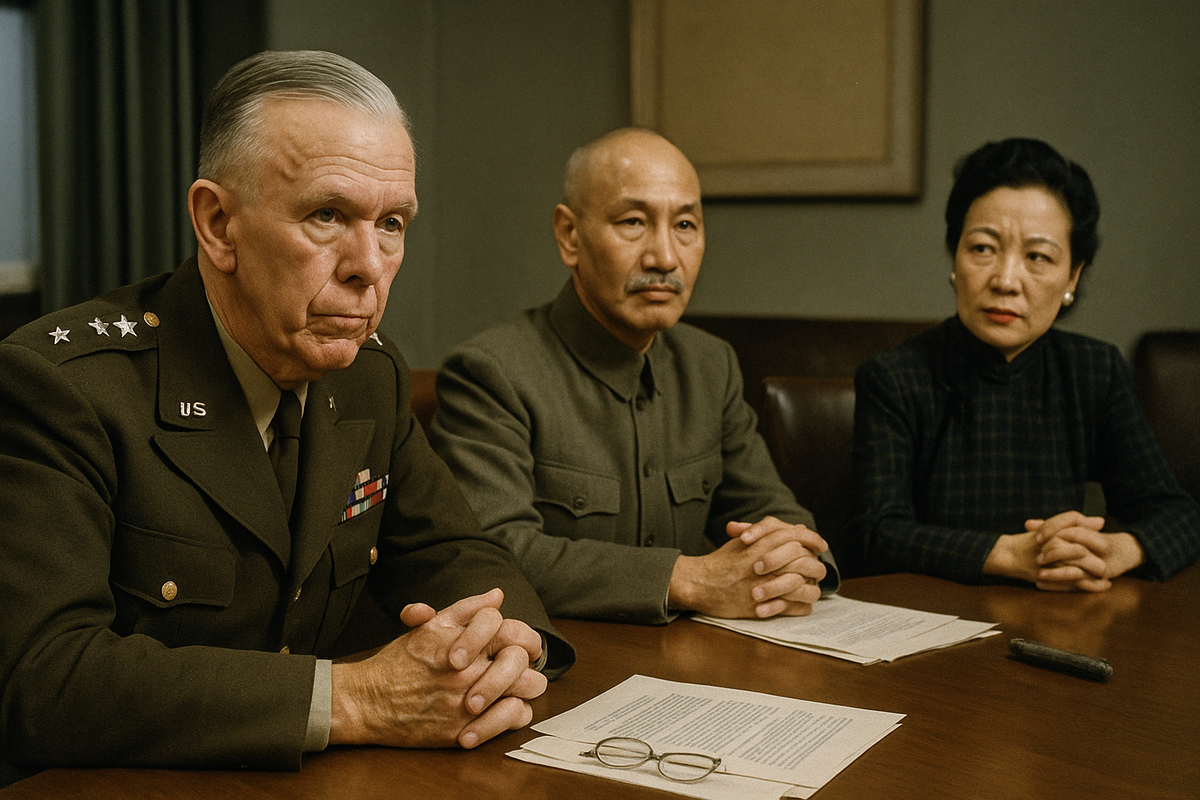
General George C. Marshall arrived in China in December 1945 with a mandate from President Truman: broker peace between Chiang Kai-shek's Nationalist government and Mao Zedong's Communist forces. Marshall was no ordinary diplomat. As Army Chief of Staff during World War II, he had orchestrated the defeat of Nazi Germany and Imperial Japan. His integrity was unquestioned. His strategic mind was unmatched.
Yet Alsop's article made a stark claim: Marshall's mission was doomed before it began.
The wounds were already too deep. General Joseph Stilwell, brilliant but abrasive, had poisoned relations with Chiang through bitter quarrels and public contempt. Patrick Hurley, sent as a mediator, watched his negotiations crumble into mutual suspicion. General Albert Wedemeyer, capable and diplomatic, arrived too late and with too little political capital to reverse the slide.
By the time Marshall stepped onto Chinese soil, the Nationalist government was hemorrhaging authority. Corruption riddled Chiang's administration. Military incompetence squandered American aid. Meanwhile, Mao's Communists—disciplined, unified, and gaining momentum—were winning the allegiance of China's rural millions.
Marshall was tasked with supporting Chiang while simultaneously pressuring him to compromise with Mao. The contradiction was impossible to resolve. Alsop argued that no amount of American influence, no matter how skillfully applied, could bridge a chasm this wide.
Historical Context
Featured Figure: General George C. Marshall
Issue Date: January 21, 1950
Publication: The Saturday Evening Post
Author: Joseph Alsop
Series: "Why We Lost China" (Concluding Article)
Why Alsop's Voice Mattered
Joseph Alsop wasn't just another columnist. He was a political force—a journalist whose access to power brokers and gift for narrative made him required reading in Washington and beyond. His three-part series "Why We Lost China" didn't merely report events; it shaped how Americans understood them.
The Saturday Evening Post gave Alsop's argument mass circulation. With millions of subscribers, the magazine reached into living rooms across every state, carrying foreign policy debates directly to kitchen tables. This was how mid-century America consumed its history: not through academic journals or policy briefs, but through the same publication that delivered Norman Rockwell covers and short fiction.
The timing was critical. Mao had proclaimed the People's Republic of China in October 1949. By January 1950, the shock was fresh, the questions raw: Who lost China? Could we have stopped this? Alsop's answer—that Marshall's mission was structurally impossible—offered both explanation and absolution for the general, while indicting the chaotic procession of American envoys who preceded him.
The Cover That Captured Two Americas
The juxtaposition on January 21, 1950, was almost too perfect to be accidental.
On the cover: a moment of universal parental exhaustion, rendered with humor and warmth. Inside: Alsop's autopsy of American failure in the world's most populous nation, a geopolitical catastrophe that would define the Cold War in Asia.
This duality was The Saturday Evening Post's genius. The magazine didn't segregate the personal from the political. It understood that American families lived in both worlds simultaneously—changing diapers at dawn, debating Communist expansion by dinner. The cover's sleepless parents could laugh at themselves, then turn the page and confront the reality that their children would grow up in a world where one-quarter of humanity had just aligned with America's existential rival.
That blend of the intimate and the global is what made the Post more than entertainment. It was a cultural barometer, a weekly ritual that bound together news, art, fiction, and national identity.
The Architect of Failure: A Cast of Characters
Alsop's narrative didn't blame Marshall. It blamed history.
General Joseph Stilwell
Known as "Vinegar Joe" for his caustic temperament, Stilwell's military acumen couldn't compensate for his open disdain for Chiang Kai-shek. His feuds with the Generalissimo crippled American-Nationalist cooperation at a critical juncture.
Patrick Hurley
A former Secretary of War sent to mediate, Hurley's negotiations collapsed under the weight of distrust on all sides. He resigned in frustration, publicly blaming Foreign Service officers for sabotaging his efforts.
General Albert Wedemeyer
Diplomatic and competent, Wedemeyer replaced Stilwell and attempted to salvage U.S.-Nationalist relations. But he arrived with limited authority and insufficient resources to reverse years of erosion.
Chiang Kai-shek's Nationalists
Plagued by corruption, factionalism, and military incompetence, Chiang's government squandered American aid and lost the confidence of China's population.
Mao Zedong's Communists
Disciplined, ideologically unified, and tactically superior, Mao's forces systematically dismantled Nationalist resistance and seized control of the mainland.
By the time Marshall arrived, these forces had set the stage for collapse. Alsop argued that Marshall's integrity and skill couldn't overcome the cumulative weight of prior failures and structural rot.
Why This Issue Endures
For collectors and historians, the January 21, 1950 issue of The Saturday Evening Post occupies rare territory.
It captures Cold War origins in real time. This wasn't retrospective analysis—it was published mere months after Mao's victory, when the shock was still visceral and the implications unknown.
It bears Joseph Alsop's byline at peak influence. Few journalists shaped Cold War policy debates as profoundly as Alsop. This series cemented his status as an architect of public understanding.
It juxtaposes humor and catastrophe. The domestic cover paired with Alsop's grim narrative creates a snapshot of how Americans processed global crisis alongside everyday life.
It documents a national trauma. The "loss of China" wasn't just a headline—it was a wound that spawned McCarthyism, reshaped American politics, and drove decades of foreign policy.
It's a physical artifact of mid-century media culture. Before cable news and the internet, this was how history entered American homes: on coated paper, delivered by mail, saved in family libraries.
The Magazine as Time Capsule
What makes vintage Saturday Evening Post issues so compelling isn't just their content—it's their form. These magazines were designed to be kept. Their covers were art. Their pages mixed fiction, humor, advertising, and world affairs into a single authoritative package.
The January 21, 1950 issue embodies this perfectly. A reader could move from Alsop's analysis of Marshall's mission to a short story, from a political cartoon to product advertisements, from cultural commentary to household tips. Each section reflected a different facet of American life, yet they coexisted naturally within the magazine's pages.
This is why collectors treasure these issues. They aren't just reading material—they're windows into how mid-century Americans understood themselves and their world. Every advertisement, every illustration, every editorial choice reveals something about the anxieties, aspirations, and assumptions of the era.
For Collectors and Historians
Cold War Milestone
This issue captures the immediate American reaction to the Communist victory in China, offering contemporary analysis from one of the era's most influential journalists.
Cultural Artifact
A perfect example of how American families consumed news, fiction, humor, and political commentary in a single authoritative package during the mid-20th century.
Historical Documentation
Original issues provide direct access to how distant geopolitical struggles entered everyday conversation, preserved exactly as contemporary readers experienced them.
Explore Our Archive
If you collect Cold War artifacts, mid-century journalism, or vintage magazines, this issue belongs in your archive. For those honoring family members who lived through this era, original issues like this offer something irreplaceable: the chance to see history as they saw it.
Browse The Saturday Evening Post Magazine CollectionA Conversation With the Past
The January 21, 1950 issue of The Saturday Evening Post remains a landmark in Cold War journalism. Through Joseph Alsop's "The Foredoomed Mission of General Marshall," Americans received not just an explanation for China's fall, but a framework for understanding the painful limits of American power.
Marshall's mission couldn't succeed because the contradictions were baked in from the start. The article didn't offer false hope or easy answers—it offered clarity about failure. And in doing so, it helped a nation begin to comprehend the new global struggle it had entered.
Holding this issue today is holding a conversation with that moment—when America looked across the Pacific and realized the world had fundamentally changed.