
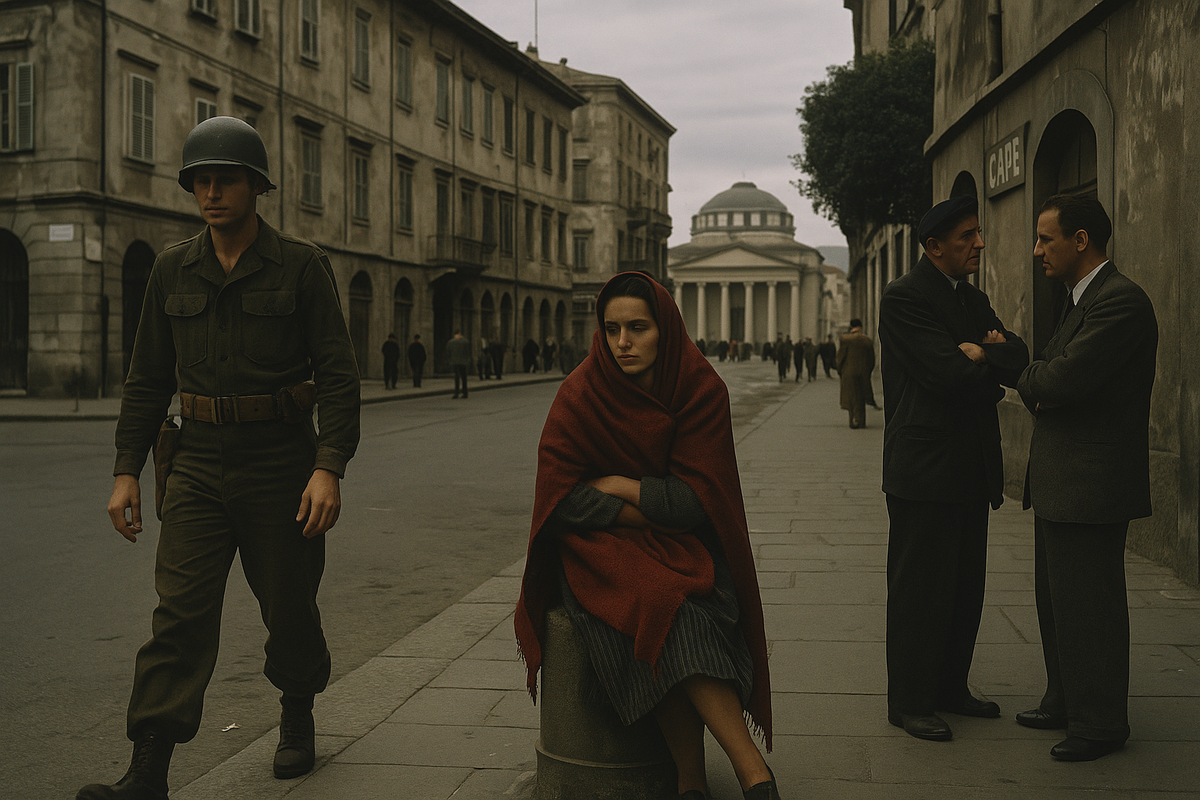
The City America Forgot to Fear
When The New Yorker Sent Readers to the Edge of World War III
October 1950. Korea was burning. Stalin's shadow stretched across Eastern Europe. And buried on page 86 of The New Yorker, between a cartoon about Park Avenue matrons and an advertisement for Chesterfield cigarettes, was a dispatch from the most dangerous city in the Western world.
"Letter from Trieste."
Most Americans had never heard of it. But diplomats in Washington knew: Trieste was where the Cold War could go hot.
The free port at the head of the Adriatic—claimed by Italy, occupied by Yugoslavia, patrolled by American and British troops—was a geopolitical tripwire. One wrong move, one riot in the piazza, one nationalist march that turned into gunfire, and NATO's southern flank could collapse. Tito's forces would roll west. The Soviets, despite their split with Belgrade, might intervene. Italy, barely a democracy, could fracture.
And The New Yorker—that bastion of wit, sophistication, and three-martini urbanity—sent a correspondent to walk those streets, to sit in those cafés where Italian shopkeepers glared at Slavic dockworkers, to watch American GIs patrol a city that belonged to no one.
The October 21, 1950 issue didn't just report on Trieste. It made readers feel the paranoia, the stalemate, the strange mundanity of living on the knife's edge of history.
Today, that issue is a rarity—and a revelation.
The Adriatic Powder Keg
Trieste in 1950 was not merely disputed. It was occupied uncertainty.
After World War II, the Allies had improvised a solution: the Free Territory of Trieste, split into two zones. Zone A—the city itself—fell under British-American military government. Zone B, the hinterland, went to Yugoslavia. The arrangement was meant to be temporary. Three years later, it remained frozen.
Italy wanted Trieste back. It had been Italian since 1918, and losing it felt like losing a limb. Yugoslav partisans, who had fought the Nazis in those hills, believed Trieste belonged to the new socialist state. Marshal Tito—freshly excommunicated by Stalin in 1948—needed victories to prove his independence from Moscow. Trieste would do nicely.
The Western powers, meanwhile, faced an impossible calculus. Support Italy too openly, and Tito might swing back toward the Soviets. Support Yugoslav claims, and Italy's fragile post-fascist government could collapse into communist hands.
So the troops stayed. The border remained a fiction. And Trieste became the Cold War in miniature: two ideologies, two nationalisms, one city, no exit.
Archive Details
Publication: The New Yorker
Issue Date: October 21, 1950
Cover Artist: Garrett Price
Featured Article: "Letter from Trieste"
Historical Context: Published four months into the Korean War, during the height of early Cold War tensions and the Trieste territorial crisis
Why The New Yorker Went There
This was not the magazine's usual beat. The New Yorker in 1950 was known for John Cheever stories, E.B. White essays, and Saul Steinberg's urbane illustrations. Foreign correspondence existed, but it leaned toward Paris, London, the theaters of culture.
Trieste was different. Trieste was dangerous.
The decision to run "Letter from Trieste" signaled something profound: The New Yorker understood that the American Century meant American entanglement. Its readers—educated, cosmopolitan, skeptical of propaganda—needed to grasp what their country was doing abroad. Not through Pentagon briefings or State Department abstractions, but through the texture of lived experience.
The article delivered exactly that. Readers encountered British officers drinking in hotel bars, Yugoslav flags unfurling during protests, Italian shopkeepers shuttering their windows when tensions rose. They heard the cadence of a city holding its breath.
The New Yorker didn't editorialize. It observed. And in that restraint lay its power.
The Art of Cold War Journalism
What made "Letter from Trieste" extraordinary was its refusal to simplify.
Other American publications—Life, Time, Collier's—framed the Cold War in stark binaries: freedom versus tyranny, democracy versus communism. The New Yorker understood that reality was messier. Trieste wasn't a morality play. It was a tragedy of competing legitimacies.
The correspondent (whose byline, frustratingly, has faded from surviving records—perhaps Janet Flanner, perhaps another of the magazine's European stringers) captured this ambiguity in every paragraph. Italian nationalists weren't villains; they were veterans who had lost a war and feared losing their identity. Yugoslav partisans weren't Soviet puppets; they were fighters who believed they had earned the city with blood.
And the Americans? They were there because someone had to be. Not out of ideology, but out of necessity. The article subtly asked: How long can necessity last?
This was journalism written with a novelist's eye and a historian's caution. It trusted readers to sit with complexity rather than demanding easy answers.
The Cover's Quiet Prophecy
Garrett Price's cover for the October 21, 1950 issue shows a sculpture class: young artists molding clay, a woman in a red robe posing as their subject, busts and figures cluttering the studio.
On the surface, pure New Yorker whimsy—the kind of urbane, slightly absurd slice of city life the magazine loved.
But context transforms it. In a magazine containing a dispatch from a city being remade by foreign powers, the sculpting studio becomes metaphor. Who gets to shape the future? The artists—or the clay? The Allies were sculpting postwar Europe, carving borders, molding identities. Trieste was their unfinished statue.
Price's cover, like the best New Yorker art, worked on two levels: accessible charm on first glance, deeper resonance on reflection.
The Deep Dive: What Made This Issue Essential
The Divided City
Trieste as microcosm: a city torn between old loyalties, new ideologies, and foreign armies—the entire Cold War compressed into one Adriatic port.
Tito's Gambit
Yugoslavia after the 1948 Stalin split: caught between East and West, using Trieste to prove independence while maintaining socialist credentials.
American Entanglement
U.S. troops on European streets raised the question: what responsibility came with this presence? The New Yorker didn't preach—it documented.
The Human Angle
From dockworkers to students, from rallies to café arguments—geopolitics lived out in everyday routines, making the abstract personal.
Each of these themes gave readers a sense that Trieste was not just a city in dispute. It was a symbol of the fragile architecture of postwar peace—and a preview of the decades to come.
The Postscript History Wrote
Trieste's crisis eventually resolved. In 1954, Italy regained the city; Yugoslavia kept the hinterland. The compromise held. No shots were fired. The crisis that obsessed diplomats for a decade ended with a signature, not a siege.
But in October 1950, no one knew that. The correspondent who wrote "Letter from Trieste" walked streets where the future was genuinely uncertain. That uncertainty—that sense of standing at history's branching path—saturates every line.
Reading it now, we know how the story ended. But the article preserves the not-knowing, the authentic dread and possibility of the moment. That's what makes vintage journalism invaluable: it captures what people felt before the outcome was decided.
Why This Issue Matters to Collectors
Historical Timing
Published four months into the Korean War, capturing the moment Americans realized global conflict wasn't ending—it was metastasizing across continents.
Journalistic Milestone
"Letter from Trieste" represents early Cold War reportage at its most sophisticated—a bridge between wartime dispatches and 1960s adversarial journalism.
Cover Artistry
Garrett Price's sculpting class scene stands out in his catalog for its subtle thematic resonance with the issue's geopolitical content.
Archival Rarity
Unlike anthologized issues (Hiroshima, Eichmann), this one hasn't been widely digitized. Original copies are the only way to experience it as intended.
Why You Should Own This
If you collect the artifacts of American intellectual life, this issue belongs on your shelf. If you study how Cold War anxieties shaped media, this is a primary source. If you simply love The New Yorker's particular alchemy of style and substance, this is the magazine at its most consequential.
It's not the most famous issue. It's not the most expensive. But it's the kind of rarity that rewards close reading—the kind historians cite, collectors prize, and readers return to.
Explore the Archive
From the Jazz Age through the Cold War, from Hiroshima to Watergate—these aren't reprints or PDFs. They're the real thing: ink, paper, history you can hold.
Browse The New Yorker Magazine CollectionThe Final Word
The October 21, 1950 New Yorker reminds us that great magazines don't just report events—they teach readers how to think about them.
Trieste could have been reduced to propaganda: the West versus the East, democracy under siege. Instead, The New Yorker delivered nuance, ambiguity, and the uncomfortable truth that history rarely offers clean resolutions.
That approach—literary, skeptical, deeply human—defined the magazine's Cold War coverage. And it's why, 75 years later, this issue still reads like news from a world we thought we'd left behind but never quite escaped.
Find it. Read it. And understand what journalism looked like when it still believed readers could handle the truth in all its complexity.