
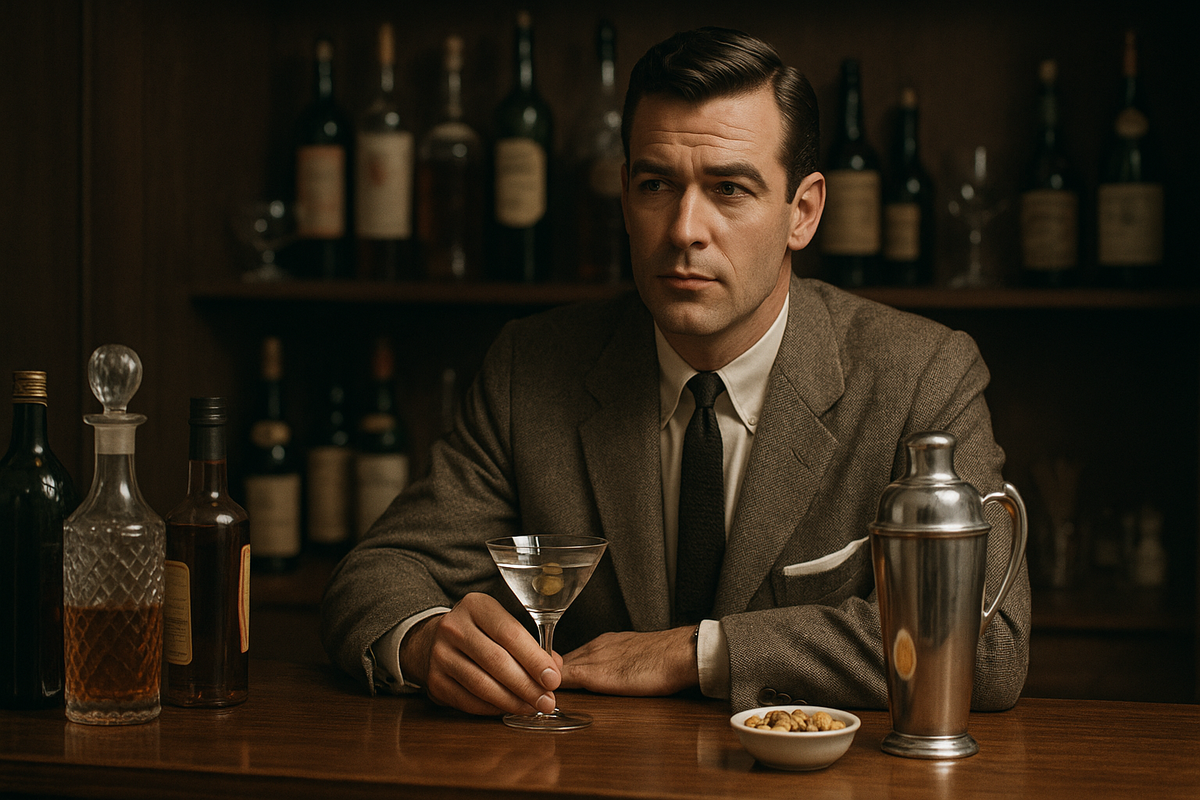
The Last Martini Before the Revolution
Inside Esquire's Lost Bible of 1960 Cocktail Culture
When Americans opened their January 1960 issue of Esquire, they had no idea they were holding the final testament of a vanishing world.
Within weeks, John F. Kennedy would announce his presidential campaign. Within months, the first sit-ins would ignite the Civil Rights Movement. Within a year, the cocktail party—that sacred ritual of mid-century manhood—would begin its slow eclipse into cultural relic. But in those opening days of 1960, before the decade detonated, Esquire published what remains the most comprehensive document of American bar culture ever committed to print: the Liquor Intelligencer.
This wasn't a drinks column. This was a 40-page manifesto on how to live.
Archive Details
Publication: Esquire Magazine
Issue Date: January 1960
Feature: The Liquor Intelligencer
Historical Context: Published on the eve of Kennedy's presidency and the cultural transformations of the 1960s
The Architecture of Desire
The Liquor Intelligencer arrived at the exact moment when the home bar had transcended furniture to become theater. Your bar didn't just hold bottles—it performed your identity. A crystal decanter of Cognac whispered European refinement. A row of single-malt Scotches telegraphed worldliness. The absence of sweet liqueurs suggested seriousness. In suburban America, where men returned from offices to kingdoms of lawn and leather, the bar was the throne room.
Esquire understood this completely. The feature opens with "The Primer of Potables," a glossary written with the clinical precision of a field guide and the swagger of a ringside commentator. Aperitifs. Aquavit. Bourbon. Vodka. Each entry serves dual purpose: education for the novice, validation for the informed. The illustrations—clean line drawings of bottles and stemware—give the pages the authority of a technical manual and the accessibility of a comic strip.
But the true genius emerges in the "Guide to Stocking the Bar," where Esquire constructs a three-tiered ladder of aspiration: the "minimum bar," the "middle-sized bar," and the "no-holds-barred bar." Each level lists bottles, mixers, glassware. Each level is illustrated. A man could measure his progress not by promotions or square footage, but by how many shelves deep his liquor cabinet ran. This was self-improvement disguised as shopping advice.
The Questions Men Wouldn't Ask
Mid-century masculine confidence had limits. A man might bluff his way through a boardroom but panic silently at a wine shop. Esquire knew this. The "Q&A for Your A.Q." section weaponized humor to disarm embarrassment.
What's the difference between cognac and brandy?
Why is a pony permitted?
Should whiskey be stored differently from wine?
The questions feel almost quaint now, but in 1960 they were urgent. Esquire answered each with wit sharp enough to entertain and authority deep enough to trust. This was the magazine's great trick: making education feel like inclusion. You weren't learning—you were joining a conversation already in progress.
172 Variations on Perfection
Then comes the monument at the center of the issue: "172 Ways to Make a Martini."
One hundred and seventy-two.
Not "10 Classic Variations" or "A Dozen Twists." One hundred and seventy-two methodical permutations of gin, vermouth, ice, and glassware. Dry. Dirty. With lemon peel. With onions. Shaken. Stirred. Each variation catalogued with the obsessive precision of a lepidopterist pinning butterflies. An illustrated diagram dissects the Martini like a blueprint, transforming America's most famous cocktail into an engineering problem with infinite solutions.
This wasn't bartending—this was philosophy. The Martini had become American shorthand for sophistication, and Esquire was publishing its Rosetta Stone. The article said: You think you know this drink? You know nothing. Let us show you everything.
The Visual Language of Aspiration
Between the prose and cartoons, Esquire deployed its secret weapon: photography that transformed liquid into luxury. Full-color spreads organized drinks by occasion—Lunch Time, Cocktail Time, Dinner Time, Coffee Time. Each photograph was lit and composed like fashion editorial. Gleaming glasses. Perfect garnishes. Condensation beading on crystal in impossibly controlled environments.
This was aspirational imaging at its most effective. Readers weren't looking at drinks—they were looking at the life that contained those drinks. The polished bar cart. The modern glassware. The casual mastery of the host who could produce any of these on command. Esquire wasn't selling recipes. It was selling transformation.
The Sociable Speller
"P.A.R.T.Y." — Esquire's acronym-based guide to entertaining that assumed a man should not merely attend gatherings but architect them with abundance, creativity, and style.
Cooking with Spirit
Liquor as ingredient: marinating with wine, flambéing with cognac, finishing sauces with vermouth. The gentleman mastered both bar and stove.
A to Z of Cocktail Foods
An alphabetical march from anchovy paste to zucchini soup, each entry with recipes and sketches. Drinks were only half the equation.
How to Read a Wine Label
Using a French Bordeaux label illustration, Esquire decoded every phrase—from Appellation Contrôlée to Mis en Bouteille d'Origine—giving readers confidence to navigate wine culture.
The Lost Art of Civilized Excess
"The Sociable Speller: P.A.R.T.Y." might be the feature's most telling artifact. Using an acronym as scaffolding, Esquire constructed a how-to guide for entertaining that reads like field notes from a vanished civilization. Abundance. Creativity. Fun. The underlying assumption—that a man should not merely attend gatherings but architect them—feels almost alien now.
So does "Cooking with Spirit," which treated liquor as an ingredient rather than escape. Marinating with wine. Flambéing with cognac. Finishing sauces with vermouth. The illustrations showed pans and flames and chefs at work, reinforcing the central thesis: the gentleman was equally competent at bar and stove.
Even the "A to Z of Cocktail Foods"—an alphabetical march from anchovy paste to zucchini soup—carries weight. Each entry includes recipes and serving suggestions, each paired with a sketch. The message was clear: drinks were only half the equation. A man who mastered cocktails but failed at canapés was a man doing homework with half the textbook.
The Wine Label as Cipher
One page may have aged better than any other: "How to Read a Wine Label." Using a large illustration of a French Bordeaux label, Esquire decoded every phrase, every designation. Appellation Contrôlée. Mis en Bouteille d'Origine. The terminology that confounds American wine buyers to this day.
In 1960, wine culture in the United States was embryonic. French wines were exotic, expensive, and wrapped in a language designed to exclude outsiders. Esquire made it legible. This single page likely gave thousands of men the confidence to navigate wine shops, order at restaurants, and stock cellars without humiliation. It was practical magic—the kind of service that built lifelong reader loyalty.
The Editorial Voice That Built an Era
What separates the Liquor Intelligencer from every drinks guide published before or since is Esquire's editorial alchemy. The magazine never talked down and never showed off. It assumed intelligence but not knowledge. It used humor to lower defenses and authority to build trust. The illustrations added levity. The cartoons added satire. The photography added aspiration. The writing combined sophistication with sly wit.
This was Esquire's genius in 1960: it didn't just report culture—it wrote the script. The magazine told men how to dress, how to think, how to host, how to signal refinement as America modernized around them. The Liquor Intelligencer was curriculum for an unofficial academy, and every reader was enrolled whether he knew it or not.
Why This Issue Matters Now
Cultural Snapshot
Captures the cocktail party era at its zenith, right before the cultural earthquakes of the 1960s cracked open every assumption about gender, leisure, and American life.
Design & Photography
The mix of whimsical illustrations and high-gloss cocktail photos makes it a visual artifact. Layouts that feel modern seven decades later.
Content Depth
Few magazines devoted this much space, this much craft, to a single subject. A 40-page manifesto on the art of living well.
Historical Significance
Documents the moment when American masculinity was codified in glassware and garnishes, when a man's bar was his biography.
To own an original copy of this issue is to hold that moment in your hands. Not a reprint. Not a digital scan. The actual artifact that sat on coffee tables and in dens as Kennedy campaigned and the Beatles were still playing Hamburg dive bars and the Martini was still America's drink.
The Document Survives
Vintage magazines endure because they are frozen time. Life. Playboy. Esquire. These weren't just periodicals—they were authority made tangible. In 1960, if Esquire said a man needed Cognac and aquavit and a proper shaker, that settled the question. Print didn't reflect culture. Print was culture.
The Liquor Intelligencer exemplifies this perfectly. It's witty, authoritative, visually stunning. It reveals not just how Americans drank in 1960, but how they thought about drinking, entertaining, performing masculinity in a world accelerating toward upheaval they couldn't yet imagine.
The cocktail party would fade. The rigid codes of mid-century manhood would shatter. But the magazine survives—a blueprint, a time capsule, a monument to the art of living well in an era that believed such things could be taught and learned and perfected with the right guidance and the right glassware and, yes, the right magazine spread open on the bar.
For collectors, historians, and anyone who understands that cocktails were never just about alcohol—they were about civilization—this issue of Esquire remains essential. Not simply reading material. An artifact. Evidence. Proof that we once believed style and substance could be mastered by any man willing to study, practice, and pour.
Explore the Archive
Browse original issues from the golden age of American magazine publishing. Each one a preserved artifact from an era when print shaped culture.
Browse Esquire Magazine Collection