
The Magazine That Saw the Future
April 12, 1982. Ronald Reagan occupied the White House. Personal computers were exotic luxuries. And buried inside that week's Forbes Magazine was a prophecy most Americans wouldn't understand for another forty years.
The article was titled "Preemptive Strike." It documented, in surgical detail, how Japan was systematically dismantling America's semiconductor industry—not with tariffs or blockades, but with a weapon far more insidious: artificially suppressed prices on 64K RAM chips. U.S. profits had cratered 60% in a single year. Intel, Motorola, and AMD were bleeding out. And the Japanese, playing a game measured in decades rather than quarters, were content to lose money today to own tomorrow.
For readers clutching that issue in their commuter trains and corner offices, it was a shock. The United States—birthplace of the transistor, architect of the Space Age—was losing a war most people didn't know had started.
Forbes didn't just report it. They dissected it like a battlefield autopsy.
When Microchips Became Missiles
The stakes were existential, and Forbes knew it. This wasn't about quarterly earnings or stock tickers. It was about who would control the substrate of the future: the silicon that would run everything from defense systems to dishwashers.
The flashpoint was the 64K RAM chip—primitive by today's standards, revolutionary in 1982. Japanese manufacturers, backed by coordinated industrial policy and deep government coffers, flooded the market with chips priced below cost. American firms, accountable to shareholders and quarterly reports, couldn't match the losses. Margins evaporated. Research budgets withered.
Jerry Sanders, the famously blunt CEO of Advanced Micro Devices, put it plainly: "By buying market share at the expense of profits, the Japanese have pumped hundreds of millions of dollars into research and development." Translation: while we're fighting to stay solvent, they're building the next generation.
IBM's Erich Bloch went further. A weakened U.S. chip industry, he warned, threatened not just commerce but national security. Semiconductors weren't commodities. They were strategic assets. Lose them, and you lose everything downstream: computing power, military superiority, economic leverage.
The article laid bare a fundamental truth that Forbes understood instinctively: profits aren't greed. They're oxygen. Without them, innovation suffocates. American companies weren't failing because they were lazy or incompetent. They were failing because they were being outspent by competitors willing to take losses for years to capture the future.
Historical Context
Publication: Forbes Magazine
Issue Date: April 12, 1982
Featured Article: "Preemptive Strike"
Key Figures: Jerry Sanders (AMD), Erich Bloch (IBM)
Archive Source: Original Magazines Collection
The Unprecedented Alliance
What made the crisis extraordinary wasn't just the threat—it was the response.
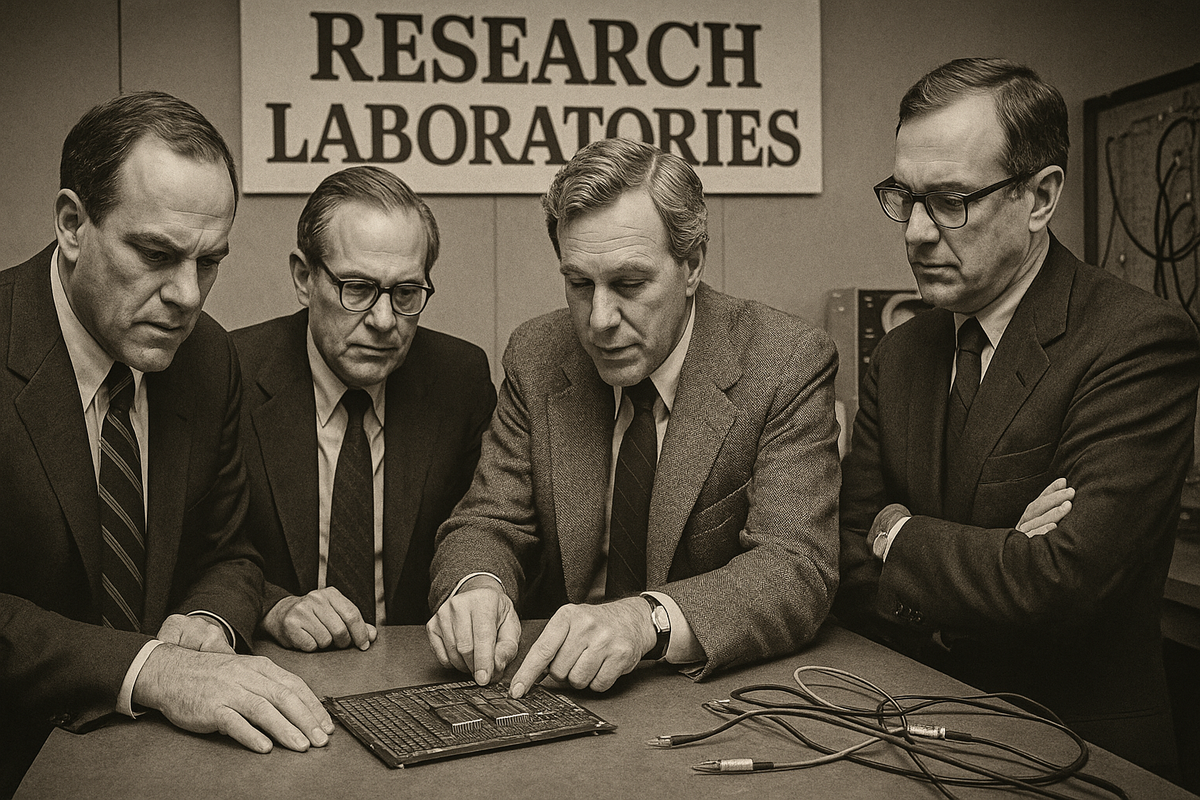
Twenty U.S. semiconductor firms, including blood rivals like Intel, National Semiconductor, and Motorola, joined forces to create a shared research consortium. Forbes illustrated this with a striking image: executives from IBM, Digital, and DEC huddled around a lab bench under a banner reading "Research Laboratories." It was Silicon Valley's version of the Manhattan Project—fierce competitors pooling resources because the alternative was collective extinction.
This kind of cooperation was unthinkable in an industry built on intellectual property wars and poaching talent. But 1982 was different. The enemy wasn't in Palo Alto or Austin. It was in Tokyo, Osaka, and Kyoto.
Forbes captured the drama without sensationalism. Their reporting blended hard financial data with voices from the frontlines, giving readers not just facts but context—the kind that made clear this was about more than chip prices. It was about whether America would control the technologies defining the 21st century or watch them slip overseas.
Why Forbes Nailed It
By 1982, Forbes had already established itself as the publication where business became strategy and commerce became power. Malcolm Forbes Sr.'s editorial vision was clear: treat capitalism not as accounting, but as warfare by other means. Cover stories weren't dry earnings reports. They were dispatches from economic battlefields.
The semiconductor piece exemplified that philosophy. Where other outlets saw a pricing dispute, Forbes saw a civilizational shift. Where others reported numbers, Forbes explained consequences. The magazine understood what many policymakers still didn't: semiconductors would become the oil of the digital age. Control them, and you control everything else.
The writing itself was sharp, authoritative, unapologetic. No hedging. No both-sides equivocation. Just clear-eyed analysis of an industry under siege and a nation sleepwalking toward technological irrelevance.
That voice—confident, contrarian, capitalist without apology—made Forbes essential reading for anyone who understood that markets were where the future got decided.
Key Themes from the April 12, 1982 Issue
Profits as Innovation Fuel
Forbes emphasized that semiconductor profits weren't optional luxury—they funded the research that kept America ahead. Without them, the U.S. risked technological obsolescence.
Japanese Long Game
By cutting prices and tolerating losses, Japanese firms forced American competitors into retreat while simultaneously expanding their own R&D capabilities.
National Security Stakes
IBM's Erich Bloch warned that a weakened U.S. chip industry would endanger not just commerce, but national defense and computing leadership.
Historic Cooperation
Twenty U.S. firms joined forces in a shared research consortium—rare collaboration in an industry defined by cutthroat competition.
The Collector's Case: Why This Issue Matters
Historical Inflection Point
Published at the apex of U.S.-Japan semiconductor rivalry, this issue captures the exact moment American technological supremacy came under genuine threat for the first time since World War II.
Voices from the Battlefield
Jerry Sanders, Erich Bloch, and other architects of the digital age speak directly from these pages. Their warnings, their strategies, their miscalculations—all preserved in original context.
Visual Character
The research consortium illustration alone distinguishes this from generic business coverage. It's a primary document with aesthetic weight.
Eerie Contemporary Relevance
Replace "Japan" with "China" and "64K RAM" with "advanced nodes," and the article reads like it was written yesterday. The semiconductor wars never ended. They just changed theaters.
The Lesson That Endures
Forbes got it right in 1982, even if the full implications took decades to unfold. The U.S. semiconductor industry did survive—barely—thanks to trade agreements, renewed investment, and eventual Japanese missteps. But the vulnerability was real. The warning was sound.
The magazine's core insight remains unassailable: innovation requires profits, and profits require protection. Markets don't regulate themselves toward optimal outcomes. Sometimes intervention isn't interference. It's survival.
That lesson echoes louder now than ever. As semiconductors return to the center of geopolitical competition, as supply chains fragment along ideological lines, as nations scramble to secure fabrication capacity, the April 12, 1982 Forbes Magazine reads less like history and more like prologue.
Holding this issue means holding a piece of the story—the moment America realized the future wasn't guaranteed, that technological leadership could be lost, and that the battles of tomorrow would be fought not with tanks but with transistors.
Forbes gave us the warning. We're still learning whether we heeded it.
Explore the Archive
Discover original Forbes magazines and other 20th-century publications that documented history as it happened.
Browse Forbes Magazines Collection