
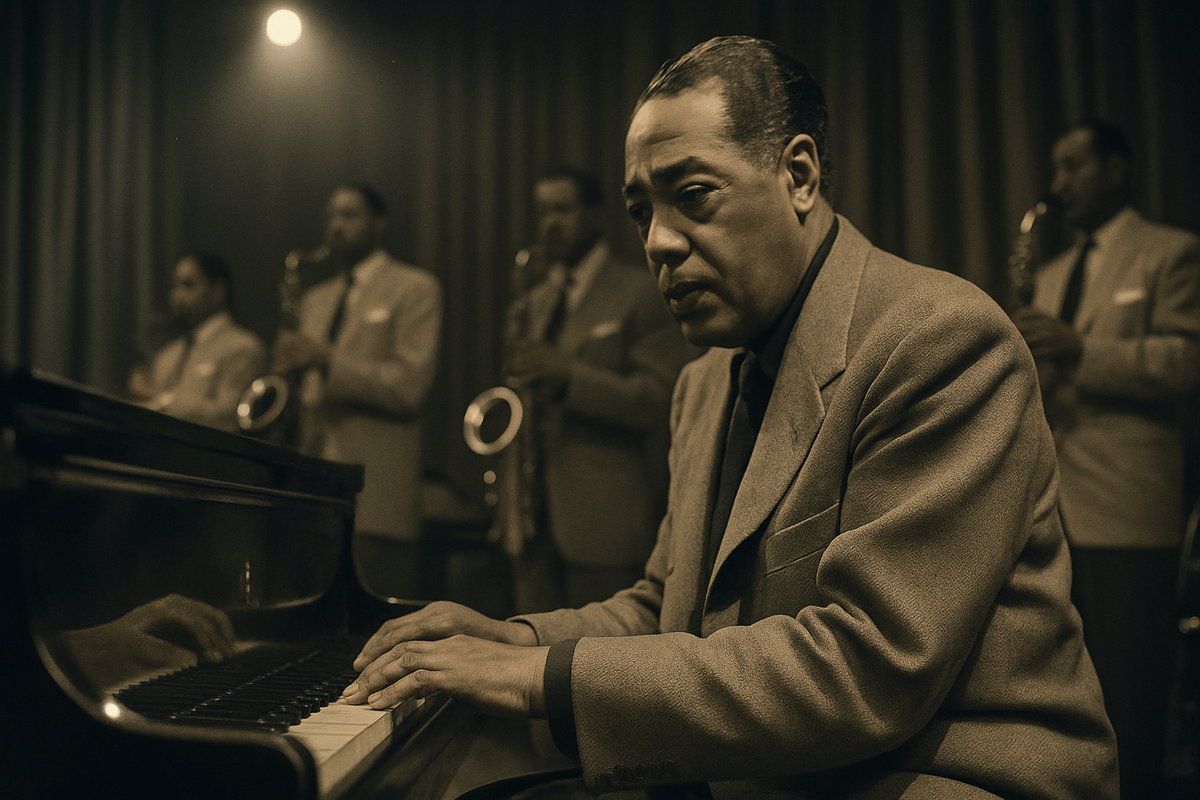
When The New Yorker Stopped the War to Praise a Jazzman
How the June 24, 1944 profile of Duke Ellington became a manifesto for wartime America
June 24, 1944. D-Day is eighteen days old. American boys are dying in French hedgerows. And The New Yorker dedicates its most prestigious editorial real estate to a Black bandleader from Washington, D.C.
That decision—to publish "The Hot Bach," a sprawling profile of Duke Ellington in the middle of the bloodiest summer of World War II—tells you everything about what jazz meant to wartime America. And what The New Yorker understood about survival.
This wasn't entertainment journalism. It was a manifesto.
Archive Details
Historical Figure: Duke Ellington
Issue Date: June 24, 1944
Archive Source: The New Yorker Magazine
Profile Title: "The Hot Bach"
Historical Context: Published 18 days after D-Day invasion
The Summer America Needed Art More Than Comfort
By late June 1944, the American home front was exhausted. Normandy had cracked open the Western Front, but the casualty lists kept growing. Rationing had stripped grocery shelves. War bond drives had emptied wallets. Every family knew someone who wasn't coming home.
And yet: jazz endured.
Duke Ellington's orchestra crisscrossed the country that summer, performing in segregated dance halls, military bases, and theaters packed with defense workers. His music wasn't escapism—it was proof that American culture could improvise, adapt, and swing under pressure. Jazz was democracy in sound: collaborative, irreverent, and impossible to silence.
By 1944, Ellington wasn't just famous. He was canonical. Mood Indigo (1930) and It Don't Mean a Thing (If It Ain't Got That Swing) (1931) had already entered the American bloodstream. European critics—the ones not fleeing fascism—compared him to Bach and Beethoven. The New Yorker's profile title made that comparison explicit: "The Hot Bach."
It was cheeky. It was accurate. And it was radical.
Why The New Yorker Bet on Ellington
The magazine's Profiles series had always been ambitious—literary portraits that treated public figures as subjects, not celebrities. But profiling a Black jazz musician in 1944 was a choice. America was segregated. Ellington toured a country where he couldn't eat in half the restaurants or sleep in half the hotels.
The New Yorker didn't flinch. The profile rendered Ellington as what he was: a composer of the first rank, an artist in perpetual motion, and a man whose genius operated on train cars, in hotel lobbies, and during late-night rehearsals. Readers met Jack Boyd, Ellington's road manager, struggling to keep the band punctual. They watched Ellington scribble compositions on scraps of paper between stops. They saw the chaos of touring—the fatigue, the camaraderie, the impossible schedule.
The prose was elegant, witty, and unsentimental. It didn't lionize Ellington. It observed him. That restraint gave the piece its power. Here was a man who refused to be contained by categories: not just a bandleader, not just an entertainer, but a modern composer working in an American idiom that Europe couldn't replicate.
The profile positioned Ellington exactly where he belonged: at the center of the country's cultural identity, as essential to the nation's morale as any general.
What the Issue Reveals About Wartime America
The cover of the June 24, 1944 issue featured a lively political convention scene—cartoonish, satirical, unmistakably New Yorker. It was a reminder that democracy's rituals—messy, noisy, absurd—still functioned even as the world burned.
Inside, the Ellington profile served a different purpose. It told readers that American art mattered because the war mattered. If soldiers were dying for freedom, then culture was part of what they were defending. Jazz wasn't frivolous. It was proof that the country had something worth protecting beyond borders and supply lines.
The piece captured Ellington's humor, his philosophy, his refusal to be pinned down by definitions. He came across as both genius and human—a man who could compose masterpieces while shrugging off attempts to categorize him. That contradiction was quintessentially American: serious about craft, skeptical of pretension.
For a magazine published in the shadow of D-Day, that balance felt urgent. The New Yorker understood what its readers needed: not just news from the front, but proof that civilization endured.
Ellington as Composer and Performer
The profile emphasized his relentless creativity, documenting how he composed constantly—often on scraps of paper during train rides between performances.
The Road Manager Jack Boyd
Readers glimpsed Boyd's struggles to keep the band organized and on time—a humorous yet revealing look at life behind the scenes of America's greatest jazz orchestra.
Comparison to Bach
The title itself signaled how seriously Ellington was taken as a composer, positioning him as America's answer to the great European masters.
Life on the Road
The article described the chaos of endless touring—the exhaustion of constant travel, the segregated venues, and the unshakeable camaraderie of the band.
Why Wartime Issues Endure
Just as Life Magazine's photo-essays froze the visual grammar of the 1940s, The New Yorker's wartime issues preserved its emotional grammar. They captured not just events, but atmosphere. The Ellington profile is a perfect example: it shows how art and survival were inseparable in 1944. While soldiers fought in Europe, artists like Ellington reminded Americans what they were fighting for.
That permanence—the ability of a single magazine to carry humor, history, and hope simultaneously—is what makes vintage New Yorker issues irreplaceable.
Why Collectors Prize This Issue
Historical Timing
Released weeks after the Normandy landings, it connects directly to the most decisive summer of the war—a time when America balanced military triumph with cultural preservation.
The Ellington Profile
One of the 20th century's greatest musicians, captured at the height of his powers by one of the century's greatest magazines. A convergence of artistic excellence.
Cover Art
The political cartoon cover remains an iconic example of The New Yorker's wartime wit and visual sophistication—democracy's theater rendered in ink and satire.
Cultural Weight
This issue documents the moment when jazz stopped being "popular music" and became American classical music. Holding it means holding proof of that transformation.
When you open this issue today, you're not reading history. You're inhabiting it. You can feel the urgency of 1944—the way Americans balanced grief and resilience, the way culture became a form of resistance.
Explore the Archive
Our collection includes thousands of original New Yorker magazines spanning the 1920s through the 1970s. Each issue is a time capsule: the advertisements, the cartoons, the Profiles, the fiction—all preserved exactly as readers encountered them decades ago.
Browse The New Yorker Magazines CollectionWhether you're a jazz historian, a collector of wartime ephemera, or someone honoring a family member who lived through 1944, these magazines offer something no digital archive can replicate: the tactile weight of history.
The Verdict
The June 24, 1944 issue—featuring "The Hot Bach" on Duke Ellington—stands as one of the great cultural documents of the war years. It proved that America could fight and create simultaneously, that jazz was as vital to national survival as steel production.
Ellington's story, told in The New Yorker's unmistakable voice, reminds us that wartime America didn't just endure. It composed. It swung. It refused to let fascism dictate the tempo.
For anyone who values history, jazz, or the stubborn resilience of American art, this issue isn't a collectible. It's a witness.