
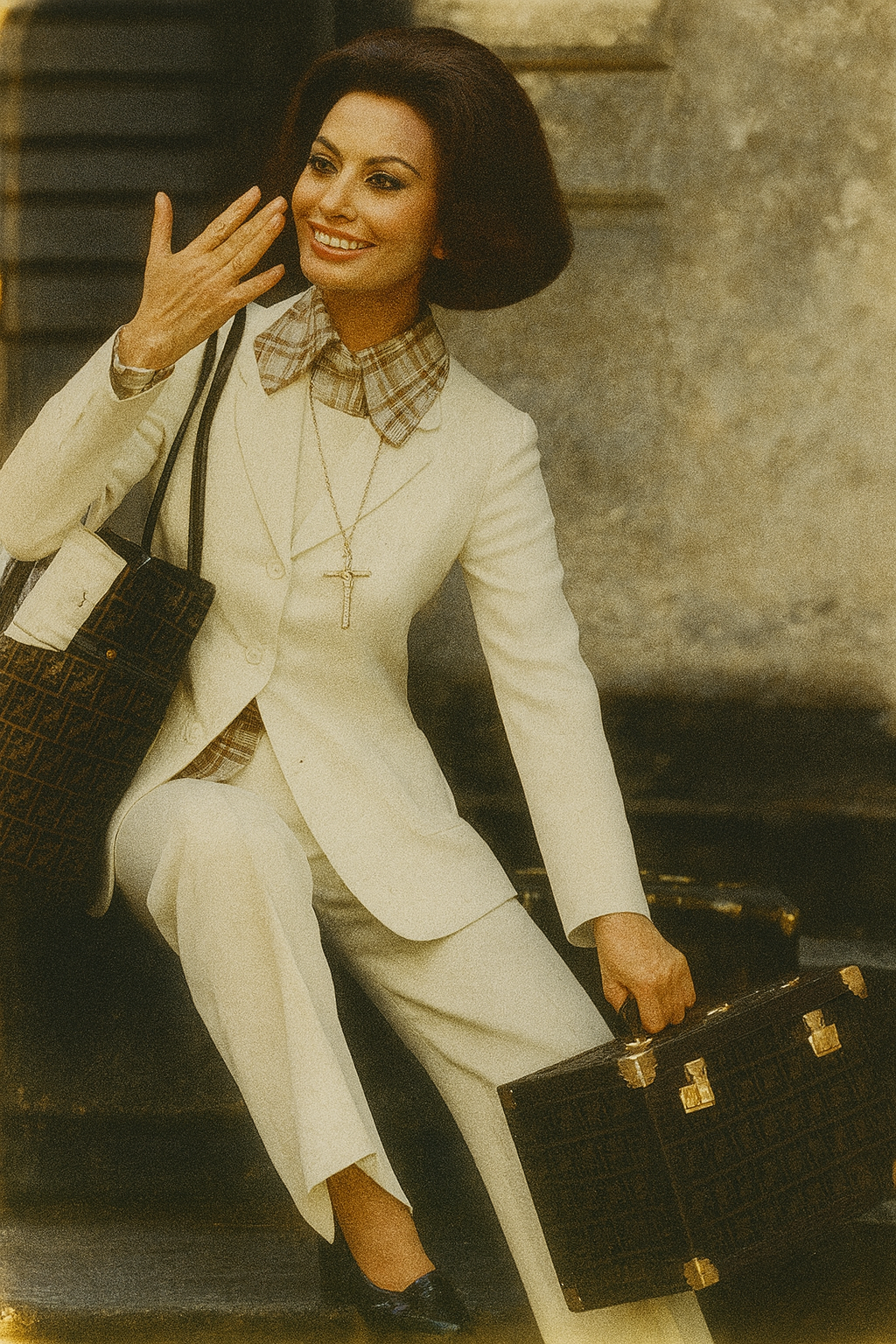
The Actress Who Turned Packing Into Performance Art
How Sophia Loren's luggage became a manifesto for modern womanhood in the pages of Vogue, 1972
Spring, 1972. While Gloria Steinem was launching Ms. magazine and women were marching for the Equal Rights Amendment, Vogue did something unexpected: it photographed Sophia Loren's luggage.
Not just photographed it—catalogued it. Three address books (Italian, foreign, business). Ivory shantung suits by Miss Dior, monogrammed to perfection. Tibetan blankets. Plastic-windowed shoe bags. Scripts. Even her favorite pillows, because first-class didn't yet mean comfort at 30,000 feet.
The April 15, 1972 issue titled the feature "Sophia Loren's Packing Plan, Plotted to the Last Detail," and it revealed something the magazine's editors understood instinctively: in an era when women were fighting for equal pay and professional respect, watching a woman systematize her life was radical.
This wasn't Marie Kondo before her time. This was a masterclass in command.
Editorial Archive
Historical Figure: Sophia Loren (Academy Award–winning actress, cultural icon)
Issue Date: April 15, 1972
Archive Source: Vogue Magazine
Feature Title: "Sophia Loren's Packing Plan, Plotted to the Last Detail"
Photographer: Henry Clarke
When Discipline Became Glamorous
By 1972, Sophia Loren had already collected an Academy Award, international fame, and a reputation for intelligence that separated her from Hollywood's manufactured starlets. She was a mother. A wife. A cookbook author. A woman who moved between Rome, Paris, London, and Los Angeles as easily as most people crossed town.
Vogue understood what it had: not a fashion spread, but a blueprint.
The magazine had perfected an editorial formula by then—fashion was never isolated from context. Every dress existed within a moment, a movement, a shift in how people lived. And in 1972, how women lived was changing rapidly. Air travel was democratizing. Professional women were proliferating. The question wasn't whether women could live internationally mobile lives—it was how.
Enter Loren's packing system.
She didn't just throw clothing into a suitcase. She rehearsed it like blocking a scene. Each category—clothes, cosmetics, accessories, scripts—had its designated space. Her Fendi luggage bore her insignia like a corporate seal. Her shoes rested in those plastic-windowed bags, visible and protected. The address books alone told a story: her life was too complex for a single rolodex, too international for casual organization.
This was discipline as aspiration. Order as art form.
And Vogue photographed it all with the seriousness usually reserved for haute couture.
Henry Clarke's Vision: The Woman in Motion
Henry Clarke's photographs for this feature did something the magazine industry had been dancing around for years—they removed the domestic frame entirely.
Earlier women's magazines had showcased female achievement within carefully bounded spaces: kitchens, living rooms, gardens. Even "career women" were often photographed at home, as if professional success needed the softening context of domesticity.
Clarke photographed Loren outdoors. In motion. Luggage in hand, wearing that ivory Miss Dior suit, smiling not for the camera but toward some destination only she could see.
One image showed her seated among patterned fabrics and cases—surrounded by beautiful things, yes, but arranged by her logic, organized by her system. The composition suggested neither chaos nor sterility, but confident control.
These weren't pictures of a woman preparing to travel. These were pictures of a woman who lived traveling. Who had made mobility not a disruption but an identity.
The visual language was clear: the modern woman isn't stationed anywhere. She moves.
What the Details Reveal
Strip away the glamour for a moment and look at the mechanics:
Three address books. Not because Loren was disorganized, but because her world had distinct spheres that couldn't collapse into each other—Italian contacts (family, Roman film industry, local connections), foreign contacts (international productions, European society), business contacts (agents, studios, publishers). This wasn't affectation. This was the infrastructure of a life lived across borders.
Scripts in transit. Even between destinations, Loren was working. The romantic notion of the jet-setter as pure leisure traveler dissolves here. She carried writing pads. She read screenplays at altitude. Her packing list was also her office.
Tibetan blankets and pillows. Here's where efficiency met humanity. Loren understood something about long-haul travel that airlines were still learning: comfort isn't a luxury, it's a performance necessity. If you arrive exhausted, you arrive diminished. She engineered her environment.
Plastic-windowed shoe bags. Small detail, enormous significance. You can see what you have without unpacking. You can protect expensive footwear without sacrificing accessibility. It's the kind of micro-optimization that separates people who travel occasionally from people who travel as vocation.
The Vogue editors knew what they were documenting: not just how a star packed, but how a professional woman architected her life to span continents without losing coherence.
The Ritual of Organization
Loren rehearsed her packing like a stage performance, ensuring every item had its place and purpose.
Fashion as Function
Ivory shantung suits by Miss Dior and monogrammed Fendi luggage combined beauty with ruthless efficiency.
Comforts of Home
Tibetan blankets and favorite pillows transformed airplanes into extensions of her controlled environment.
The Traveler's Identity
Each piece of luggage bore her insignia—not vanity, but the mark of a woman who commanded her world.
Why This Issue Endures
Collectors pursue the April 15, 1972 Vogue for reasons that go beyond Loren's fame—though her enduring icon status certainly elevates value.
This issue captured a hinge moment. Women's roles were expanding faster than culture could process. The imagery and ideals of femininity were being renegotiated in real-time. And here was Vogue, traditionally a bastion of traditional glamour, presenting something genuinely new: a woman whose authority came not from her beauty (though she had that), not from her domesticity (though she was married with children), but from her systems.
The designers featured—Dior, Fendi—remain powerhouses, which adds market value. Henry Clarke's photography continues to be studied and celebrated for its compositional elegance. And the cultural timing is impeccable: published during the height of second-wave feminism, this issue documents what that movement looked like when translated through high fashion's lens.
But perhaps most significantly, this issue represents Vogue at its editorial peak—when the magazine understood that fashion was never just about clothes, but about the architecture of aspiration itself.
The Artifact as Evidence
We live in an era of ephemeral content. Travel influencers post packing tutorials that disappear into algorithmic oblivion within days. But these magazines—these physical objects—remain.
They preserve not just how fashion looked, but how it was conceived. The page layouts, the typeface choices, the sequencing of images, the tone of the copy—all of it reflects editorial decisions that reveal how culture understood itself.
When you hold the April 15, 1972 Vogue, you're not reading history. You're holding the original transmission—the primary document that shaped how readers understood modernity, mobility, and feminine authority in that moment.
It's the difference between reading about World War II and holding a Life magazine from 1944. Context versus artifact. Interpretation versus evidence.
Collector Significance
Sophia Loren's Enduring Fame
Few stars embody timeless glamour like Loren, making any issue tied to her highly collectible across generations.
Designer Highlights
Dior and Fendi, both central to the article, remain among the world's most coveted luxury houses.
Henry Clarke's Photography
Clarke's work for Vogue is celebrated for its elegance and artistry—these images are museum-quality.
Cultural Timing
Published during the height of women's liberation, the issue captures the changing expectations of modern womanhood.
Vogue's Prestige
As always, the Vogue brand itself elevates the collectible status of its archival issues.
Editorial Peak
This represents Vogue at its most culturally sophisticated—when fashion magazines shaped culture itself.
Explore the Complete Archive
From the 1930s through the 1970s, Vogue documented entire decades of shifting fashion, politics, and culture. Whether you're a seasoned collector, a film historian, or simply someone who loves the intersection of fashion and culture, these issues offer something extraordinary: the chance to see history as it was first reported, photographed, and imagined.
Browse Vogue Magazine CollectionThe April 15, 1972 issue of Vogue remains one of the most significant cultural publications of its decade. Its profile of Sophia Loren, presented through the lens of her packing rituals, was more than a lifestyle feature. It was a meditation on order, glamour, and independence in a world where women were redefining their roles.
Holding this issue today is like holding a moment when independence became glamorous, when organization became aspirational, and when a global star showed women everywhere how to move through the world with grace.