
The Magazine That Captured the Jacksons Before the World Knew What They'd Become
How a pocket-sized publication documented the family's crossroads—and preserved a moment before mythology hardened
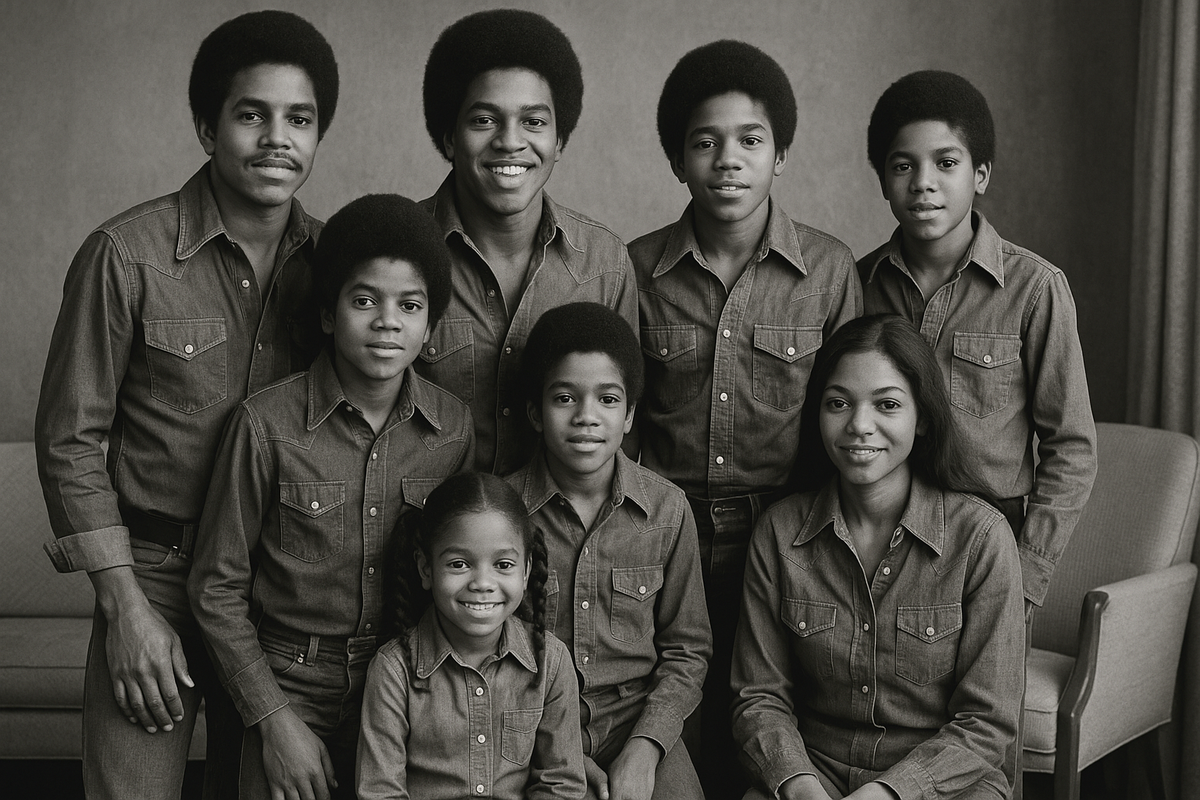
August 1, 1974. A family of eight stares out from the cover of Jet Magazine, dressed in matching denim, arranged against a blood-red background. At the center: Michael Jackson, fifteen years old, months away from the solo career that would redefine pop music. Kneeling at the front in a red dress: Janet Jackson, eight years old, decades away from her own superstardom. The headline reads: "Jackson Five Plus Three Equal A New Entertainment Act."
This wasn't just another celebrity puff piece. It was Jet documenting a crossroads—the moment America's most famous Black musical family stopped being teen idols and started becoming something larger, stranger, and more durable than anyone could have predicted.
For collectors and historians today, this issue is a rarity: a snapshot of the Jacksons in transition, caught between what they were and what they would become. It's also a window into how Black entertainment was reshaping itself in the summer of 1974, when disco was rising, Motown was fracturing, and Las Vegas—still segregated a decade earlier—was opening its stages to the same performers it had once forced to enter through service doors.
Archive Details
Publication: Jet Magazine
Issue Date: August 1, 1974
Featured: The Jackson Family (Michael, Jermaine, Tito, Jackie, Marlon, Randy, LaToya, and Janet)
Historical Context: Documentation of the Jackson Five Revue at the MGM Grand Hotel, Las Vegas
From Gary, Indiana to the MGM Grand
By mid-1974, the Jackson 5 had already conquered the charts. "I Want You Back," "ABC," "I'll Be There"—these weren't just hits. They were cultural events, proof that Berry Gordy's Motown machine could manufacture magic. But the machine was slowing. The bubble gum soul formula that had made them famous was aging poorly, and the brothers needed to prove they could command an audience as adults, not just charm them as kids.
That summer, the family launched the Jackson Five Revue at the MGM Grand Hotel in Las Vegas. This wasn't a concert. It was a variety spectacular—music, comedy sketches, impersonations of the Supremes and the Andrews Sisters, sibling banter, choreography that mixed Motown precision with Vegas showmanship. The original five brothers—Jackie, Tito, Jermaine, Marlon, and Michael—were joined by younger siblings Randy, LaToya, and Janet, turning the act into a multigenerational showcase.
The symbolism wasn't subtle. A decade earlier, Black performers in Las Vegas couldn't sleep in the hotels where they performed. By 1974, the Jacksons were headlining one of the Strip's premier stages, claiming space in the same venues that had elevated Sammy Davis Jr., Diana Ross, and the Rat Pack into American royalty. The revue was both a family act and a civil rights victory lap.
What Jet Saw That Others Missed
Jet Magazine had been chronicling Black life since 1951—pocket-sized, portable, sold in barbershops and beauty salons across the country. It didn't reduce Black entertainers to novelty acts or relegate them to "special interest" sidebars. It treated them as what they were: cultural leaders, community representatives, and architects of American sound.
The August 1, 1974 issue captured the Jacksons with precision. Critics quoted in the article praised Michael as the group's undeniable center, noting his ability to seduce audiences with both youthful energy and unsettling maturity. At fifteen, he was already being recognized as something beyond the Jackson 5—a star with gravitational pull.
The piece also highlighted the family dynamic. Randy, LaToya, and Janet weren't just backup—they were the next generation, proof that the Jackson family was building a dynasty, not just a band. Reviewers called the revue "polished" and "versatile," one of the best shows of the year. The Jacksons, Jet made clear, were no longer the princes of bubble gum music. They were entertainers who could cross generational and cultural boundaries, who could hold Vegas, and who could survive whatever came next.
Michael's Star Power
Critics singled out the fifteen-year-old as the group's magnetic center, displaying both youthful energy and mature showmanship that foreshadowed his solo dominance.
Family Dynasty
The inclusion of Randy, LaToya, and Janet signaled the Jacksons were building something multigenerational—a legacy that would outlast any single act.
Vegas Milestone
Headlining the MGM Grand represented both artistic evolution and cultural progress—Black performers claiming elite entertainment spaces once closed to them.
Critical Acclaim
Trade papers and Jet alike praised the revue as one of the year's best shows, validating the family's transition from teen idols to sophisticated entertainers.
The Cover That Foreshadowed Everything
Look at that cover again. Michael at the center, already commanding attention. Janet in red at the front, small and smiling, decades away from Control and Rhythm Nation. The coordinated denim, the confident smiles, the family unity—it's all there, frozen in newsprint.
Jet's covers were designed to be striking. Bold colors, tight framing, subjects who looked directly at the camera. This wasn't editorial photography—it was portraiture with purpose, images meant to announce importance. The August 1, 1974 cover did exactly that. It told readers: This family matters. Watch them.
Inside, the photography balanced two identities: the Jacksons as polished professionals and as playful siblings. Readers saw them on stage, in rehearsal, in candid moments—proof that stardom and family bonds could coexist, at least for a while.
The Archive That Preserved a Culture
The Jackson 5 story is just one thread in Jet's larger tapestry—a publication that spent decades blending entertainment reporting with cultural history. While mainstream outlets trivialized or ignored Black life, Jet preserved it: the concerts, the protests, the weddings, the funerals, the victories, the humiliations. Each issue is a time capsule, a record of what Black America looked like, sounded like, and fought for in the 20th century.
For today's collectors, Jet isn't just memorabilia. It's primary source material, the kind historians cite and archivists preserve. It's proof of what happened, who was there, and what it meant.
Why This Issue Matters Now
Timing
Captures the Jacksons at their rarest moment—after the Motown hits but before Michael's solo explosion, before Thriller, before the family fractured. The Jackson 5 in full, together, still intact.
Cultural Documentation
This issue doesn't just cover entertainment. It documents how Black performers were claiming elite spaces, how families were building legacies, and how the terms of American fame were being rewritten in real time.
Dual Icon Status
Both Michael and Janet Jackson appear in these pages. Two of the most important performers in 20th-century music, both documented before anyone knew what they'd become. That convergence is rare in archival media.
Collector Demand
Vintage Jet issues are already sought after. Those featuring the Jacksons at pivotal moments—especially issues predating Michael's solo career—command premium interest among music historians, archivists, and collectors preserving family heritage.
Hold History in Your Hands
If you're drawn to the Jacksons, to 1970s entertainment, or to the architecture of Black cultural power in America, this issue is essential. It captures a family on the edge of transformation—famous but not yet mythological, talented but not yet isolated by fame, together before the machinery of celebrity pulled them apart.
Browse Jet Magazine CollectionWhether you're a collector, a music historian, or someone who understands that archives matter, vintage Jet magazines offer something increasingly rare: the chance to hold history as it was first reported, before the revisions and the retrospectives, before everyone claimed they saw it coming.
The August 1, 1974 issue stands as proof that Jet saw it first—and had the good sense to document it before the world caught up.