
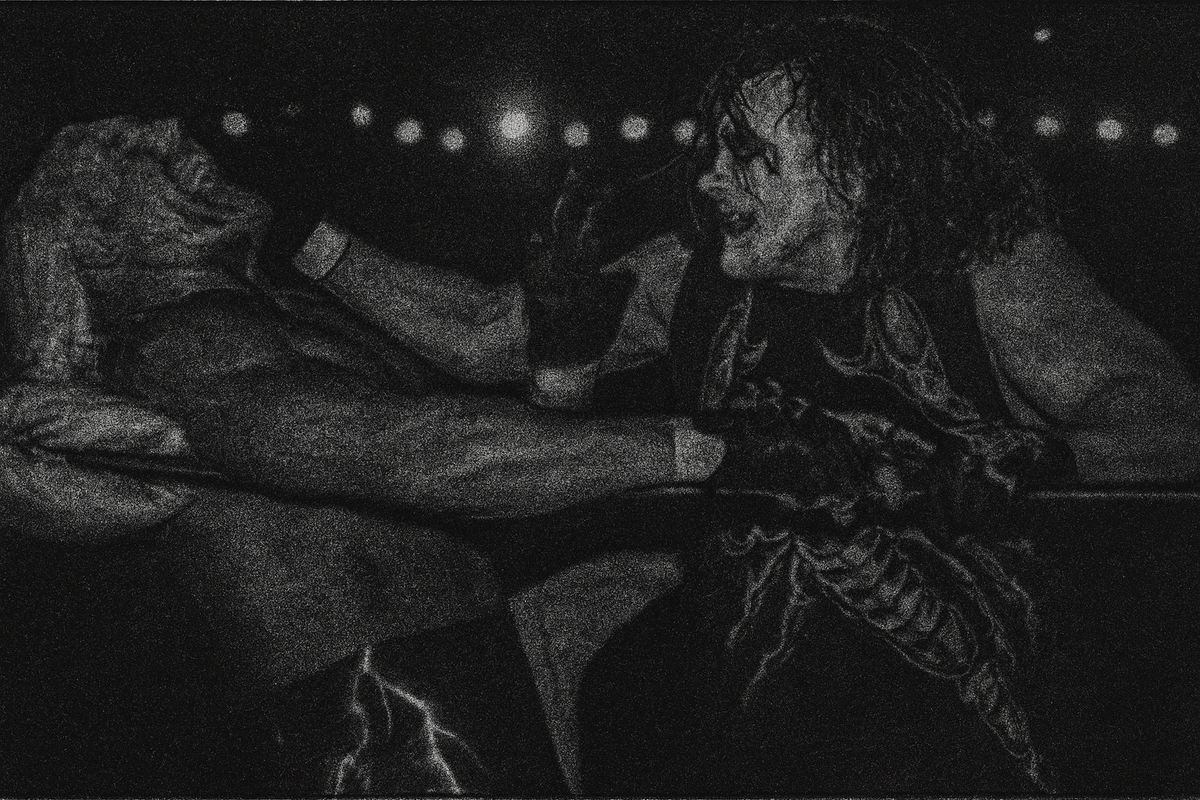
When Sting Named His Demons
The Holiday 1999 Inside Wrestling Confessional That Defined an Era
The scorpion on his face had become wrestling's most recognized war paint. But in the Holiday 1999 issue of Inside Wrestling, the man beneath it did something wrestlers rarely do: he stopped performing and started remembering.
Fourteen years into his career, Sting—the franchise player who'd watched legends come and go while he remained WCW's immovable constant—was asked to identify the ten opponents who had tested him most. Not the matches that drew the biggest gates. Not the feuds that sold the most pay-per-views. The men who had changed him.
What followed wasn't a countdown. It was a confession.
The Franchise Speaks
By late 1999, WCW was hemorrhaging talent and credibility. The nWo storyline had metastasized. Hogan's creative control clause had paralyzed booking. Rivals were jumping to Vince McMahon's suddenly dominant WWF. Through it all, Sting had stayed. Since entering the NWA in 1985—the organization that would evolve into WCW—he "never looked back." That loyalty wasn't just professional. It was existential. Sting was WCW.
Inside Wrestling understood this. Rather than producing another match recap or speculative storyline piece, the magazine handed Sting the microphone and asked him to curate his own legacy. In an era before Twitter threads and podcast confessionals, this was radical transparency: a top-tier wrestler naming the rivals who had broken through his defenses.
The full-page photograph that opens the feature says everything. Sting stands in his scorpion singlet, black-and-white face paint immaculate, staring directly into the camera. The headline announces: "Sting: My 10 Toughest Opponents." Not the toughest matches. Not the biggest draws. The toughest opponents—the ones who got inside his head.
Archive Details
Historical Figure: Sting (Steve Borden)
Issue Date: Holiday 1999
Publication: Inside Wrestling Magazine
Archive Source: Original Magazines Collection
Feature: "Sting: My 10 Toughest Opponents"
The Three Inevitabilities
The first names confirm what fans suspected but rarely heard acknowledged:
Ric Flair – The mental assassin. Sting's assessment is surgical: Flair was both "career-maker and career-ender," a man who "never completely out of my mind" even during Flair's WWF exile. The accompanying photograph—Sting and Flair locked inside a steel cage—captures the claustrophobic reality of their decade-long entanglement. Flair nearly ended Sting's career "on a number of occasions," Sting admits. Not through dirty tactics or fluke injuries, but through Flair's ability to make every match feel like a career referendum.
Hulk Hogan – The psychological invasion. Sting had dreamed of facing Hogan long before the Hulkster arrived in WCW. The reality proved more complex than the fantasy. Hogan's 1996 heel turn—the nWo betrayal that rewrote wrestling's rules—didn't just create a storyline. It created a trauma. "No man affected Sting's psyche more than Hogan," the article states plainly. The mind games were so intense they kept Sting out of the ring for fifteen months. The photograph of their encounter shows Hogan bleeding, but the real wound was deeper: Hogan had weaponized Sting's loyalty against him.
Lex Luger – The eternal question mark. Where Flair was predictable in his excellence and Hogan calculable in his manipulation, Luger represented something more destabilizing: uncertainty. "I honestly can't tell you if being his friend is easier than being his enemy," Sting confesses. The betrayals came so frequently that Sting "lost count" of Luger's turns. Their matches weren't just physically punishing. They were philosophically exhausting—battles against an opponent Sting could never fully read.
What the Magazine Understood
Inside Wrestling succeeded in the pre-digital age because it recognized a fundamental truth: fans didn't just want results. They wanted context. They wanted to understand the emotional architecture behind the feuds that dominated their Saturday nights.
This feature delivered. The magazine paired Sting's direct testimony with images that functioned as evidence: the cage match with Flair, the bloodied confrontation with Hogan, the countless permutations of the Luger partnership. These weren't glamour shots. They were forensic documentation of Sting's career-defining conflicts.
The article's structure mirrors its subject. It begins with loyalty (Sting's commitment to WCW), moves through specificity (the three detailed rivalries), and ends with reflection (what these battles meant). The prose never oversells. There are no hyperbolic declarations about "changing the industry" or "rewriting history." Instead, the piece trusts Sting's words and the photographs to convey their own weight.
This restraint makes the revelations land harder. When Sting admits Hogan's games drove him from the ring for over a year, the statement needs no embellishment. When he acknowledges he can't categorize his relationship with Luger, the confusion is the point.
Key Themes
The Enduring Confession
What makes "Sting: My 10 Toughest Opponents" more than wrestling ephemera is its subject's willingness to acknowledge vulnerability. Professional wrestling succeeds through the maintenance of kayfabe—the carefully constructed illusion that protects the business. Wrestlers don't typically admit that opponents "got to them" mentally or that mind games drove them from the ring.
Sting broke that protocol. He acknowledged Flair's dominance, Hogan's psychological warfare, and Luger's destabilizing unpredictability. He admitted that trust and betrayal shaped his career as much as athleticism and showmanship.
The article works because it treats wrestling as what it actually is: performance art with real consequences. The matches were predetermined, but the pressure was authentic. The storylines were scripted, but the physical toll was genuine. Sting's reflections honor both truths simultaneously.
For readers in 1999, this feature provided context for years of feuds that had defined Monday nights. For readers today, it offers something rarer: a wrestler speaking honestly about his craft before social media made such access routine. The magazine format forced a specificity and thoughtfulness that Twitter threads and podcast appearances rarely achieve.
Why Collectors Circle This Issue
Primary Source Authority
This isn't retrospective analysis or third-party commentary. It's Sting, at the height of his powers, assessing his own career in real time. The quotes are preserved exactly as he gave them, making the issue a direct line to 1999-era wrestling consciousness.
The Holy Trinity
Flair, Hogan, and Luger weren't just opponents. They were the three axes around which WCW's entire narrative rotated in the 1990s. Their presence in this feature ties the issue to the decade's most significant storylines.
Visual Documentation
The full-page Sting portrait and battle photography give the issue both aesthetic and historical value. These images captured moments that defined an era with the grain and color saturation of pre-digital photography—a quality impossible to replicate.
Timing as Content
Released as WCW entered its terminal decline, this issue functions as an unintentional time capsule. Sting's reflections carry the weight of someone speaking from the eye of a storm he doesn't yet realize will destroy the promotion he'd refused to leave.
The Incomplete List
While the article promises ten opponents, it details only three in depth. This incompleteness adds mystique. Collectors speculate about the missing seven names, creating a small mystery that enhances rather than diminishes the issue's value.
Condition Premium
Clean covers, intact spines, and the absence of mailing labels significantly increase collectibility. But even well-read copies carry historical weight. This was the issue fans kept, not the one they discarded after a single read.
The Collector's Case
If you're assembling a WCW archive, building a Sting collection, or documenting professional wrestling's Monday Night Wars era, the Holiday 1999 Inside Wrestling belongs in your holdings. From Flair's cage battles to Hogan's psychological campaigns, from Luger's betrayals to Sting's perseverance through all of it, this issue documents the internal experience of being wrestling's most reliable constant.
Browse Inside Wrestling Magazine Collection