
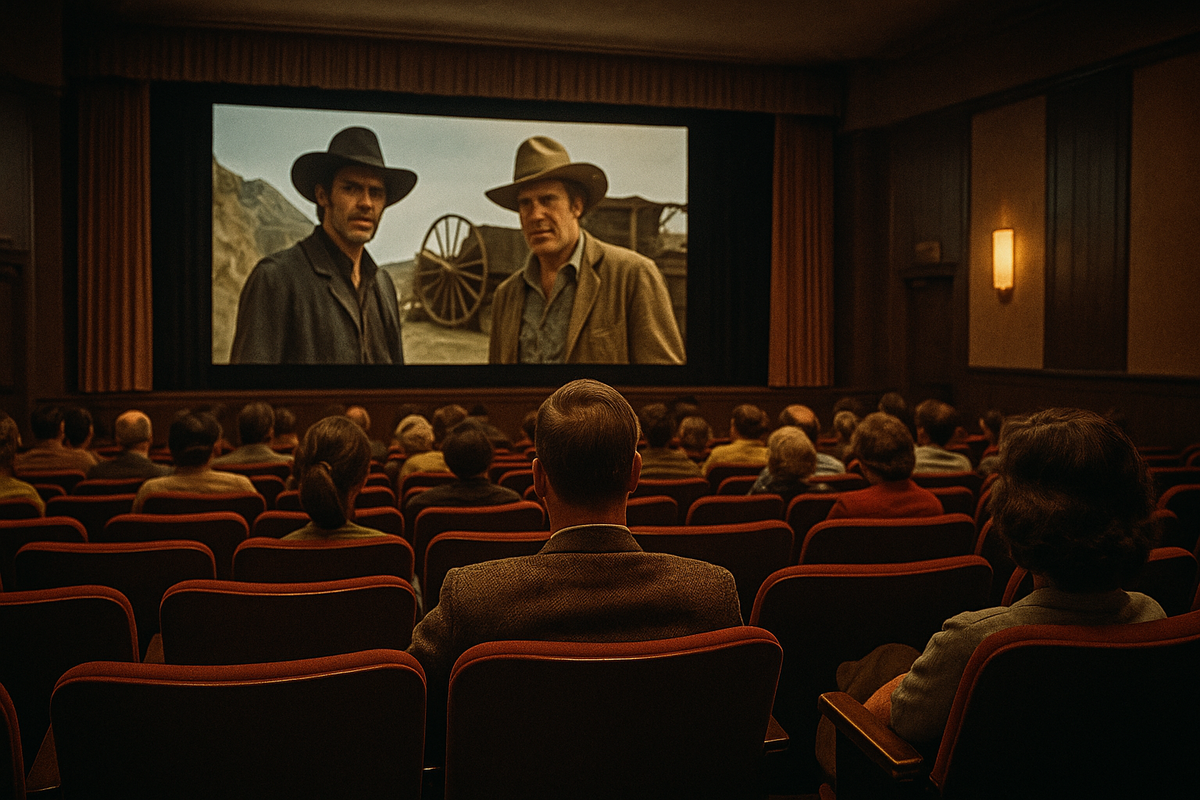
When Hollywood Glamour Couldn't Pay the Rent
Forbes Exposes the Movie Theater Profit Crisis of 1971
Walter Reade sat in his Manhattan office—decorated by his wife, a great-niece of Oscar Hammerstein—and called himself "a theatrical entrepreneur, not a mere movie exhibitor." The flourishes were impeccable. The stock price was not.
When Forbes published "But Where Are The Profits?" on July 1, 1971, it asked the question Wall Street was too polite to voice: Why were America's movie theaters making money at the box office but losing it on the balance sheet? Audiences were back. Suburban chains were expanding. Hollywood was rebounding from its television-induced coma. Yet shareholders—those unfortunate souls who'd bought into the glamour—were left holding empty popcorn buckets.
This wasn't just another entertainment industry puff piece. It was Forbes doing what Forbes did best: cutting through the marquee lights to expose the cold mathematics of profit margins, reinvestment strategies, and the uncomfortable truth that revenue and returns are not the same thing.
Archive Details
Publication: Forbes Magazine
Issue Date: July 1, 1971
Featured Article: "But Where Are The Profits?"
Historical Context: Post-television contraction, suburban theater expansion, Wall Street skepticism
The Numbers That Told the Real Story
By 1971, American movie theaters had survived television's assault on their business model, but survival came at a cost. The statistics were brutal:
In 1946, nearly 19,000 theaters attracted 82 million weekly customers, grossing $1.5 billion. By 1971, the industry had contracted to 14,500 theaters drawing only 15 million weekly customers for $1.25 billion in grosses.
The grand Moorish palaces and art-deco monuments of the 1930s—temples built for mass entertainment—had given way to economical 800-seat suburban theaters tucked into shopping centers. The average ticket price hit $1.65, though urban moviegoers paid as much as $5 for X-rated screenings, revealing both the inflation creeping through American cities and the industry's desperate hunt for audiences willing to pay premium prices.
Television hadn't killed the movies. It had simply reset the terms of engagement, and theaters were still figuring out how to turn cultural relevance into shareholder dividends.
Where Forbes Found the Bodies
While Variety celebrated box office hits and The Hollywood Reporter tracked star contracts, Forbes did what financial journalists do: it audited the claims. The magazine profiled the era's major players and found a pattern of style over substance, expansion over profitability.
E.D. Martin, the Atlanta exhibitor who'd once lived like royalty, sold his 150 theaters to Fuqua Industries in 1969. The entrepreneurial families were cashing out to conglomerates, and the conglomerates were discovering what the families had known: theaters were better at generating press releases than profits.
General Cinema, under Richard Smith's direction, operated 256 theaters grossing $70 million annually. Impressive—until you examined the profit: $7.2 million, or 78¢ per share. Smith reinvested relentlessly, building new auditoriums and buying real estate rather than rewarding shareholders. His bet was on long-term asset appreciation, not quarterly dividends.
ABC Theaters leveraged its 434 screens and media empire to cross-promote films and television properties, turning corporate synergy into a survival strategy.
Loew's and MGM theaters, still entangled with Hollywood's crumbling studio system, spent as much time in courtrooms as they did in boardrooms.
And then there was Walter Reade—the man with the Hammerstein-decorated office and the self-described theatrical vision. His company was losing money, but his personal style never wavered. Forbes understood the symbolism: Reade embodied the industry's central contradiction. Movie exhibition could be glamorous, culturally significant, even personally enriching for its operators. It just couldn't reliably reward the people who bought the stock.
The Visual Evidence of a Broken Model
Forbes reinforced its case with photographs that spoke louder than the financials. One image showed Reade seated confidently in his theatrical office, surrounded by the trappings of success. The caption noted, with characteristic Forbes dryness, that his company was hemorrhaging money.
These weren't lifestyle portraits. They were crime scene photographs—evidence of an industry where appearance and performance had diverged completely.
The magazine's cover design during this era followed its tradition of understated authority: no flashy graphics, no celebrity faces, just the visual vocabulary of serious capital. Forbes covers in 1971 reminded readers that inside, they'd find rigorous reporting, not press kit rewrites. The magazine treated business as a blood sport, not a social club.
The Forbes Difference
Forbes earned its reputation by refusing to accept industry narratives at face value. The entertainment press treated Hollywood as a special case, exempt from ordinary financial scrutiny. Forbes treated it like any other business: if you can't generate returns, you're not succeeding, no matter how many people show up or how beautiful your office looks.
This commitment to financial truth-telling—blended with sharp profiles of the personalities involved—made Forbes indispensable to anyone who wanted to understand how American business actually worked, not how executives claimed it worked.
The magazine's legacy isn't just the Forbes 400 list of wealthiest Americans. It's these deep excavations of specific industries during transitional moments, when old models collapsed and new ones hadn't yet emerged.
Why This Issue Matters to Collectors Today
Historical Timing
The article captures the exact moment when suburban theaters replaced downtown palaces, when television permanently reshaped American leisure habits, and when Wall Street's patience with Hollywood's excuses finally ran out.
Personalities
Walter Reade, Richard Smith, and E.D. Martin weren't just executives—they were characters in the larger drama of postwar American capitalism, each representing a different strategy for navigating an industry in transformation.
Editorial Authority
This issue demonstrates why Forbes became the gold standard for financial journalism. While other publications chased trends, Forbes examined fundamentals. While others celebrated personalities, Forbes studied profit-and-loss statements.
Cultural Documentation
The article exists at the intersection of entertainment history, suburban development, and shareholder capitalism—three forces that continue to shape American business today.
Owning this issue isn't nostalgia. It's holding a primary source document from the moment when one of America's most beloved industries faced its identity crisis and had to choose between art, commerce, and investor expectations.
For the Serious Collector
If you collect business history, entertainment economics, or simply value primary source documents from inflection points in American culture, this Forbes issue offers something rare: unvarnished analysis from the moment of crisis itself.
It shows how television, suburbanization, and the demands of public shareholders reshaped an industry that had defined American leisure for half a century. More importantly, it shows what happens when an industry mistakes audience enthusiasm for financial health—a lesson that remains relevant in every era of technological disruption.
Explore the Complete Archive
From the 1940s through the 1980s, these magazines document more than business deals. They capture the spirit of entrepreneurship, the drama of markets, and the personalities who built—and sometimes destroyed—American industries.
Browse Forbes Magazine Collection"But Where Are The Profits?" remains a landmark examination of an industry at its cultural crossroads. It explained why packed theaters didn't translate to profitable companies, why expansion strategies bankrupted operators, and why glamour and shareholder returns rarely occupied the same office.
Holding this issue today means possessing more than vintage paper. It means owning an artifact from the moment when American entertainment confronted its economic reality—when the marquee lights stayed on, but the balance sheets told a different story entirely.