
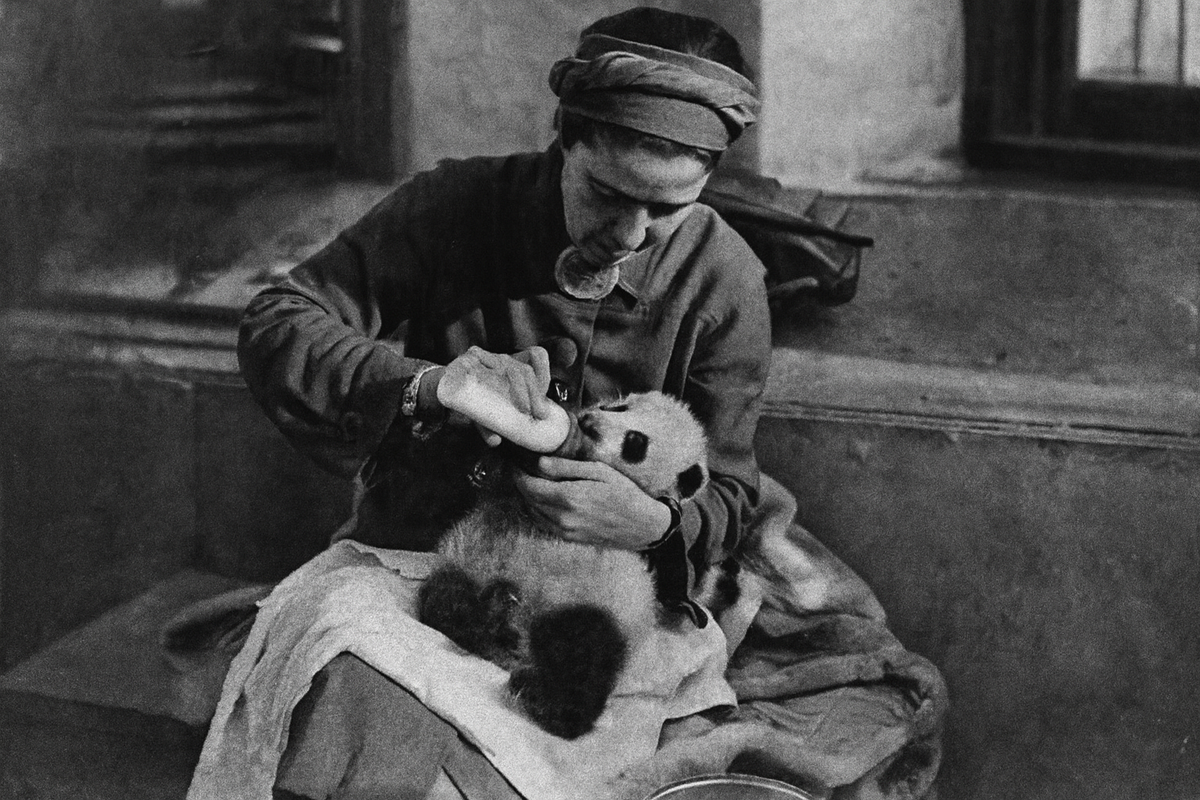
The Day America Met the Panda
How Life Magazine Turned a Chinese Cub Into a National Obsession
On a spring morning in 1937, millions of Americans opened their mailboxes to find something extraordinary waiting inside their weekly Life Magazine. Tucked between advertisements for Listerine and Chevrolet was a photograph that would alter the country's relationship with the natural world: a nine-pound ball of black-and-white fur being bottle-fed like an infant, cradled in human arms with the tenderness reserved for newborns.
Her name was Su-Lin. She was a giant panda. And until that moment, no American had ever seen one alive.
What followed wasn't just a news story—it was a cultural detonation. Within weeks, Su-Lin became more famous than most Hollywood actresses. Her diet was reported like a society column. Her weight gain tracked like a stock ticker. She represented something America desperately wanted in 1937: proof that the world still held mysteries worth discovering, creatures worth protecting, and wonders that transcended the gathering darkness of global conflict.
The May 17, 1937 issue of Life Magazine didn't just introduce Americans to an animal. It inaugurated an obsession that has never ended.
Archive Details
Featured Subject: Su-Lin, first giant panda in the United States
Issue Date: Life Magazine, May 17, 1937
Article Title: "Baby Giant Panda Gains 30 Pounds"
Historical Context: First widespread American coverage of a living giant panda
Archive Source: Original 1937 Life Magazine
When the Exotic Became Intimate
In the mid-1930s, giant pandas existed largely as rumor. Western scientists had described the species, but living specimens remained confined to the remote bamboo forests of China's Sichuan Province. Then, in 1936, Mrs. William H. Harkness Jr.—an American explorer operating in terrain few Westerners had penetrated—accomplished what naturalists had considered nearly impossible: she captured a nine-month-old panda cub and transported it across the Pacific.
The cub arrived in New York weighing just 11 pounds 10 ounces. Mrs. Harkness named her Su-Lin—a Chinese phrase sometimes translated as "a little bit of something cute"—and the panda quickly became the most sought-after attraction in American zoology.
By the time Life's photographers arrived at the Chicago Zoological Park in early 1937, Su-Lin had tripled in size to 35 pounds. The magazine's feature, "Baby Giant Panda Gains 30 Pounds," documented her transformation with the forensic precision Life brought to every subject. Readers learned the specifics of her improvised diet: powdered milk, syrup, and cod-liver oil, carefully administered by Mary Bean, daughter of the zoo's director. They learned her projected adult weight—a staggering 300 pounds. They learned, in essence, how to care for an animal the Western world barely understood.
But the facts weren't what made the story electric. It was the photographs.
The Revolution in the Frame
Life Magazine had launched just months earlier with a radical editorial philosophy: that photographs could carry narrative weight equal to—or surpassing—written prose. The Su-Lin feature proved the thesis beyond dispute.
The images were disarmingly intimate. In one frame, Mary Bean cradles Su-Lin during feeding time, the panda's face turned toward the camera with an expression somewhere between curiosity and contentment. Another shows the cub nestled in blankets, vulnerable and small. These weren't the formal, distant shots typical of natural history documentation. They were portraits that erased the boundary between exotic specimen and beloved pet.
The effect was calculated and profound. Americans didn't just see a rare animal—they saw a creature that elicited the same protective instincts as a human child. The panda's round face, its apparent gentleness, its dependence on human care: all of it conspired to transform scientific curiosity into emotional investment.
Life's editors understood that intimacy breeds empathy, and empathy breeds cultural permanence. By presenting Su-Lin not as a zoological specimen but as a character in an unfolding story, they gave readers permission to care. The photographs did what words alone could not: they made the panda ours.
The Architecture of Celebrity
The May 17, 1937 issue didn't feature Su-Lin on its cover—a strategic choice that heightened anticipation. Readers had to turn the pages, move through the magazine's other stories, before encountering the panda spread in all its glory.
When they arrived, they found more than pictures. They found a complete narrative architecture. Captions provided weight measurements down to the ounce. Sidebars explained dietary adaptations. Projections of future size invited readers to imagine Su-Lin as a 300-pound adult, transforming today's cub into tomorrow's marvel. Every detail reinforced the same message: you are witnessing history as it unfolds.
This was Life's particular genius. Where other publications might have published a single image with a paragraph of text, Life constructed an experience. The magazine didn't just report Su-Lin's existence—it invited Americans into her daily life, creating the illusion of personal connection across thousands of miles.
The result was celebrity of a new order: not manufactured through publicity stunts, but built through sustained visual storytelling. Su-Lin became a household name not because she performed tricks, but because Life made her impossible to ignore.
Ten Moments That Changed Everything
Historic Precedent
Su-Lin was the first giant panda ever exhibited in the Western Hemisphere—not merely the first in America, but the first anywhere outside Asia. The article documented genuine discovery.
Documented Transformation
Her weight nearly tripled in months, from 11 pounds 10 ounces to 35 pounds. Readers witnessed biological reality unfold in real time.
Improvised Science
The diet of powdered milk, syrup, and cod-liver oil revealed how little was known about panda nutrition. Zoos were inventing care protocols from scratch.
Maternal Imagery
Photographs of Su-Lin being bottle-fed collapsed the distance between human and animal, creating a template for how Americans would view wildlife for decades.
Cultural Timing
The story arrived during the Great Depression's final years, offering escapism wrapped in scientific legitimacy—wonder without frivolity.
Diplomatic Symbolism
Though unstated, Su-Lin represented China itself at a moment when that nation faced Japanese invasion. The panda became an inadvertent ambassador.
Predictive Narrative
By forecasting her adult size and habits, Life transformed a static animal exhibit into a serialized story, giving readers reason to follow her future.
Institutional Validation
The feature elevated zoos from entertainment venues to educational institutions, reshaping public perception of their mission.
Evidential Photography
The images weren't illustrative—they were proof. Life's camera granted authority that prose alone could never achieve.
Sustained Impact
Thanks to this single article, Su-Lin transcended novelty to become a cultural fixture, the beginning of America's permanent panda fixation.
The Long Shadow of a Small Panda
Today's panda diplomacy—China's strategic loan of giant pandas to foreign zoos—traces its cultural roots to Su-Lin's 1937 arrival. Modern conservation efforts that have pulled the species back from extinction rest on a foundation of public affection that began with Life Magazine's photographs.
Su-Lin herself died in April 1938, just two years after her capture. But her impact had already metastasized beyond her brief life. She established the template for how Americans would relate to endangered species: through visual intimacy, through narratives of vulnerability and care, through the belief that preservation was both scientifically important and emotionally imperative.
Life Magazine didn't merely document this shift—it engineered it. By giving Americans unprecedented visual access to an animal they would never encounter in nature, the magazine created a constituency for conservation before the term entered common usage. The panda in the photograph wasn't just in Chicago. She was in every living room where the magazine lay open.
Why Collectors Covet This Issue
For those who pursue original Life magazines, the May 17, 1937 edition occupies special territory. It represents the precise moment a cultural phenomenon began—the documented origin point of America's panda obsession.
The issue commands attention for reasons beyond sentiment. It captures historical primacy: the first widespread American encounter with an animal that would become central to conservation diplomacy for the next century. The photographs inside are among the earliest panda images ever published to a mass American audience, predating the species' iconic status by decades.
Condition matters intensely. Issues with intact covers, minimal foxing, and crisp interior pages carry premium value. The 1930s paper stock was not archival grade; surviving copies in very good or excellent condition are increasingly scarce. Collectors prize tight bindings, vibrant color in the advertisements, and absence of the mustiness that afflicts many Depression-era publications.
But the issue's value transcends its panda content. The magazine is a complete artifact of 1937 America: the advertisements reveal consumer priorities, the editorial voice captures pre-war optimism, and the other features—ranging from news photography to cultural commentary—provide context that single-subject reprints cannot match. To own this issue is to hold a comprehensive snapshot of a particular moment in American consciousness.
Explore the Archive
From the magazine's 1936 launch through its transformation into a cultural institution, Life chronicled the twentieth century with unmatched visual authority.
Browse Life Magazine CollectionThe Artifact and the Memory
The May 17, 1937 issue of Life Magazine remains more than a collectible. It is the physical record of a cultural turning point: the moment Americans first saw a giant panda and decided, collectively, that such a creature must not be allowed to vanish.
Through images that balanced scientific documentation with emotional resonance, Life transformed Su-Lin from zoological curiosity into national treasure. The article's power lay not in its prose—which was serviceable—but in its photographs, which remain arresting nearly ninety years later.
For those who seek such issues, the appeal is both historical and tactile. To hold the original magazine is to return to that spring of 1937, when the world seemed larger, mysteries still abounded, and a small panda from China's mountains could capture an entire nation's imagination.
The pages yellow. The paper grows brittle. But the moment they captured remains incandescent: America's first glimpse of an animal that would become, against all odds, one of the most beloved creatures on Earth.