
The Comeback Nobody Believed In
When Sugar Ray Robinson Bet Everything on One More Fight
The pocket-sized magazine hit newsstands on November 3, 1955, with a question that split barbershops, boxing gyms, and living rooms across Black America: "Can Sugar Ray Regain His Title?"
For three years, Sugar Ray Robinson had been gone—vanished into the velvet-curtain world of nightclub entertainment, trading leather gloves for stage lights. Now, at 35, broke and supposedly broken, he was climbing back through the ropes to face Carl "Bobo" Olson, a champion eight years younger and hungry to prove the legend was just a memory.
Jet Magazine didn't frame it as a long shot. They framed it as a reckoning.
Archive Details
Historical Figure: Sugar Ray Robinson
Issue Date: November 3, 1955
Archive Source: Jet Magazine
Cultural Context: Published between the Emmett Till verdict and Montgomery Bus Boycott
The Weight of a Crown, The Burden of a Symbol
Robinson's return came during one of the most volatile autumns in American history. The Emmett Till murder trial had just concluded in Mississippi—a grotesque theater of Jim Crow justice that Jet had covered with unflinching photographs and reportage. Within weeks, Rosa Parks would refuse to surrender her bus seat in Montgomery, igniting a boycott that would reshape the nation.
Black athletes in 1955 weren't just entertainers. They were proof of concept—living arguments against segregation's lies. And Robinson, widely considered the greatest pound-for-pound fighter who ever lived, carried that symbolism like a second weight class.
His 1952 retirement had stunned the sport. He'd walked away as middleweight champion, undefeated in his prime, chasing dreams of showbiz stardom. But the nightclub circuit proved less lucrative than the ring, and by 1955, Robinson needed money. More than that, he needed to prove he was still Sugar Ray Robinson.
"Short on Cash, Long on Pride"
Jet's coverage refused to romanticize the comeback. In their feature "Short on Cash, Long on Pride," the magazine laid out the brutal arithmetic: Robinson was older, slower, and financially desperate. Bobo Olson held the middleweight crown and had every physical advantage.
But the magazine understood what the oddsmakers didn't. This wasn't about youth versus experience or speed versus ring IQ. This was about hunger—the kind that gnaws through doubt and rewrites the script.
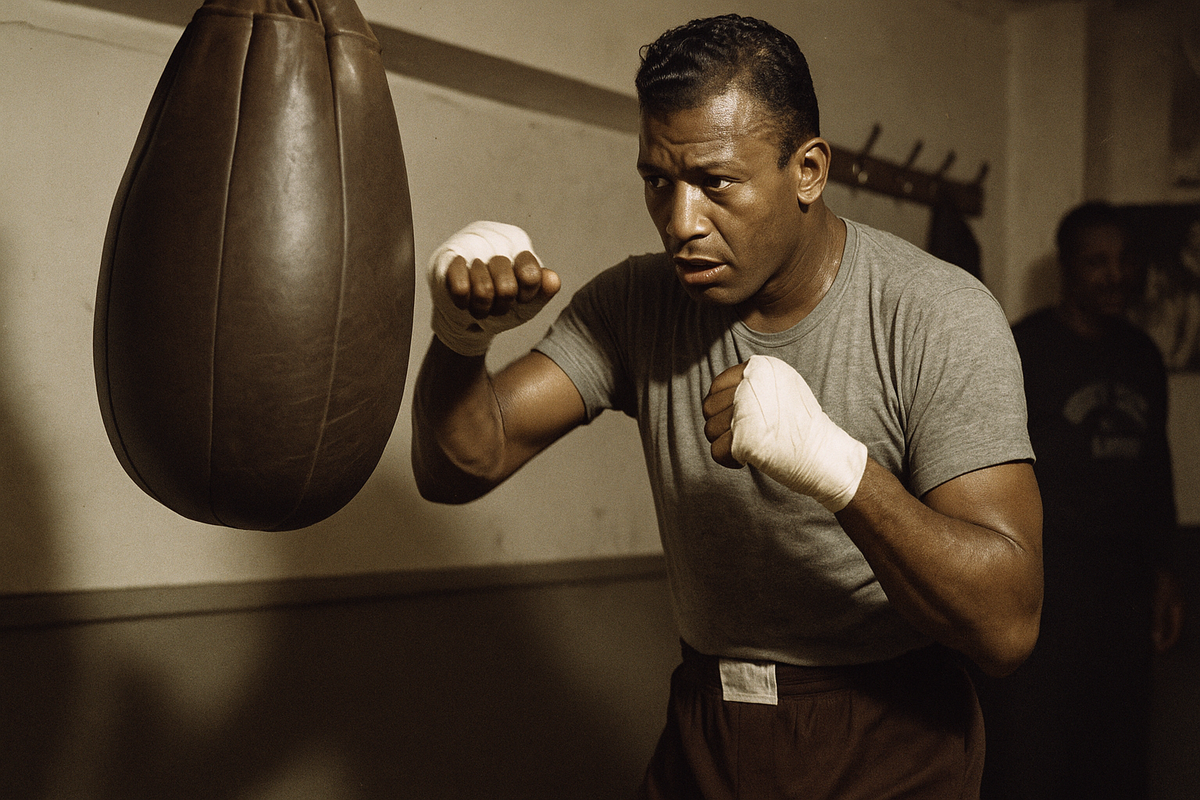
In "Hungry Sugar Ray Wants Crown," Jet documented Robinson's training regimen with the precision of a campaign diary. The roadwork. The conditioning. The quiet fury of a man preparing to humiliate everyone who'd written him off. The articles didn't predict victory—they documented belief.
For Jet's readership, Robinson's fight transcended boxing. It was a story about falling and rising, about reclaiming what the world said you'd lost forever. It was a narrative Black America knew intimately.
Glamour and Grit: The Cover That Captured Both
The November 3 cover was pure Jet—a study in contrasts. Against a rich blue background, Anita Cipriani, a New York drama student and aspiring actress, gazed out with the poise of someone on the verge of breakthrough. The headline cut across her portrait like a challenge: "Can Sugar Ray Regain His Title?"
This juxtaposition defined the magazine's genius: the promise of Black excellence in the arts alongside the determination of a sports legend fighting his way back from oblivion. Inside those pages, readers found both the shimmer of possibility and the sweat of struggle—the full spectrum of Black aspiration in the 1950s.
The Fight Within the Fight
Jet understood the layered drama of Robinson versus Olson:
Age as Weapon and Liability
At 35, Robinson couldn't rely on the blinding hand speed that had made him untouchable. But he possessed something Olson didn't—a Ph.D. in ring psychology earned over 154 professional fights.
The Economics of Pride
Robinson admitted financial necessity drove his comeback, but Jet recognized the deeper fuel: a competitive fire that retirement had only banked, not extinguished.
Legacy Versus Legitimacy
Olson wore the belt, but he didn't own the mystique. Jet portrayed the bout as a collision between reputation and reality—between a reigning champion trying to build a legacy and a former king demanding his throne back.
Symbolism Beyond Sport
For readers navigating a nation that daily questioned their worth, Robinson's battle represented radical possibility: that a Black champion could stumble, fall, and rise again—not just to survive, but to reclaim greatness.
Why Collectors Hunt This Issue
Historical Convergence
Published between the Till verdict and the Montgomery boycott, this issue captures a pivotal American moment when the battle for dignity was being waged simultaneously in courtrooms, on buses, and in boxing rings.
Boxing's Greatest Comeback
Robinson would go on to reclaim his title, vindicating Jet's faith and cementing one of sport's most iconic second acts. This issue documents the doubt and determination before the triumph—the rarest kind of historical artifact.
Cultural Completeness
From Cipriani's cover portrait to Robinson's training regimen to the magazine's unflinching civil rights coverage, this issue presents Black American life in full dimension—ambitious, complex, and unbowed.
Tangible Connection
To hold this issue is to touch the same pages that sparked debates in 1955 barbershops and living rooms, to read the same words that fueled hope when hope was a radical act.
The Enduring Power of a Comeback Story
Jet's Robinson coverage has outlasted both the magazine and most of its contemporary competitors because it understood a fundamental truth: sports stories become immortal when they're really about something else.
While mainstream outlets reduced Black athletes to statistics and spectacle, Jet positioned them within the larger narrative of American struggle and achievement. Robinson's comeback wasn't just about reclaiming a championship—it was about embodying resilience at a moment when African Americans were demanding recognition, respect, and rights across every sector of society.
Vintage Jet issues endure as historical documents precisely because they refused to separate sports from culture, entertainment from politics, personal triumph from collective struggle. They understood that history happens everywhere—in championship rings as much as on protest lines.
Sugar Ray Robinson's 1955 comeback was one chapter in that history: a story of courage, calculation, and the refusal to accept someone else's verdict on your worth.
Explore the Archive
The full collection of original Jet magazines offers an unmatched window into 20th-century Black American life.
Inside these issues, you'll find:
- Civil rights milestones—the Montgomery Bus Boycott, the March on Washington, Freedom Summer, and the daily battles that transformed a nation.
- Athletic legends—Joe Louis, Jackie Robinson, Muhammad Ali (then Cassius Clay), and the sports figures who carried symbolic weight far beyond their arenas.
- Entertainment and culture—rising stars in film, music, and theater; the glamour and grit of Black creative life in an era of both constraint and breakthrough.
- Unflinching journalism—coverage of politics, justice, violence, and achievement that mainstream media ignored or distorted.
Each issue is an original artifact, preserved exactly as it appeared on newsstands—a direct transmission from the past, waiting to be held, read, and understood.
The Question That Still Resonates
"Can Sugar Ray Regain His Title?"
In November 1955, it was a question about boxing. But for Jet's readers—and for anyone who's ever been counted out, written off, or told their moment had passed—it was always a larger question about possibility itself.
Robinson answered it in the ring. Jet answered it on the page. And seven decades later, both answers still echo: Yes. Against the odds, against the doubters, against time itself—yes.
For collectors, historians, and anyone who believes that the past still has something urgent to teach us, this issue remains what it was in 1955: not just a magazine, but a manifesto—proof that the fight for greatness is never finished, and the comeback is always possible.
Start Your Collection Today
Discover authentic vintage magazines that document the moments that shaped America.
Browse Jet Magazine Collection