
The Night Rolling Stone Sent Sun Ra Into Orbit
How the April 19, 1969 issue introduced cosmic jazz and Afrofuturism to the counterculture
The spring of 1969 belonged to rock and roll. Or so the story went.
But when readers cracked open the April 19th issue of Rolling Stone—still a scrappy upstart magazine finding its voice—they didn't find another think piece on the Stones or a Hendrix concert review. Instead, they found themselves face-to-face with a man in an Egyptian headdress who claimed he was from Saturn and that music could save the universe.
Sun Ra had arrived in the mainstream.
John Burks' long-form profile didn't treat the avant-garde bandleader as a sideshow curiosity or a psychedelic footnote. It presented him as what he was: a philosopher-composer whose fusion of free jazz, space-age mythology, and Afrofuturist vision represented something the counterculture desperately needed but hadn't yet named. For a magazine still defining its editorial identity, this was a gamble. It was also a turning point.
Rolling Stone proved it could see beyond the Fillmore and into the South Side jazz clubs where the real revolution was brewing.
The Man Who Fell to Earth (Via Birmingham, Alabama)
Born Herman Blount in Jim Crow Birmingham, Sun Ra had spent the better part of two decades constructing an alternate cosmology. By 1969, he and his Arkestra—a rotating collective of musicians who lived, rehearsed, and performed as a unified spiritual experiment—had built a cult following that stretched from Chicago's experimental music scene to the lofts of New York's avant-garde underground.
His message was deceptively simple: Black people didn't just belong in America's future. They belonged in the future—among the stars, beyond oppression, in dimensions where freedom wasn't negotiated but assumed.
This wasn't escapism. It was reclamation.
While the Civil Rights Movement had reshaped the legal and political landscape, systemic racism remained entrenched. The space race had turned the cosmos into a battleground for Cold War supremacy, but in Sun Ra's hands, outer space became something else entirely: a metaphor for Black liberation, a canvas for reimagining identity, and proof that the future didn't have to replicate the past.
Free jazz became his instrument. The cosmos became his stage.
Archive Details
Featured Artist: Sun Ra (born Herman Blount)
Issue Date: April 19, 1969
Publication: Rolling Stone Magazine
Writer: John Burks
Cultural Context: Afrofuturism, Free Jazz Movement, Counterculture Era
What Rolling Stone Saw (And How They Framed It)
Burks' article immersed readers in Ra's philosophy without condescension. Where other publications might have framed the bandleader as an eccentric outlier, Rolling Stone positioned him alongside Ornette Coleman, John Coltrane, and Archie Shepp—artists who understood that jazz had evolved beyond entertainment into something closer to ritual, protest, and prophecy.
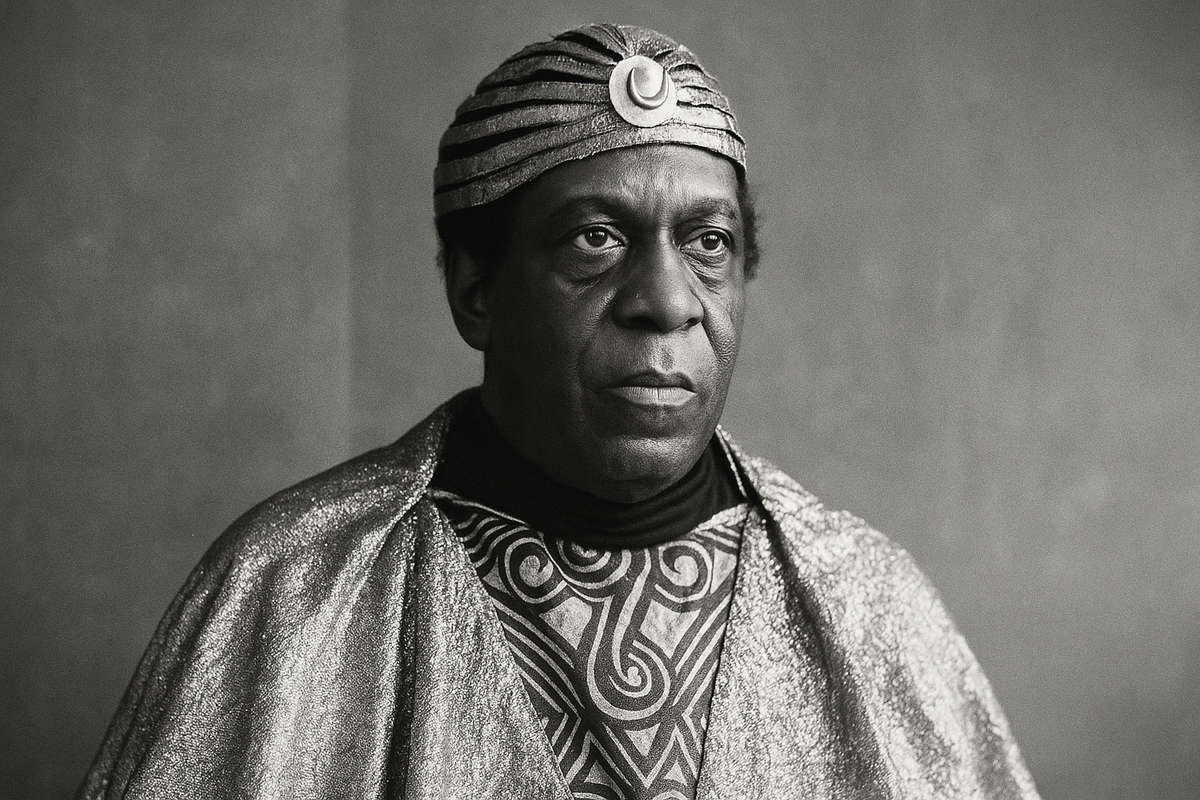
The photography told its own story. Stark black-and-white portraits showed Ra in full regalia: the Egyptian headdress, the flowing robes, the intensity of someone who genuinely believed he was channeling transmissions from another dimension. These weren't the images readers expected from a music magazine. No guitars. No amplifiers. No backstage debauchery.
Just a man dressed like a pharaoh from the future, staring directly into the camera as if daring you to look away.
For an audience accustomed to Mick Jagger's swagger or Janis Joplin's raw emotion, Sun Ra represented something fundamentally different: music as cosmology, performance as metaphysics.
Inside the Cosmic Laboratory
The Rolling Stone profile traced Ra's evolution with precision. It chronicled his Chicago years, where he assembled the Arkestra in South Side clubs that barely broke even. It detailed his creation of Saturn Records, an independent label born from necessity and ideology—Ra refused to let commercial interests dictate his sound, so he built his own infrastructure. Decades before punk bands would adopt DIY ethics, Sun Ra was already living them.
The article explored his philosophy with unexpected depth. Ra explained that infinity had multiple aspects, positioning his music as a gateway to dimensions beyond conventional perception. His compositions weren't just songs—they were experiments in consciousness, designed to break listeners free from earthly limitations.
The Arkestra itself functioned as more than a band. Saxophonist John Gilmore and other core members didn't just play Ra's music; they lived communally, rehearsed obsessively, and treated performance as spiritual practice. The costumes, the chants, the elaborate mythology—all of it served a purpose beyond spectacle. Ra was constructing an alternative reality, and the Arkestra was both its priesthood and its proof of concept.
Rolling Stone understood what made this significant. By framing Ra's self-determination and cosmic iconography as revolutionary rather than merely weird, the magazine acknowledged that the cultural upheaval of the late '60s wasn't confined to rock festivals or protest marches. It was also happening in experimental art collectives and Black cultural spaces where artists were reimagining the very terms of existence.
Infinity as Philosophy
Sun Ra's belief that music could tap into dimensions beyond the physical world, using sound as a universal language of transformation.
The Arkestra as Community
A communal living experiment where musicians like John Gilmore created both revolutionary sound and alternative lifestyle.
Saturn Records & DIY Revolution
Ra's independent label prefigured punk's DIY ethos by decades, proving artists could control their own means of production.
Afrofuturist Imagery
Egyptian symbolism and space-age costuming reframed Black history and identity as central to humanity's cosmic future.
Why 1969 Mattered (And Why This Issue Still Does)
The April 19, 1969 issue stands as evidence of Rolling Stone's evolving ambition. The magazine could have played it safe—more Beatles coverage, another Woodstock preview. Instead, it used its platform to introduce a predominantly white, rock-oriented readership to an artist whose work challenged every assumption about what popular music could be or mean.
This wasn't tokenism. It was editorial vision.
Jazz was undergoing its own transformation. Free jazz had shattered bebop's conventions, turning improvisation into a form of liberation that mirrored the civil rights struggle. For many readers, Burks' profile would have been their first encounter with Sun Ra's Afrofuturist philosophy—a vision that would echo through decades of music, from George Clinton's Parliament-Funkadelic mothership to Janelle Monáe's android alter egos.
The magazine recognized that 1969's story couldn't be told through Woodstock alone. Sun Ra's cosmic message of infinity and liberation was just as essential to understanding the era's creative ferment.
The Collector's Case
Historical Rarity
Mainstream jazz profiles were uncommon in rock-oriented magazines. This issue represents rare documentation of Sun Ra receiving serious critical attention during his creative peak.
Afrofuturism Archive
Early example of Afrofuturist philosophy receiving substantive coverage in popular media, decades before the term entered common usage.
Iconic Imagery
The black-and-white photographs of Ra in cosmic regalia have become iconic representations of late '60s performance art and experimental music culture.
Cultural Documentation
Captures the moment experimental Black artists began receiving wider recognition, serving as primary source material for jazz and counterculture historians.
For anyone building a collection around jazz history, '60s counterculture, or the evolution of American music journalism, this issue represents an essential acquisition. It's not just a magazine. It's documentation of the moment Rolling Stone helped bring Sun Ra's vision into wider consciousness.
Where the Archives Live
Thousands of original Rolling Stone issues spanning the 1960s through the 2000s are available for collectors, historians, and enthusiasts who understand that these magazines aren't just reading material—they're primary sources for understanding how music, politics, and culture evolved in real time.
Explore the Archive
Browse decades of original Rolling Stone issues and discover the moments that shaped music history.
Browse Rolling Stone Magazines CollectionThe April 19, 1969 Rolling Stone endures because it documented something that transcended its moment. Sun Ra's philosophy—that music could heal, that Black identity belonged in the cosmos, that infinity contained multitudes—resonated in 1969 and continues to resonate today.
Rolling Stone took a risk by giving him that platform. The magazine understood that its readers might be ready to expand their definition of what counted as revolutionary music. They were right.
Holding this issue now means holding a fragment of that vision—the moment when a cosmic jazz prophet from Birmingham, Alabama, by way of Saturn, proved that the future was big enough for everyone willing to imagine it.