
The Marriage No One Could Save
Inside the June 1953 Issue That Exposed America's Domestic Lie
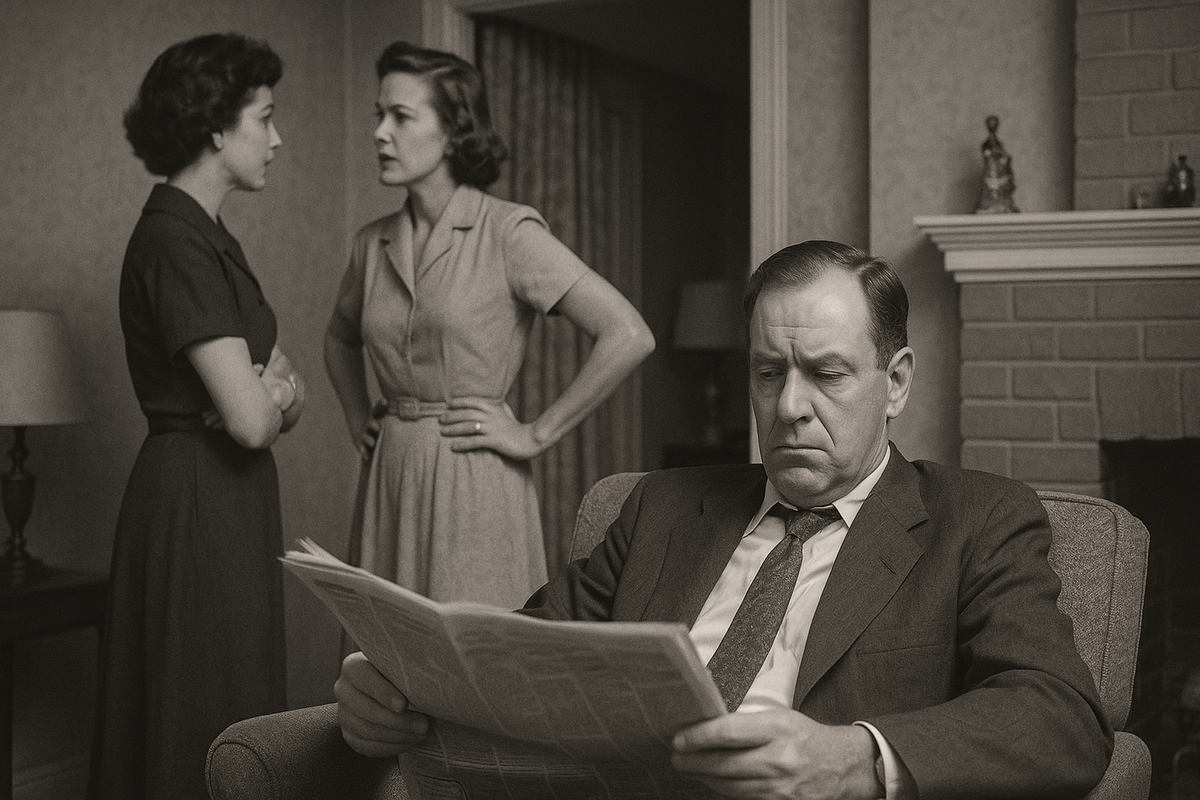
Ray slouched in his chair, newspaper raised like a shield. Across the room, Edna spoke to a neighbor—her words aimed at her husband, her eyes burning with fifteen years of accumulated silence. The photograph, staged for Ladies' Home Journal in June 1953, wasn't just illustration. It was indictment.
"Ray has no sentiment," Edna told the magazine's readers. "He's cold, like his mother."
Ray fired back: "I was taught to be clean-minded; Edna humiliates me about sex all the time. And she flirts with other men."
This wasn't tabloid gossip. This was the most widely read marriage column in America—"Can This Marriage Be Saved?"—and in the hands of millions of suburban housewives, Edna and Ray's fifteen-year union had become a referendum on postwar domesticity itself.
What made this particular case explosive wasn't the novelty of their complaints. It was their familiarity.
Archive Details
Featured Couple: Edna and Ray (15-year marriage)
Publication: Ladies' Home Journal, June 1953
Column: "Can This Marriage Be Saved?"
Counselor: Mrs. Evelyn Powell
Cultural Context: Height of postwar suburban expansion
The Architecture of Silence
By 1953, the American marriage was being sold as the cornerstone of national prosperity. Suburbs mushroomed across former farmland. Veterans Administration loans made homeownership accessible. Magazine spreads showcased gleaming kitchens, backyard barbecues, and the nuclear family as both aspiration and obligation.
But the Ladies' Home Journal knew better. Or rather, it knew the cost.
Edna's testimony laid bare what suburbia's cheerful façade concealed: marriages gutted by emotional absence. "No companionship, no social activities together, no sex life," she reported—not as scandal, but as inventory. Ray, meanwhile, defended himself through the language of duty. He worked. He provided. What more could she want?
This was the fracture line running through postwar America: men who believed provision equaled love, women who starved for intimacy within materially comfortable homes. Ray's stoicism—learned in wartime, reinforced by his mother's coldness—had calcified into something his wife experienced as cruelty. Edna's longing for connection read to Ray as nagging, as insatiable demand.
The counselor, Mrs. Evelyn Powell, diagnosed "temperamental incompatibility." The culture diagnosed something larger: a generation discovering that winning the war hadn't taught anyone how to come home.
The Formula That Held a Mirror to Millions
Ladies' Home Journal reached more American households in 1953 than any publication of its kind. Its pages promised recipes, fashion guidance, and fiction—but "Can This Marriage Be Saved?" delivered something more dangerous: recognition.
The column's architecture was deceptively simple. Three voices in sequence:
She speaks. Edna positioned herself as abandoned, unloved, invisible in her own home.
He speaks. Ray cast himself as the victim of impossible expectations, criticized for failing at tasks he'd never been taught to perform.
The expert interprets. Powell's professional authority transformed private shame into diagnosable problem, suggesting that marriage could be analyzed, treated, perhaps even cured.
This structure did more than entertain. It educated readers in a new vocabulary—one where "emotional needs" and "psychological compatibility" replaced older frameworks of duty and endurance. The magazine wasn't just reflecting cultural change; it was engineering it, teaching women to name what they'd been taught to ignore.
The staging reinforced the message. Ray behind his newspaper. Edna turned away, speaking to someone—anyone—else. The mise-en-scène of disconnection, reproduced in living rooms across America.
The Gendered Language of Blame
Strip away the mid-century decorum and the accusations expose their infrastructure. Ray called Edna a nag. Edna called Ray cold. Both words carried weight beyond their literal meaning.
"Nagging" had long been deployed to dismiss women's attempts at communication as irritating noise rather than legitimate grievance. It transformed the content of complaint into evidence of feminine irrationality. Ray wielded it as both defense and counterattack.
"Cold" struck at masculine identity differently—not at competence but at humanity itself. For Edna to call Ray cold was to suggest he'd failed at something more fundamental than husbanding: he'd failed at feeling.
The sexual dimension intensified everything. Ray invoked his "clean-minded" upbringing to frame Edna's desires as improper. She accused him of withholding intimacy. In 1953, when divorce remained socially catastrophic and women's sexuality was either sanctified in marriage or pathologized outside it, this battlefield had no neutral ground.
Mrs. Powell's clinical language—"temperamental incompatibility"—offered a way out of the moral quagmire. Not sin, not failure, but mismatch. It was revolutionary in its compassion and conservative in its outcome: the problem could be managed, accommodated, endured.
Provision vs. Companionship
Ray believed hard work and financial stability fulfilled his marital duty. Edna longed for warmth, romance, and shared life—a divide that defined the generation.
Psychology as Authority
The 1950s marked the rise of marriage counseling. Mrs. Powell's diagnosis elevated private struggles into subjects worthy of expert intervention rather than shame.
The Stigma of Divorce
With divorce still socially catastrophic, magazines became safe spaces where marital struggles could be explored indirectly through the stories of others.
Cultural Silence Breaking
For many readers, this was the first time they saw their own struggles reflected in print—validation that their loneliness wasn't personal failure but structural.
What Edna and Ray Tell Us About Ourselves
Read their story today and the language shifts but the dynamics persist. Emotional labor remains unevenly distributed. Work still provides cover for avoidance. Women still describe feeling unseen; men still retreat into silence.
The magazine couldn't save Edna and Ray's marriage. Mrs. Powell offered tools for accommodation, not transformation. But by publishing their story, Ladies' Home Journal did something more subversive: it told millions of women that their loneliness wasn't personal failure. It was structural. It was shared.
That recognition—that what feels like individual inadequacy might actually be cultural design—remains the most radical gift these old magazines offer.
Why This Issue Matters Now
Historical Convergence
Published during the apex of postwar domesticity, it captures the tension between cultural propaganda and lived reality. The advertisements sell the dream; the articles document the cost.
Cultural Influence
"Can This Marriage Be Saved?" ran for decades, shaping how generations of Americans conceptualized relationships, therapy, and the possibility of change.
Material Rarity
Household magazines were disposable by design. Survival rate is low. Copies in good condition command attention from serious collectors.
Visual Archive
The photography, layout, and advertising provide unmediated access to mid-century aesthetics—the visual language of a culture selling itself to itself.
For Collectors and Cultural Historians
The June 1953 issue represents a turning point in how America discussed marriage, gender, and domestic life. These aren't reproductions or digital scans—they're original artifacts, touchstones of the moment when American culture began interrogating the mythology it had built around the suburban housewife.
Browse Ladies' Home Journal Magazines Collection