
The Day The New Yorker Brought the Atlantic's Dead Home
How "Eighty-Three Days" transformed wartime journalism and gave Americans the unbearable truth about survival at sea
August 21, 1943. Americans unfolded their latest issue of The New Yorker expecting wit, cartoons, perhaps a mordant essay on wartime rationing. What they got instead was salt water in their throats.
Buried inside that issue—beneath the magazine's signature cover illustration of uniformed girls raising the flag at summer camp—was "Eighty-Three Days," a survival account so visceral it transformed a sophisticated literary magazine into a lifeline between the home front and the war's most merciless theater: the open Atlantic.
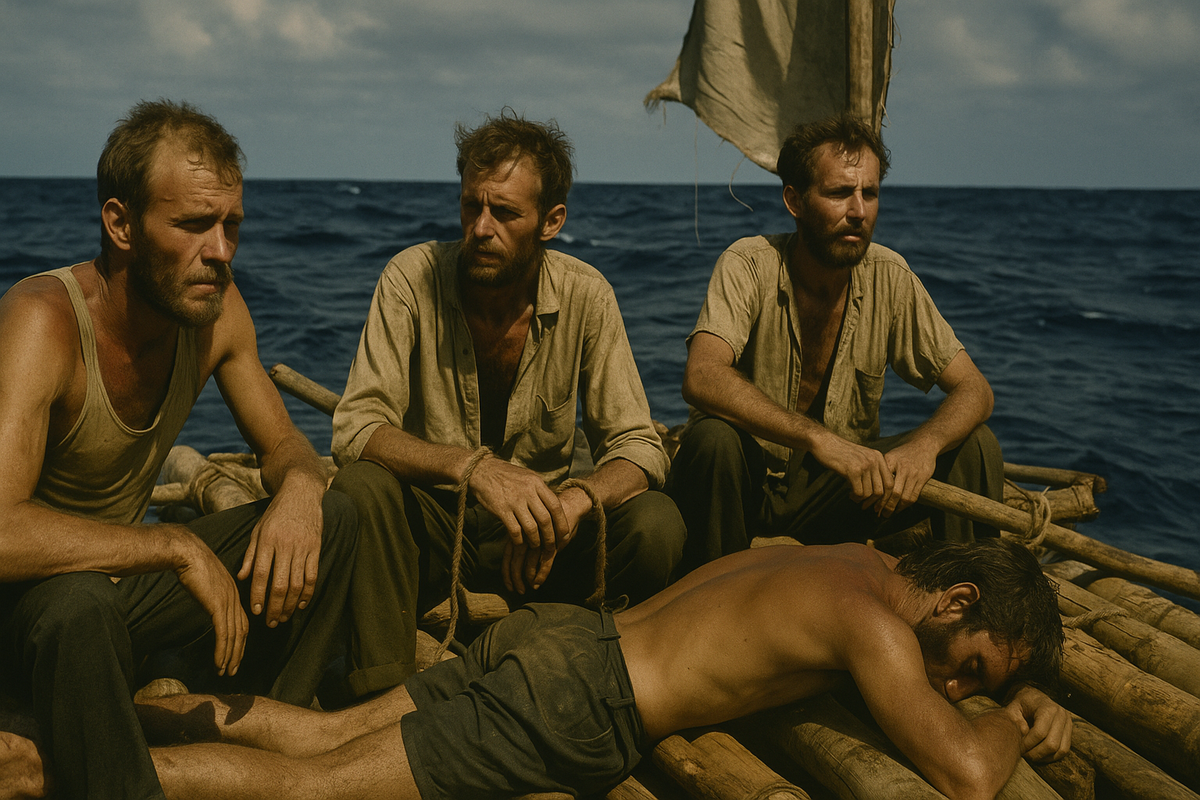
This wasn't propaganda. It wasn't a morale-boosting dispatch from the War Department. It was something far more dangerous to a nation's carefully managed optimism: the truth about what happened after the torpedoes hit, after the ship went down, after the headlines moved on. It was the story of American sailors lashed to bamboo rafts, fighting sharks and madness and the slow betrayal of their own minds under a pitiless sun.
For readers turning those pages in living rooms across America, "Eighty-Three Days" did what no photograph could: it made them feel the war's unfinished business—the men still drifting, still dying, long after the initial attack had ended.
Archive Details
Publication: The New Yorker
Issue Date: August 21, 1943
Featured Article: "Eighty-Three Days" — Atlantic survival narrative
Historical Context: Published during the height of the Battle of the Atlantic, midpoint of World War II
Cover Art: Summer camp flag-raising scene (uniformed girls)
The Drowning Year
By August 1943, the war had calcified into a grinding arithmetic of losses. Allied forces had taken North Africa. Sicily had fallen. The Pacific island campaigns churned forward in blood and coral. But the Battle of the Atlantic—the silent, statistical war of tonnage and U-boats—remained unresolved.
German submarines still prowled the shipping lanes, hunting convoys that kept Britain alive and American forces supplied. Every merchant vessel, every troop transport, every tanker that left an American port carried not just cargo but the knowledge that the ocean floor was littered with the wreckage of ships that hadn't made it.
The men aboard those vessels understood what most civilians did not: survival in the Atlantic wasn't about heroism. It was about clinging to wreckage, rationing hallucinations, and discovering whether your body could outlast your mind's collapse.
"Eighty-Three Days" forced that understanding into American living rooms. The New Yorker had chosen to publish not a sanitized account of rescue and redemption, but an unflinching chronicle of what survival actually cost.
The New Yorker's Gamble
Since its founding in 1925, The New Yorker had cultivated a reputation for sophistication laced with irony—a magazine that could run Dorothy Parker and Thurber cartoons in the same issue, that could discuss high culture and low comedy with equal seriousness. It was urbane, literary, skeptical of sentiment.
Which made its decision to run "Eighty-Three Days" all the more remarkable.
The article reads like a fever dream transcribed in real time. Survivors hallucinating walls rising from the ocean. Men imagining hamburgers and coffee so vividly they could taste them. The psychological erosion of watching companions slip beneath the waves, not from injury but from the simple surrender of hope. The bamboo rafts lashed together with desperation. The sharks. The storms. The sun that blistered skin until it cracked and wept.
The New Yorker presented this horror without photographs, without maps, without the visual apparatus that magazines like Life relied upon. Just words. Just the slow accumulation of detail until readers could feel the salt crusting their own lips.
This was literary reportage weaponized for wartime—a demonstration that language could accomplish what images could not. It could make you inhabit another person's suffering from the inside out.
The Architecture of Endurance
What makes "Eighty-Three Days" so devastating is its refusal to lionize its subjects. The men in the rafts aren't heroes performing acts of courage. They're human beings discovering the limits of human endurance in real time.
The article tracks their slow disintegration: the initial shock giving way to hunger, hunger giving way to thirst, thirst giving way to hallucination, hallucination giving way to something beyond despair—a kind of animal persistence that has nothing to do with patriotism or duty.
Some men held together through sheer force of will, creating makeshift rituals to mark time, to maintain sanity. Others drifted away—literally and psychologically—until the ocean claimed them. The article doesn't sentimentalize these losses. It records them with the precision of a ship's log.
The Endless Sea
Survivors clung to bamboo rafts and wreckage, battling waves, sharks, and storms while drifting helplessly for weeks.
Hallucinations and Hunger
Men began to imagine walls, towers, hamburgers and coffee—a testament to the psychological torment of deprivation.
Nature as the Enemy
The sun blistered skin, sharks circled the rafts, and storms battered survivors who had no shelter.
The Human Spirit
Despite impossible odds, some men endured for over two months—eighty-three days of refusing to surrender.
Nature appears not as a backdrop but as an active antagonist. The sun blisters. Sharks circle. Storms arrive without warning, threatening to tear apart the flimsy rafts that are the only barrier between life and drowning. And through it all, the men endure not because they believe in rescue but because stopping—surrendering—requires a decision their bodies refuse to make.
Eighty-three days. Nearly three months adrift. The number itself became a kind of horror.
The Magazine as Time Capsule
The August 21, 1943 issue captures American culture at a moment of profound dislocation. The cover's whimsical summer camp scene—all innocence and flag-waving ritual—sits in direct opposition to the nightmare unfolding in the magazine's interior pages.
This wasn't an accident. It was The New Yorker's signature move: the juxtaposition of domestic normalcy with global catastrophe, the insistence that culture and irony and even humor could coexist with the grimmest realities of war.
Flip through the issue and you'll find cartoons satirizing office life, essays on Manhattan social rituals, fiction that has nothing to do with combat. And then, without warning: eighty-three days of men slowly dying at sea.
That tonal whiplash is what makes the issue so powerful as a historical artifact. It doesn't try to reconcile the war with everyday life. It presents them as simultaneous, overlapping realities—both true, both demanding attention, neither fully comprehensible without the other.
Why Collectors Hunt This Issue
Historical Pivot Point
Published at the war's midpoint, when victory was imaginable but not yet assured, the issue captures American anxiety in suspension.
Literary Achievement
"Eighty-Three Days" stands as one of the war's defining survival narratives—not written by a novelist but by someone who understood that the truth required no embellishment.
Cultural Artifact
The cover's playful patriotism contrasted with the interior's unflinching reportage creates a document of national psychology under extreme pressure.
Physical Scarcity
Wartime paper rationing and the disposable nature of magazines means surviving copies are increasingly rare, especially in good condition.
To hold this issue is to hold a moment when American media grappled with how to tell the truth about war without breaking the public's will to endure it. The New Yorker chose honesty over comfort, literary precision over propaganda. That choice makes the magazine more than collectible—it makes it essential.
The Persistence of Print
In an era when news evaporates into the digital void within hours, wartime magazines like this offer something increasingly rare: permanence. These pages absorbed the crisis of their moment and held it, preserving not just facts but the texture of how events were first understood and communicated.
The August 21, 1943 New Yorker doesn't just report history. It is history—the paper fibers themselves witnesses to the anxieties, endurance, and moral calculations of a nation at war.
That's why serious collectors, cultural historians, and families preserving wartime memory continue to seek out these issues. They're not nostalgic curiosities. They're primary documents that speak with an authority no digital archive can replicate.
Explore the Archive
Our collection spans decades of original New Yorker magazines, from the Jazz Age through the counterculture '70s—each issue a window into how Americans understood their moment.
Browse The New Yorker Magazines CollectionWhether you're building a research library, honoring a family member's wartime service, or simply drawn to the power of vintage journalism, these magazines offer something rare: the chance to experience history as it was first written, first read, first absorbed into the nation's consciousness.
The men who survived eighty-three days at sea did so by refusing to let go. These magazines endure for the same reason—they hold tight to truths that deserve to be remembered.