
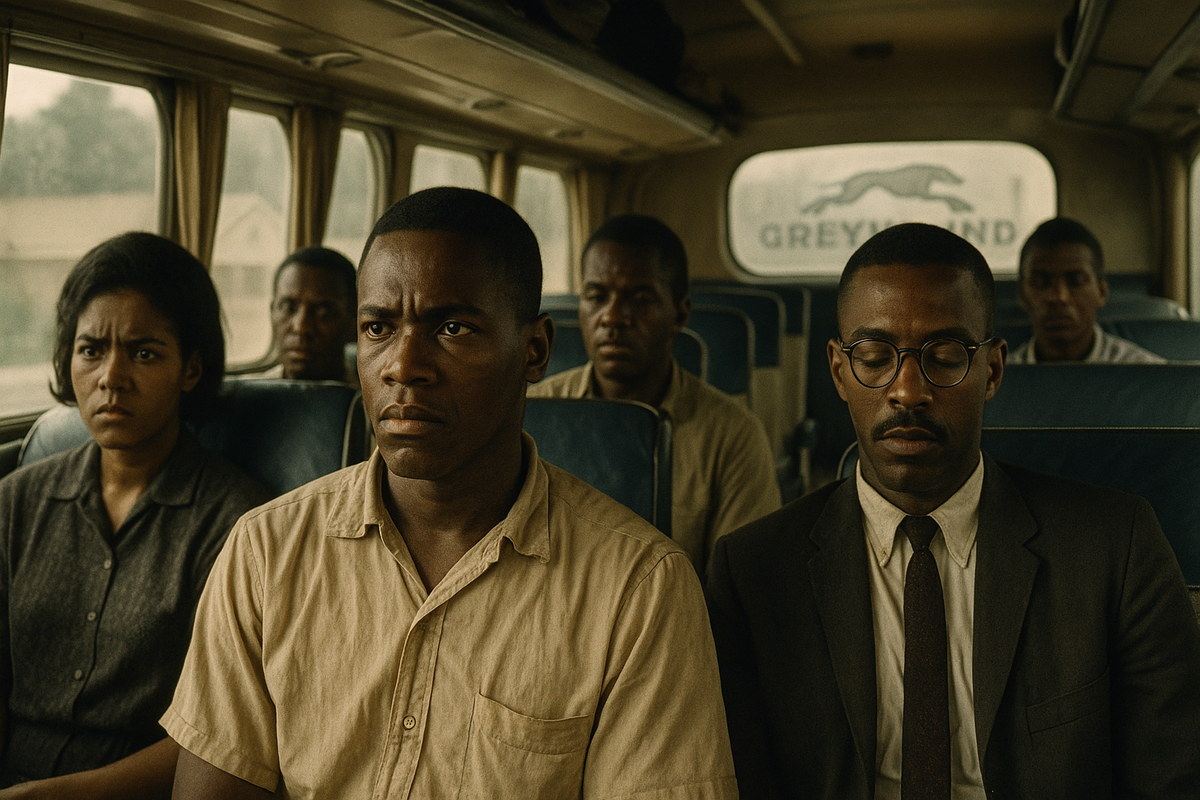
When Ebony Put Readers Inside the Freedom Ride: August 1961
How Larry A. Still's photo-essay transformed a magazine into witness, weapon, and time capsule
The bus is on fire in Anniston. In Montgomery, a white student's face is beaten beyond recognition. In Jackson, Mississippi, young activists sing hymns from behind bars while police dogs snarl inches from the cell doors.
These were not scenes Americans discovered decades later in documentaries. In August 1961, Black families across the country opened their mailboxes, pulled out the latest issue of Ebony Magazine, and sat down at kitchen tables to witness the Freedom Rides as they happened—through the lens of a journalist who had ridden alongside them.
Larry A. Still's photo-essay "A Bus Ride Through Mississippi" did something no other publication had managed: it placed readers directly inside the most dangerous civil rights campaign of the era. While Life and Time offered dramatic images from a distance, Ebony gave its audience the voices of the riders, the stench of the jail cells, and the cold calculation of Mississippi's strategy to break the movement through mass arrest rather than mob violence.
This single issue became one of the most important artifacts of the Civil Rights Movement. And it did so while featuring Diahann Carroll and Sidney Poitier on the cover.
Historical Document
Publication: Ebony Magazine
Issue Date: August 1961
Feature Story: "A Bus Ride Through Mississippi" by Larry A. Still
Cover Stars: Diahann Carroll & Sidney Poitier
Historical Context: Freedom Riders campaign, post-Boynton v. Virginia
The Summer America's Patience Ran Out
By the summer of 1961, the Supreme Court had already spoken. Boynton v. Virginia (1960) declared segregation in interstate bus terminals unconstitutional. The law was settled. Southern states simply ignored it.
"White" and "Colored" signs still divided waiting rooms. Black travelers who challenged these barriers were arrested under charges like "breach of peace"—a catch-all statute that let local authorities jail activists without charging them with violating federal law.
The Congress of Racial Equality (CORE) responded with a test that would force the nation's hand. They organized integrated groups of riders—Black and white, students and ministers—to travel together through the Deep South. They would sit in the same seats, eat at the same lunch counters, and use the same restrooms. Every mile was a provocation. Every stop was a confrontation.
The violence came fast. In May, a Greyhound bus carrying riders was firebombed in Anniston, Alabama, its passengers barely escaping the flames. In Montgomery, mobs with chains and clubs attacked activists while police watched from the sidelines. But Mississippi perfected a different tactic: arrest them by the dozens, pack them into penal farms, and let the heat, the crowding, and the isolation do the work.
Ebony sent Larry A. Still to document it all.
Why Ebony Could Tell This Story Like No One Else
Founded in 1945 by John H. Johnson, Ebony had become the most influential Black publication in America by 1961. It wasn't a protest journal or a literary quarterly—it was a glossy, aspirational magazine that covered fashion, celebrity, business, and politics with equal sophistication.
That breadth gave Ebony a unique authority. It could profile Lena Horne's Hollywood career on one page and document police brutality on the next. It celebrated Black excellence without sanitizing Black struggle. For its readers, Ebony was both mirror and megaphone: it reflected their lives while amplifying their fight.
Still's reporting placed readers in the front seat of the Freedom Ride. His photographs captured exhausted activists in bus stations, Rev. C. T. Vivian confronting officers on the highway, white students bloodied for standing with their Black peers, and dozens of young people crammed into Mississippi jails. The images were stark, documentary, and immediate.
For Black families reading Ebony at the kitchen table, these weren't distant headlines. They were affirmations—proof that ordinary students were making extraordinary sacrifices and that the world was finally being forced to watch.
The Genius of the August 1961 Issue
The cover featured Diahann Carroll and Sidney Poitier, two stars who were breaking Hollywood's color line with elegance and force. Inside, the Freedom Ride coverage provided a perfect counterbalance: Carroll and Poitier represented Black artistry at its peak; the Freedom Riders embodied Black courage at its most dangerous.
This was Ebony's editorial genius. A reader could flip from glamorous celebrity portraits to photographs of burning buses and courtroom injustice without ever feeling disoriented. Advertisements for Tampax and hair products appeared beside images of jailed students. The magazine presented Black life in its full complexity—the everyday and the historic, the beautiful and the brutal.
No other publication of its era carried that range. Ebony was cultural mirror and historical archive in one.
What the Issue Captured
Still's reporting created one of the most complete records of the Freedom Rides available in print at the time:
Riders prepared under Rev. Martin Luther King Jr., Rev. Ralph Abernathy, Rev. C. T. Vivian, and James Farmer, rehearsing how to absorb abuse without fighting back.
Stark images of the charred Greyhound bus and passengers who narrowly escaped the flames and subsequent beatings.
Photographs of James Zwerg of Fisk University, whose swollen, beaten face became one of the movement's most haunting images.
Rather than unleash mobs, authorities arrested riders by the hundreds, packed them into cells and penal farms, and waited for exhaustion to break them.
Judge James Spencer sentenced dozens of riders under "breach of peace" charges while barring Black spectators from his courtroom.
CORE's strategy to "fill the jails" tested Mississippi's capacity and forced national media attention.
Mississippi businessmen admitted to Ebony that civil rights activism "hurt our business"—a rare acknowledgment of how commerce and racism were intertwined.
Many riders were barely out of their teens, yet their discipline under pressure inspired a generation.
Together, these details didn't just chronicle events. They captured the moral clarity and endurance of a movement that refused to break.
Why This Issue Matters to Collectors
First-Hand Documentation
One of the movement's most dangerous campaigns, documented by a Black journalist riding alongside the activists.
Celebrity Cover
Diahann Carroll and Sidney Poitier, two legends of Black culture at the height of their influence.
Historic Photography
Irreplaceable documentary evidence—images of bus burnings, mass arrests, and courtroom trials that shaped the nation's conscience.
Extreme Rarity
Surviving copies in good condition are scarce. The magazine was read, shared, passed hand to hand, and worn down by use—which is exactly what made it powerful.
Owning this issue means holding a piece of living history. It's both cultural treasure and historical document, proof of how media shaped and preserved the fight for equality.
The Ebony Legacy
Ebony endures because it refused to flatten Black life into a single narrative. It celebrated joy and documented injustice. It profiled entertainers and activists with equal seriousness. For African American readers in 1961, it was a lifeline of pride and truth. For today's collectors and historians, it's a time capsule of resilience.
The August 1961 issue reminds us that freedom wasn't an abstraction. It was contested on buses, in diners, and inside Southern jails—and thanks to Ebony, it was recorded for generations to witness.
Explore the Collection
Thousands of original Ebony magazines are available in our collection, spanning the 1940s through the 1990s. They capture the evolution of African American life, politics, fashion, music, and culture across five decades.
Browse Ebony Magazines CollectionWhether you're a dedicated collector, a student of history, or someone honoring the memory of those who rode buses into danger, these magazines offer something irreplaceable: a chance to experience history as it was first told.
The August 1961 Ebony Magazine is one of the most important publications of the Civil Rights era. Its coverage of the Freedom Riders—their arrests, their courage, their strategy of nonviolence—gave readers an unflinching view of the fight for equality. Paired with a cover featuring Sidney Poitier and Diahann Carroll, the issue perfectly embodied Ebony's mission: to show Black life in its full range, from brilliance on screen to bravery on buses.
Holding this issue today is holding history itself.