
The Jacket That Conquered Air-Conditioning
How Seventeen Taught Girls to Dress for 1959's Climate-Controlled America
When teenage girls flipped open their June 1959 Seventeen, they found something unexpected nestled between the beauty columns and record reviews: a fashion manifesto for the modern indoor climate.
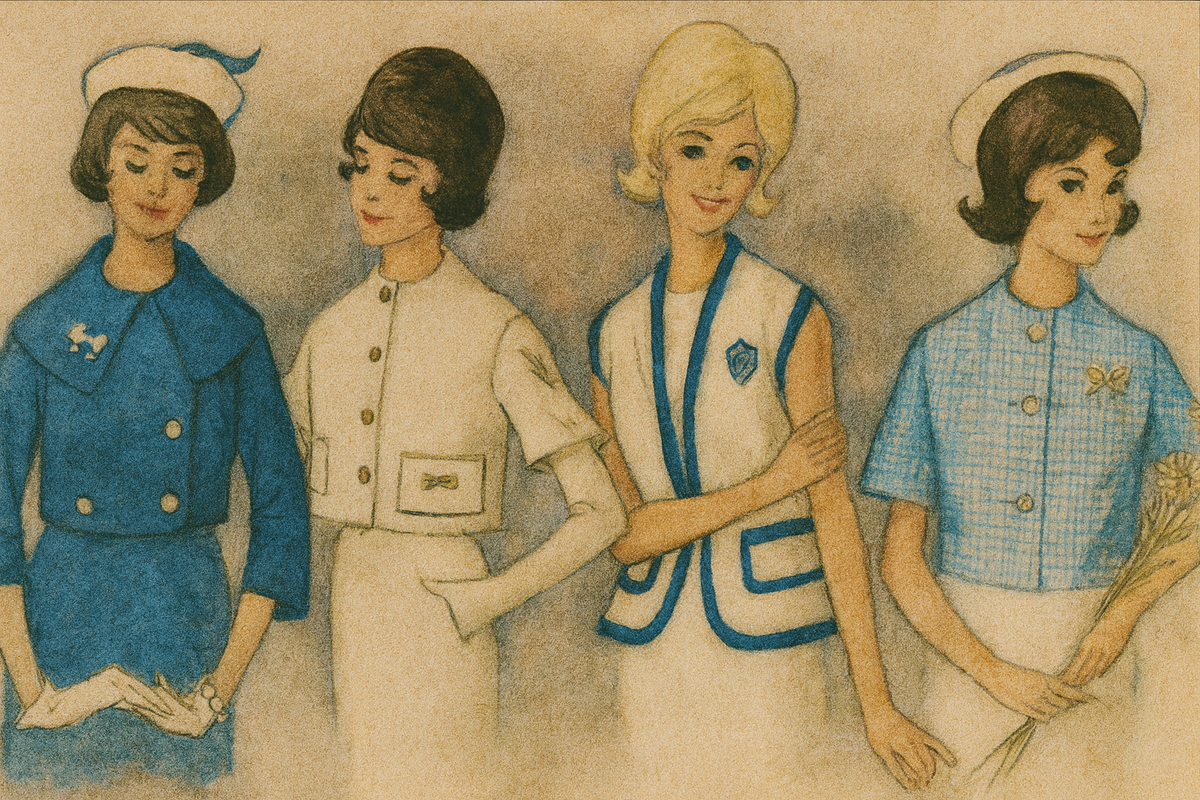
The "tag-along toppings" spread—lightweight summer jackets sketched in cheerful blues and whites—wasn't just another style guide. It was Seventeen's answer to a technological revolution sweeping American life. Air-conditioning had escaped the movie palace and invaded restaurants, schools, and living rooms. For the first time, summer fashion needed to solve a new problem: how to look effortless in 90-degree heat, then stay warm in a 68-degree theater, all without lugging around a winter coat.
The magazine's solution married practicality with aspiration. Illustrated fashion drawings showed cropped jackets and capelets paired with the era's emerging short hairstyles—those liberating pixies and bouffants that marked a clean break from postwar permanents. Small black-and-white photographs of real teenagers anchored the fantasy, proving these weren't Hollywood costumes but actual clothes worn by girls navigating dates, drive-ins, and the new rituals of teen culture.
Archive Details
Publication: Seventeen Magazine
Issue Date: June 1959
Featured Spread: "Tag-Along Toppings"
Featured Brands: Van Raalte, Junior House of Milwaukee, Korell, Marjorie Montgomery, Briggs of Boston
Cultural Context: Rise of teenage consumer culture, air-conditioning adoption, shift to shorter hairstyles
The Teenager as Economic Force
By 1959, the American teenager had solidified into something unprecedented: a consumer identity with its own economy. Seventeen stood at the crossroads of this transformation, translating adult marketing into the language of adolescent desire.
The magazine recognized what clothing manufacturers and record labels had just discovered—high school girls controlled serious purchasing power. They bought their own clothes, chose their own music, and made independent decisions about beauty products. Seventeen became the interpreter, showing readers how to decode fashion trends while advertisers learned how to speak directly to this newly minted demographic.
The "tag-along toppings" feature captured this dynamic perfectly. At the article's close, brand names appeared like credits in a film: Van Raalte, Junior House of Milwaukee, Korell, Marjorie Montgomery, Briggs of Boston. For many readers, these were first introductions to fashion branding—the beginning of a lifetime relationship between identity and label.
Climate Control Meets Couture
The spread's practical focus on air-conditioning reveals how thoroughly technology had reshaped daily life. What started as a luxury amenity had become infrastructure. Movie theaters advertised their cooling systems as aggressively as their feature films. Restaurants promised relief from summer swelter. Schools installed units to extend productive learning into August.
This environmental shift demanded new wardrobes. Girls needed garments that traveled well between climates, that could be carried without effort, that added polish without weight. Cotton, linen, and seersucker—the breathable fabrics praised in the article—became summer's holy trinity. The jackets themselves were engineering marvels of lightweight construction, designed to ward off goosebumps without inducing heatstroke on the walk home.
Seventeen's genius lay in presenting this utilitarian solution as aspirational. The illustrations projected ease and confidence. The accompanying text described not just garments but scenarios: slipping into a theater for the latest Elvis picture, meeting friends at an ice cream parlor, hosting a backyard record party. The clothes were characters in a larger story about how to move through the world with grace.
The New Short Hair Revolution
The spread's pairing with "the new short hair" marked a generational pivot. Postwar beauty standards had favored elaborate updos and carefully maintained length—styles that required setting lotions, pin curls, and patience. By 1959, younger women were rejecting that maintenance regime for something more immediate.
Cropped bobs, pixies, and the emerging bouffant offered freedom. They dried faster, moved naturally, and projected a modern sensibility that separated teenage style from maternal tradition. The short cuts complemented the streamlined jackets, creating a unified aesthetic of efficiency and youth.
This wasn't mere fashion—it was identity construction. The magazine understood that helping girls choose a hairstyle meant helping them choose how to present themselves to peers, parents, and potential romantic interests. Every style tip carried psychological weight.
The Magazine as Cultural Architecture
What distinguished Seventeen from high-fashion publications like Vogue or Harper's Bazaar was its intimate tone. The magazine positioned itself not as an authority dictating from above but as a knowledgeable friend offering guidance. The voice was conversational without being juvenile, instructive without lecturing.
The June 1959 issue demonstrated this approach across its features. Film reviews (including Don't Give Up the Ship), music recommendations, advice columns on dating and friendship, college preparation guides—each section spoke to a girl navigating the space between childhood and independence. The magazine acknowledged that its readers faced genuine questions about identity, relationships, and self-presentation, then provided answers grounded in both practicality and aspiration.
The "tag-along toppings" spread exemplified this editorial philosophy. It combined aspirational illustration with documentary photography, fantasy with proof. The drawings showed an idealized version of teen life—confident girls moving through social spaces with ease. The photographs confirmed that real teenagers could achieve these looks. Together, they formed a complete argument: You can be this person. Here's how.
Why Vintage Seventeen Endures
Sixty-five years later, the June 1959 issue functions as more than nostalgia. It's primary source material for understanding how American culture constructed teenage girlhood at mid-century.
For women who grew up reading Seventeen, these pages resurrect specific memories—the texture of first formal dresses, the anxiety of early dates, the careful calculations of peer approval. The magazine captured not just what girls wore but what they hoped for, worried about, and dreamed of becoming.
For historians and cultural researchers, vintage Seventeen reveals the mechanisms of socialization. The magazine taught skills and values: how to dress appropriately, how to maintain friendships while pursuing romance, how to balance parental expectations with personal desires. It mediated between adult authority and teen autonomy, helping readers navigate that fraught transition.
Fashion designers and stylists mine these archives for authentic period detail. The magazines document not just major trends but the granular reality of everyday dressing—the specific fabrics, the actual silhouettes, the precise language used to describe style. They show what was available, what was affordable, and what was considered appropriate for different occasions.
Collectors pursue vintage Seventeen issues for all these reasons and more. Each magazine is an artifact of a particular cultural moment, dense with information about values, aspirations, and daily life. They're historical documents that happen to be beautiful objects, printed on quality paper with skilled illustration and thoughtful design.
Decoding the Tag-Along Topping Phenomenon
The Artifact Speaks
Seventeen magazines from the 1950s document a unique moment in American life—when teenage culture had fully emerged but hadn't yet fractured into competing subcultures. The magazine assumed a relatively unified audience sharing common experiences and aspirations. It could speak confidently about what "girls" wanted because social consensus still seemed achievable.
The June 1959 issue captures this optimistic moment. The "tag-along toppings" spread reflects a culture confident in its values: style matters, preparation matters, moving gracefully through social spaces matters. The magazine believed it could teach these skills, and its readers believed they could learn them.
Looking back, we see both the appeal and the limitations of this worldview. The magazine offered genuine guidance to girls navigating new social terrain. It validated their concerns and provided practical solutions. But it also enforced conformity, narrowed acceptable identities, and rarely acknowledged readers who didn't fit the implied suburban, middle-class norm.
Yet even with these constraints, vintage Seventeen remains valuable. It shows us not an idealized past to return to, but an actual past to understand—complete with its innovations, its blind spots, and its influence on the generations who learned about womanhood from its pages.
Collector Significance
Historical Documentation
Original issues preserve the complete cultural context—advertising, editorial voice, visual design, and period assumptions—that digital reproductions cannot capture.
Research Value
Fashion historians, cultural researchers, and designers rely on vintage Seventeen for authentic period detail unavailable in secondary sources.
Material Quality
Mid-century printing techniques, paper quality, and illustration methods make these physical artifacts superior to modern reproductions.
Cultural Touchstone
For generations of American women, Seventeen shaped coming-of-age experiences. Original issues connect personal memory to broader social history.
A Living Archive
For enthusiasts of fashion history, media studies, or mid-century American culture, original Seventeen magazines offer unmediated access to the past. These aren't reproductions—they're the physical objects that shaped teenage identity across decades.
Browse Seventeen Magazine CollectionThe Jacket's Legacy
The June 1959 Seventeen remains significant not because the tag-along topping became a permanent wardrobe staple—it didn't. The spread matters because it captured a precise cultural moment when technology, youth culture, and fashion converged in a magazine's illustrated pages.
It shows us how teenage girls learned to navigate modernity, how publications shaped consumer identity, and how something as mundane as indoor climate control could reshape an entire category of clothing. The magazine wasn't just reporting on teen life—it was actively constructing it, providing the scripts and costumes for performing a newly invented social role.
Sixty-five years later, we can still see the tag-along toppings in those cheerful blue-and-white drawings, paired with their modern short hairstyles, ready for a world of air-conditioned possibilities. They're fashion history. They're cultural history. They're artifacts of American girlhood at a pivotal moment. And they're waiting in the pages of a magazine that understood exactly what it meant to be young, stylish, and learning how to move through the world with confidence.