
When Vogue Predicted the Wild
How January 1970 Announced a Decade of Beautiful Rebellion
The 1960s died with beads, fringe, and reptile prints draped across the pages of high fashion.
When the January 1970 issue of Vogue arrived, it didn't ease readers into a new decade. It announced it with the force of a cultural manifesto. The cover promised "Forecast 1970," and inside, the magazine delivered something more radical than hemlines or color palettes: it declared that the counterculture had won. The hippies—long dismissed by the fashion establishment as anti-fashion—were now the fashion. And Vogue, arbiter of taste for the world's most discerning readers, had chosen to consecrate them.
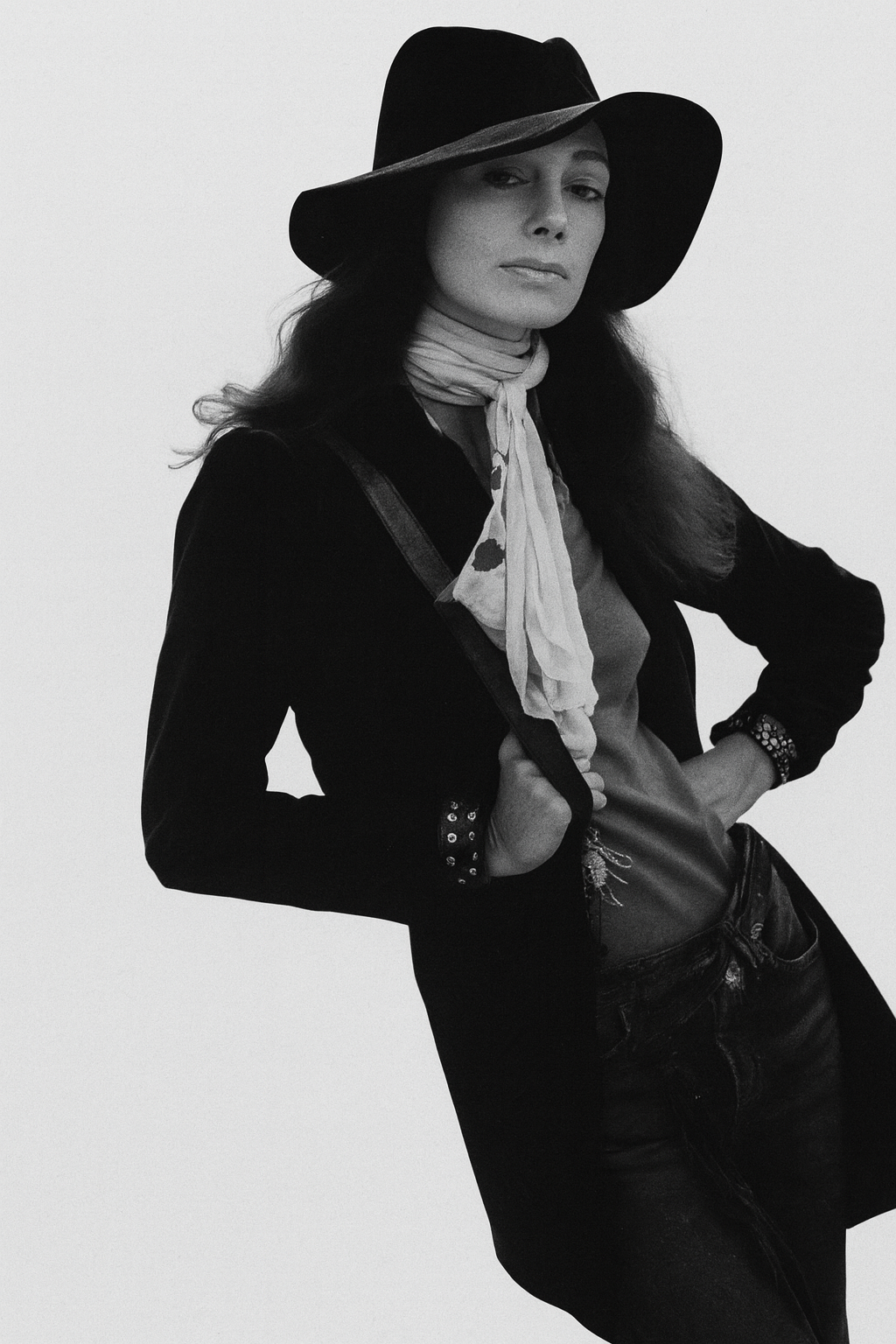
The editorial spread was a collision of worlds. Marisa Berenson—granddaughter of Elsa Schiaparelli, Warhol muse, and the era's most ethereal face—appeared draped in bohemian shawls and heavy jewelry, her wide-brimmed hat casting shadows across cheekbones that could have been carved from marble. Beside her: Pilar Crespi, wrapped in fringe that moved like water. And behind them both, improbably, sat the Chevrolet Astro III, a jet-inspired concept car whose sleek futurism clashed magnificently with the ancient tribal aesthetic of the garments.
This wasn't fashion reporting. This was Vogue telling America what the 1970s would become before the decade had barely begun.
Archive Details
Publication: Vogue Magazine
Issue Date: January 1970
Featured Editorial: "Forecast 1970"
Key Figures: Marisa Berenson, Pilar Crespi
Cultural Context: Post-Woodstock, Post-Moon Landing, Vietnam War Era
Significance: First major fashion publication to embrace counterculture aesthetics as high fashion
The Moment Between Two Worlds
January 1970 stood at a strange cultural intersection. Woodstock had happened just five months earlier—400,000 people in the mud, proof that youth rebellion had reached critical mass. The moon landing was six months behind, humanity's most audacious technological achievement still fresh in collective memory. The Vietnam War raged on. Second-wave feminism was reshaping gender roles. The civil rights movement had fundamentally altered American consciousness.
Fashion could no longer pretend these forces didn't exist.
For decades, Vogue had maintained its distance from street culture, treating haute couture as a realm apart from social upheaval. But by 1970, that position had become untenable. The counterculture wasn't just a youth movement anymore—it was reshaping how people understood identity, freedom, and beauty itself. The question wasn't whether high fashion would acknowledge this shift. The question was how.
Vogue's answer was brilliant: don't resist the revolution. Aestheticize it.
The "Forecast 1970" editorial transformed bohemian rebellion into luxury aspiration. It took the anti-establishment uniform of fringe, beads, and ethnic prints and elevated it through the lens of haute couture. What emerged was something entirely new: a vision of the 1970s where ancient tribal craft, hippie ideology, space-age futurism, and high fashion existed not in opposition, but in glamorous synthesis.
"The Beast is Wild in Fashion Today"
Vogue's language in January 1970 reads like prophecy disguised as fashion commentary.
"The beast is wild in fashion today."
"Timidity has vanished."
"Reptiles are moving in."
These weren't product descriptions. They were cultural declarations. Vogue was announcing that the new decade would be defined by fearlessness, by visual excess, by a rejection of the restraint that had characterized earlier eras. The magazine positioned itself not as observer but as oracle, telling readers what the future would look like before they'd even fully left the past.
The editorial's specific predictions were remarkably precise. Shawls, ponchos, and capes would dominate—draped garments that rejected rigid tailoring in favor of movement and freedom. Reptilian patterns would invade runways, with faux snakeskin, vinyl pythons, and cobra prints representing a new kind of dangerous sensuality. Fringe would hang from everything, symbolizing both tribal craft and kinetic energy. Colors would be bold, prints would be loud, and timidity—that old virtue of proper dress—would be banished entirely.
Most importantly, Vogue identified "The Beautiful Hippies" as the decade's aesthetic avatars. Marisa Berenson and Pilar Crespi weren't just models wearing clothes. They embodied a new ideal: women who combined haute couture sophistication with bohemian authenticity, who wore heavy jewelry and natural confidence in equal measure, who looked equally at home in a Paris salon or at a folk festival.
This was the alchemy Vogue performed: taking the anti-fashion stance of the counterculture and transforming it into the most fashionable position possible.
Technology Meets Tribalism: The Astro III Moment
The most audacious image in the entire spread paired Marisa Berenson's bohemian glamour with the Chevrolet Astro III concept car.
On the surface, this juxtaposition made no sense. Berenson wore layers of draped fabric, ethnic prints, and jewelry that evoked centuries-old craft traditions. The Astro III was pure jet-age fantasy: a wedge-shaped, aerodynamic machine that looked like it belonged on a runway at Cape Canaveral, not parked beside a fashion model. Its design spoke to the same technological optimism that had put men on the moon—sleek, modern, forward-looking.
But this tension was precisely the point. Vogue was arguing that the 1970s wouldn't choose between past and future, between earth and space, between handcraft and high-tech. It would embrace both simultaneously. The same decade that would see continued space exploration would also see a revival of folk traditions. The same culture that celebrated technological progress would also turn toward natural materials, organic forms, and pre-industrial aesthetics.
Fifty years later, this prediction seems almost uncanny. The 1970s did exactly what Vogue forecast: it became a decade of beautiful contradictions, where disco futurism coexisted with back-to-the-land movements, where synthetic fabrics competed with natural fibers, where people wore both platform shoes and Birkenstocks.
Vogue as Cultural Authority
By 1970, Vogue had spent decades establishing itself as more than a fashion magazine. Under the editorial direction of visionaries like Diana Vreeland (who had departed for the Met in 1971 but whose influence still permeated the publication), Vogue had transformed fashion journalism into cultural commentary.
Other magazines described clothes. Vogue mythologized them. It understood that fashion wasn't separate from art, politics, or social change—it was where all these forces became visible on the body. Every editorial spread was a statement about identity, aspiration, and possibility.
The January 1970 issue exemplified this philosophy perfectly. The photography was stark and dramatic—high-contrast black-and-white portraits that emphasized form and texture. Berenson's wide-brimmed hat created shadows that turned her face into sculpture. Crespi's fringed ensemble was captured in movement, the fabric alive with kinetic energy. These weren't catalog shots. They were art photographs that happened to feature clothing.
The layout reinforced the editorial's message about cultural fusion. Tribal motifs appeared alongside futuristic designs. Reptilian metaphors mixed with romantic language about beauty and freedom. The magazine moved fluidly between discussing fashion as craft, fashion as commerce, and fashion as cultural revolution.
No other publication in 1970 could execute this kind of synthesis. Vogue didn't just report on trends—it created the intellectual and visual framework through which those trends would be understood. It gave readers permission to see hippie culture not as threat but as inspiration, to embrace bold prints as sophistication rather than vulgarity, to understand that timidity was the real fashion crime.
What the Forecast Got Right
Looking back from our current vantage point, Vogue's January 1970 predictions were remarkably accurate.
The 1970s did become the decade of bohemian chic entering the mainstream. Fringe, layered jewelry, ethnic prints, and draped garments dominated fashion throughout the decade. Designers like Yves Saint Laurent would spend the entire 1970s exploring non-Western influences, creating collections inspired by Africa, Asia, and indigenous cultures. The hippie aesthetic that Vogue identified in January 1970 would evolve into the decade's most enduring fashion signatures.
The reptilian motif proved prescient as well. Snakeskin patterns, python prints, and reptile textures became synonymous with 1970s glamour, appearing on everything from platform boots to handbags to jackets. What Vogue called "the beast" in fashion became the decade's favorite predatory aesthetic.
Most significantly, the magazine correctly predicted that timidity would vanish. The 1970s became famous for visual excess—loud colors, bold patterns, maximum jewelry, platform shoes that defied physics, collars that could double as wings. The restraint of previous decades disappeared, replaced by a philosophy of more-is-more that would define the era.
Even the technological optimism paired with tribal aesthetics proved accurate. The 1970s saw both the continued development of synthetic fabrics and space-age designs alongside a massive revival of natural materials, handcrafts, and folk traditions. The decade's fashion oscillated between these poles, sometimes within the same outfit.
The Magazine as Time Machine
What makes vintage Vogue magazines so valuable transcends their role as fashion documentation. These publications captured entire cultural moments—not just what people wore, but how they thought, what they aspired to become, and how they understood beauty itself.
The January 1970 issue remains striking because it documented a moment of genuine transformation. The 1960s were ending, but the counterculture hadn't disappeared—it had evolved, mainstreamed, and merged with the establishment it once opposed. Vogue recognized this synthesis before most other cultural institutions did, and its "Forecast 1970" editorial stands as proof of the magazine's cultural intelligence.
Reading this issue today feels remarkably contemporary. We live in another era of cultural collision, where high fashion regularly borrows from street culture, where technology and nostalgia compete for aesthetic dominance, where boundaries between luxury and accessibility continue to dissolve. The January 1970 Vogue speaks directly to these tensions because they're the same tensions that have defined fashion for the past fifty years.
These magazines aren't just collectibles. They're portals into how previous generations imagined their futures—and evidence that those futures became our present.
Why This Issue Matters to Collectors
Decade Threshold
As the first Vogue of the 1970s, this issue marks the precise moment when the magazine announced its vision for the new decade. It's fashion journalism as prophecy, captured at the instant of declaration.
Iconic Faces
Marisa Berenson and Pilar Crespi were not just models but cultural figures who embodied the era's aesthetic ideals. Berenson, in particular, became one of the decade's most photographed women.
Cultural Crossroads
This issue documents the exact moment when counterculture aesthetics entered high fashion. It's evidence of a massive cultural shift, preserved in magazine form.
Forecasting Premium
Collectors prize issues that make bold predictions, especially when those predictions prove accurate. The "Forecast 1970" editorial did exactly this, offering a roadmap that the decade would largely follow.
Enduring Influence
The trends identified here—bohemian chic, ethnic influences, bold patterns, fringe details—continue to cycle through contemporary fashion. This issue shows where those recurring motifs first entered mainstream consciousness.
Visual Excellence
The photography and layout represent Vogue at peak aesthetic power, combining art direction, fashion photography, and editorial vision into a cohesive statement.
Original copies in excellent condition are increasingly rare. The magazine was meant to be read, handled, and discarded. Surviving examples that retain their covers, maintain crisp page quality, and show minimal wear represent genuine artifacts of cultural history.
Explore the Full Archive of Fashion History
If this vision of 1970s fashion revolution has captured your attention, you can explore the full arc of fashion history through our extensive collection. From the 1930s through the 1990s, original Vogue magazines document every major shift in style, beauty standards, and cultural aspiration.
Whether you're a collector building a comprehensive archive, a designer seeking authentic inspiration from past decades, or a cultural historian studying the evolution of fashion journalism, these magazines provide something irreplaceable: primary source documents that show how each era first saw itself.
Browse Vogue Magazine Collection